Thursday, May 31, 2012

Glorious Gloria's!


Lots of people know Gloria Vargas (below left) from her long-running gig at the Beaverton Farmers' Market, dishing out signature Salvadoran-style tamales with their sensuous banana leaf wrappers and lighter-than-air cornmeal filling wrapped around fall-apart tender chicken, pork or vegetables. But even area locals haven't picked up on the fact that just blocks away lies Gloria's home base, from whence flows her market goodness.

From the outside a cheery storefront with café tables and flowers on the sidewalk, step inside Gloria's Secret Café and you're instantly transported to sunnier climes with intriguing aromas of chiles and spices wafting through the air. Salvadoran cuisine, while not spicy hot, still has the signature complex mix of herbs and spices found in most Latin cuisines. Sauces often contain dozens of ingredients, and can take a couple of days to simmer to perfection.

My luck was on overdrive when I stopped in for lunch the other day, since Gloria was featuring Salvadoran chile rellenos (top photo) as the daily special. Made with green bell peppers rather than the more typical Anaheim or poblanos, she somehow roasted them so that instead of having an acidic bite they had a sweeter, fuller character.

Stuffed with long-braised, fork-tender pork and covered with an intriguing chunky tomato-based sauce, every forkful caused my eyes to roll back in my head. The brightly colored plate also held Gloria's outstandingly flavorful black beans, a beautiful serving of saffron-colored rice and a small vinaigrette-infused salad of seasonal greens. If this dish is on the menu when you go, order it immediately before someone else takes the last one…it goes quickly and when it's gone, it's gone.

My friend's pupusas (right), essentially a layer of meat sealed and pressed between two masa pancakes, were the best I've had of this quintessential Salvadoran dish, with their fresh corn flavor, rich filling and the lightness that comes from skilled, caring hands (any hint of oiliness or overcooking can make these heavy and tough). These were accompanied by the same terrific beans, rice and salad that I had, along with the traditional sides of quick-pickled cabbage and a tangy salsa.

If there's any better, fresher Latin food in town, especially at such reasonable prices, I have yet to find it. And with authentic Salvadoran cuisine in short supply in Portland, it's definitely worth a quick trip out to the burbs for lunch. I'm intrigued by Gloria's dinner offerings, which are only available by calling ahead and making a reservation…I'll be sure and report back when I do!

Details: Gloria's Secret Café, 12500 SW Broadway St., Beaverton. 503-268-2124.

Wednesday, May 30, 2012

New Creole: Jambalaya with Brown Rice


I've never had Creole food straight from the source. My exposure has been limited to what's available in the Northwest, so I wouldn't know an authentic jambalaya if I tripped over it on the sidewalk. But I trust contributor Jim Dixon of RealGoodFood to point me in the right direction, since he's a regular habitué of the Big Easy.

For years my go-to rice was Calrose, a medium grain japonica rice developed in the 1940s for California rice growers. But while I’d always been troubled by the nutritional void of white rice, I’d never found a brown rice I liked as much. Then Albert Katz introduced me to Koda Farms incredible heirloom rice, Kokuho Rose. Like the other products I sell, I eat it all the time.

But because of the longer cooking time, I’d never used the Kokuho Rose brown rice, also a medium grain japonica, in dishes where it cooks in some kind of flavorful sauce. And I couldn’t find a source of reliable information for using it that way. So I tried a simple experiment. I made jambalaya.

Brown Rice Jambalaya

The basics of this traditional Creole dish are simple: make a tomato sauce using the aromatic “trinity” of onion, celery and green pepper, use some hearty seasoning, cook at least one but more often several forms of animal protein in the sauce, add rice and either stock or water, and cook until done.

I’d learned from cooking Kokuho Rose that soaking makes the difference. The brown rice, like all whole grains, takes longer to rehydrate, and the results are much better if you let it happen before you start cooking. When I make it in the rice cooker, I soak for 20-30 minutes, drain, add the measured cooking water and then turn on the heat. My light bulb moment was, “I can soak the brown rice for jambalaya!”

First I cooked chopped onion, celery, and green bell pepper in extra virgin olive oil, added some crushed tomatoes and a bit of tomato paste, and a little Dulcet Creole seasoning. Into the sauce went slices of smoky andouille sausage and boneless chicken thigh; when those had cooked a bit, I added the rice.

I’d soaked it for a half hour, then poured off most of the water. For each cup of dry, unsoaked brown rice, I added 1 3/4 cup water. I covered the pot, turned the heat down to simmer, and let it cook. After 45 minutes the rice was getting tender, but the jambalaya seemed soupy, so I let it simmer uncovered for a bit longer.

I won’t claim this jambalaya is the same as you’d find on the Gulf Coast, but the rice was tender and it tasted great. Next experiment: paella.

(Wikipedia says jambalaya comes from transplanted Spanish cooks substituting new world tomatoes for old world saffron when making paella. Food writers and cooks striving for the elusive authenticity claim paella can only be made using Spanish bomba rice and a special pan. We’ll see.)

Photo by Polyparadigm.

A Brilliant (If Random) Solution For Dinner


I've already confessed to being a cookbook addict, with shelves of titles from well-known authors like Diana Kennedy, James Beard, Marcella Hazan and Betty Crocker. Then there are those that cover cuisines ranging from Moroccan to Chinese to Latin American, and more that focus on a technique like pickling or grilling.

And then, of course, there's the internet, with millions of recipes available at the stroke of a few keys. But, honestly, some of our best meals have come from random rummaging in the fridge and the pantry for something…anything…to make for (yet another) dinner.

For example, the other evening I'd spent far too long bouncing around on Facebook or Twitter, trying to keep up with the endless conversations and very important links to the latest cat-in-a-box videos. Then I heard Dave's truck drive up outside and thought, Holy crap! Dinner!

I ran to the fridge like some demented TV housewife, hoping that somewhere in it would be the solution to my family's evening repast. Now, it's not like anyone at our house gets bent out of shape having scrambled eggs or leftovers for dinner, but I do feel a certain obligation to put an at-least-decent meal on the table.

After a few minutes I'd found a bulb of fennel and some spring onions from the farmers' market, and with chicken broth made from our last grilled roaster and some rice from the pantry, I had my answer. One that I think Di, Jimmy, Marcella and Betty would approve of!

Roasted Fennel and Spring Onion Risotto

1 fennel bulb, chopped
1 large spring onion or leek, chopped
3 Tbsp. olive oil, divided
1 Tbsp. butter or margarine
1 Tbsp. garlic, minced
2 c. arborio rice
1 tsp. fennel seed
1 tsp. tarragon
1/2 c. dry white wine or dry vermouth
4 1/2 c. chicken stock
Zest of 1 lemon
Juice of 1 lemon
1 c. parmesan
Salt and pepper to taste
Fennel fronds, chopped fine, for garnish (optional)

Preheat oven to 400°.

Toss chopped fennel and onion in 1 Tbsp. olive oil and a sprinkling of salt. Place in small roasting pan and roast for 20 minutes or until vegetables are slightly brown on the edges and tender.

Over medium to medium-high heat, melt 2 Tbsp. oil and butter in medium saucepan. When it's bubbling, add garlic and heat briefly, then add rice to pan and stir till heated, about 1-2 minutes. Add fennel, tarragon and wine and stir until the liquid is absorbed. Add stock a ladle at a time, stirring after each addition until it is absorbed into the rice. After second ladle of stock, add the roasted vegetables. Continue ladling the rest of the stock, and when rice is still toothy, remove from heat. Add lemon zest, juice and parmesan and stir. Salt and pepper to taste, then garnish with fennel fronds, if desired, and serve.

Tuesday, May 22, 2012

The Zen of Dining in Oregon Wine Country


Self-described "bookstore Buddhists," David and Tina Bergen of Dundee's landmark Tina's closed the restaurant and took a month-long sabbatical to reflect and rejuvenate. They returned with both personal insights—David's become a vegetarian—and with a renewed sense of mission to serve all of their customers the freshest locally sourced food and wine available, especially those with special dietary needs.

Read my article in this week's Oregonian Spring Wine Guide titled Food for Thought: Tina's in Dundee.

Photo by Beth Nakamura for the Oregonian.

Monday, May 21, 2012

Master of Meat: Dario Cecchini


My profile of storied Italian butcher Dario Cecchini and his recent trip to Portland appears in this week's FoodDay section of the Oregonian.

Cecchini said of this shot, "Two pig."

There was so much to this story that I couldn't squeeze into the article, so I hope to post about it in the future. But for now, you can read what I think of as Part One: "Portland Butchers Learn from an Italian Master of the Craft."

Leftover Salmon? Make Cakes!


With salmon filets and steaks running up toward twenty bucks a pound at the fish counter, this time of year, when I'm craving it, I buy the whole fish, head on, for much less per pound. This way you get the (cleaned) fish, which you can throw on the grill with herbs and lemon stuffed into the cavity. You can also have your fishmonger filet it, or you can slice it into steaks yourself. But any way you choose to cook it, make sure to save the head, fins and tail to make a terrific fish broth for your next risotto or paella.

Cake for breakfast? Oh, yeah!

With out-of-town friends coming over for dinner, and wanting to share some of the crazy goodness of the Northwest, we grilled a whole salmon with a side of wild mushroom risotto and a salad of seasonal greens. Throw in some local red to go with the fish, a fruit crisp made with the last of the frozen berries to top off the meal, and they were putty in our hands. Even with everyone eating their fill, there was a good amount of fish left over…which fit into my clever plan to make salmon cakes for dinner a couple of nights later.

These cakes are great as an appetizer or with a salad for a simple dinner, and they also make a great breakfast with eggs, sautéed greens and a slice of homemade bread. It's not necessary to have all the ingredients—the fish, mayo and eggs are the critical ingredients—so the seasonings can go in any direction you desire. These are meant to be mostly meat, with just enough of the other ingredients to (barely) hold it together.

And if you ever happen to have any leftover smoked salmon (does that really happen?), that would be the gilding on this particular lily.

Salmon Cakes

2 c. cooked salmon, flaked
1-2 Tbsp. mayonnaise
1/4 c. minced red or green onion
2 cloves garlic, minced
1 serrano pepper, seeded and finely minced
2 Tbsp. cilantro, minced
1/4 c. bread crumbs
Zest of 1 lime

Whisk together and add:
Juice of 1 lime
1 egg

2 Tbsp. olive oil or vegetable oil for frying

Combine salmon with other ingredients (except oil) and mix thoroughly. Form into loose cakes about 2" across. Can be refrigerated at this point, which will firm up the cakes a bit, but it's not necessary. Heat 2 Tbsp. olive oil in medium frying pan until it shimmers. Put cakes in pan, but don't crowd them—do them in batches if necessary. Cook until browned, then carefully flip them over and brown on the other side. Makes about eight cakes.

Sunday, May 20, 2012

Garden 2012: Blueberries, Peas and Leafy Greens


The blueberries were the first to go in, a selection that included Duke, Blueray, Earliblue and a mature Bluecrop bush from a friend who was removing a few of hers. I'm hoping to baby the young bushes through the summer, though it'll be a year or two before they start to bear fruit. But we should be in for a haul assuming they all survive.

After getting the blueberries settled into their new homes, I poked sugar and snap peas along the chain link fence behind them. It took about a week, but with regular watering and a string of warm, sunny days, they began to pop out of the soil and wrap their little tendrils around the fence wire.

This year I'm dedicating the raised beds to salad greens and carrots, planting rows of individual varieties rather than combining the seeds from the packets and sowing them in large patches. As usual, I got a little overzealous in my selection, ending up with mixed mesclun, arugula, two types of oak leaf lettuce, red velvet lettuce, romaine and a fascinating sounding Australian Yellowleaf. Who could resist?

My plan is to pick the baby and mid-size greens to thin them, then let some mature into heads. About half the second bed will have eight rows of carrots, an orange Yaya hybrid that's purported to be sweet and crunchy, and a sweet purple variety called Purple Haze that grew well last year, tasted great and looked really impressive with other roasted roots.

Coming soon will be tomatoes and kale, though they may have to wait till after the beginning of June to go in. At least the soil will be warm enough by then…I hope!

Thursday, May 17, 2012

The Untold History of Milk Production


If you hear about raw milk, it's almost always portrayed as a fringe product consumed by wacko hippies who are just asking to get sick.

In this video from a new series about local farmers and cooks called Food Farmer Earth, farmer Mike Guebert of Terra Farma Naturals in Corbett reviews the history of milk production in this country. From its roots in small farm-based dairies to its current state as a highly processed commodity with a hugely influential political lobby promoting it, I found his take on the subject riveting.

In Oregon, raw milk can only be bought on the farm that produces it. And if you're considering consume raw milk, the best advice I've heard came from Clare Carver of Big Table Farm, a customer of Champoeg Creamery (see link below). She said, "If you're going to buy raw milk, go to the farm and ask to see their operation." Asking questions is the key: find out what the cows eat, how they're treated and how clean the farmer's process is.

Which, come to think of it, isn't a bad idea when it comes to the milk we buy in the store.

You can also read about another small farmer, Charlotte Smith of Champoeg Creamery, who produces raw milk in St. Paul.

Tuesday, May 15, 2012

The View From My Kitchen Window


Ka-POW!

Quite the explosion, isn't it? My neighbor JoAnn's 20-foot-tall rhodies are positively incandescent this time of year, and I get to enjoy them every time I look out my kitchen window. Lucky me!

Monday, May 14, 2012

In Season: With Artichokes, Babies Are Best


Sometimes I think contributor Jim Dixon of RealGoodFood has his booth at the PSU Farmers' Market for the sole reason that he gets first pick of all the newest produce as it comes in season. So if you see him there, be sure to quiz him about his recommendations while you peruse the Italian olive oils, vinegars, fennel pollen and particularly the addictive origano Pantesco (Italian oregano) he has on offer.

The first artichokes of the year appeared at the farmers' market on Saturday, so I bought a bag of the little thistles from my friends’ at Groundworks Organics. When the globes are really young, the fuzzy choke is hardly there, so trimming them down to just the bottoms isn’t too onerous. It still takes some time, but I think the results are worth it and there should be still be plenty available for the next several weeks.

Carciofe Pantesco
 
Cut the top half of the baby artichokes away, pull off most of the leaves, split the artichokes from top to bottom, and dig out any fuzzy choke. Most recipes call for putting cut artichokes into acidulated water (lemon juice or vinegar added) to prevent browning, but they turn brown when you cook them anyway, so I skip this part. Just put the trimmed artichokes halves in a heavy pan (one you can cover) with a good bit of extra virgin olive oil.

Into the same skillet add a couple (2-4, depending) of the best anchovies you can buy (these at Gustiamo are the best I’ve found and worth every penny), cleaned if salt-packed, diced small. Also add a few cloves of garlic, diced, a couple of tablespoons of good capers (you can buy the Pantellerian capers from Gustiamo, too, until my load arrives), and a good pinch or two of origano Pantesco. Cook everything gently in the oil for about 10 minutes, then add about a quarter cup of water, cover and simmer for about 20 minutes or until the artichokes are tender. Good hot or at room temp.

Wednesday, May 09, 2012

My House Smells Delicious!


Every year my friend Maggie drops off a bouquet of lilacs when the prodigious bushes at her place are in bloom. Today was the day for this year's blooms to arrive!

Tuesday, May 08, 2012

In Season: Asparagus Risotto


Whether its miner's lettuce, nettles or fiddleheads, I just can't get enough of the first green things that pop out of the ground in spring. Call it months of chard or kale overload, but the appearance of the first rapini or asparagus at the farmers' market sings a siren song that has my feet dancing over and my hands loading my basket with them.

The sturdier greens are perfect for grilling or blanching for dinner, and they're perfect for tossing into a stir-fry with rice or pasta. Plus I've finally started pickling some of them to enjoy later in the year with grilled and smoked meats or throwing into salads for a vinegar-y kick.

But right now I want them fresh, so other evening I made an asparagus risotto that featured the crunch of the bright green tips combined with the puréed stalks, which colored the creamy rice a lovely chartreuse. With a last-minute shower of crumbled hard boiled eggs and ribbons of duck prosciutto, I was sure I heard an echo of that irresistible song of spring.

Asparagus Risotto

1 lb. asparagus, peeled, trimmed and cut into one-inch-long pieces, tips reserved

4 c. chicken or vegetable stock

1 c. white wine
2 Tbsp. extra virgin olive oil

3 Tbsp. butter or margarine
1/2 onion, diced

2 tsp. garlic, finely chopped
2 c. Arborio rice

1 c. dry white wine
Salt to taste

1/2 c. grated Parmesan cheese
2 hard-boiled eggs, crumbled
4 thin slices pork or duck prosciutto, cut in ribbons

Bring a pot of water to a boil. Add the asparagus stalks and simmer until just tender but still a bit crunchy. Drain and immediately rinse under cold water. Put cooked asparagus in a blender or food processor and add just enough water to allow machine to puree until smooth; set aside.

Put stock in a medium saucepan over low heat. Then, in a deep nonstick skillet, heat oil and 1 tablespoon butter over medium flame. When it is hot, add onion and garlic, stirring occasionally until it softens, 3 to 5 minutes.

Add rice and cook, stirring occasionally, until it is glossy, about 2 to 3 minutes. Add white wine, stir, and let liquid bubble away. Add a large pinch of salt. Add warmed stock, 1/2 cup or so at a time, stirring occasionally. Each time stock has just about evaporated, add more.

After about 15 minutes, add asparagus tips, continuing to add stock when necessary. In 5 minutes, begin tasting rice. You want it to be tender but with a bit of crunch; it could take as long as 30 minutes total to reach this stage. When it does, stir in asparagus puree. Remove skillet from heat, add remaining butter and stir briskly. Add Parmesan and stir briskly, then taste and adjust seasoning. Risotto should be slightly soupy. Sprinkle with crumbled egg and prosciutto ribbons. Serve immediately.

This recipe also works quite nicely with the microwave method, but you'll have to ignore the screams of risotto purists. (The noise will die down once they taste it.)

Potatoes with a Northwest Flavor


I have to begin this post with a disclaimer: My husband, though he's lived here for several decades and now considers himself an Oregonian, descends from a long line of New England potato farmers, famous for growing varieties with names like Kennebec, Katahdin and Green Mountain. Growing up, the children of his small town in Maine were let out of school for a period in the fall to help with the potato harvest. He is quick to tell of the time that his right arm was pulled into the potato harvester when his sleeve caught in it, and of the child whose arm had to be amputated in the field in a similar incident.

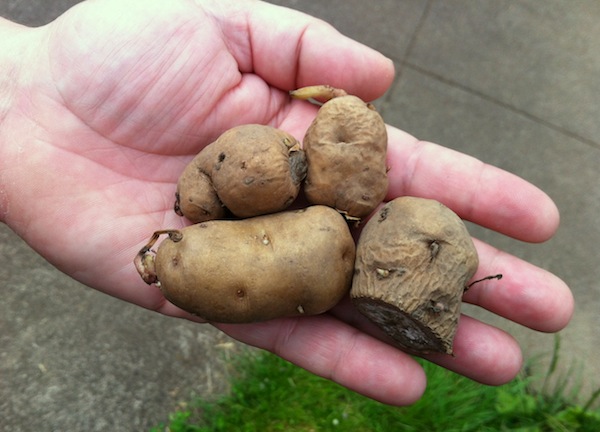
This history also means that he considers any potatoes grown elsewhere as inferior, pooh-poohing them as being "grown in sand" rather than in the rich soil of his native land. Though I think he would cede some props to the Ozette potato, a variety that was brought to the Northwest by Spanish explorers more than two centuries ago.

Originally picked up by the Spaniards in South America, the potatoes came on ships sent to establish beachheads on the west coast of America. One fort was built on the northwestern tip of what is now Washington state, where the Pacific meets mouth of the Straits of Juan de Fuca. Apparently the settlement didn't work out for the Spanish, and they left after only one year.

The native people of the area, members of the Makah tribe, found the potatoes in the overgrown gardens of the settlement and propagated them, naming this new food after one of the five villages in the area of Neah Bay. Because of the relative isolation of the region, these small, flavorful fingerlings maintained their unique heritage and weren't known to the outside world until the 1980s.

The Ozette potato was cataloged and seed was grown outside the region, and in 2005 it was added to the Slow Food Ark of Taste. In 2006 a partnership called a Presidium was formed to promote the potato and encourage farmers and individuals to grow it. Recently the Herbfarm in Washington offered seed to Northwest gardeners, and my neighbor Susana, co-owner of Portland's Culinary Workshop, volunteered to grow them in in the workshop's large vegetable garden.

If you're interested in growing this native potato yourself, check out the links above for information on where to get your own seed. I'll keep you posted as Susana's grow!

Friday, May 04, 2012

An Oasis in Milwaukie


If a food desert is defined as any area in the industrialized world where healthy, affordable food is difficult to obtain, it would make sense that a restaurant desert would be a place where there aren't many good places to find a meal.

The delicious blackboard. (Can I say that?)

In the past, the town of Milwaukie on Portland's southeastern edge would have qualified, in my book, as just such a place. As far as I could discern, the opportunities for dining were very few, and the drive from our restaurant-heavy Northeast neighborhood seemed not worth the time or cost of gas. But now that Pascal Sauton, chef and former owner of the trés Français Carafe Bistro in Portland, has opened Milwaukie Kitchen, I may have to rethink my desert map.

Needing a place to go for lunch with friends who live in the Sellwood area, we agreed to meet there and check out the scene. We walked into a bright and welcoming space, the day's offerings posted on a floor-to-ceiling chalkboard. The opposite wall was populated with a broad selection of wines from trés cher to not so, with other shelves lined with specialty grocery selections, mostly French and Italian with a nice representation from local producers, as well.

To-die-for duck fat roasted potatoes.

Sauton, no fool he, has tailored his menu to fit both duck fat roasted potato-fancying foodies and those looking for a good, simple deli sandwich, with the devilishly clever ploy of offering breakfast items all day, always a good call. There are plenty of tables scattered across the floor for sit-down dining, but this place caters to the take-out crowd, too. As a matter of fact, dinner is pretty much strictly take-out, since the place closes at 7 pm. The dinner menu has some amazing sounding, and reasonably priced, dishes that had me considering putting together an easy evening meal for my family.

Roasted lamb and pipérade sandwich.

As for our order, my roasted lamb sandwich was comprised of a sturdy ciabatta roll that soaked up the juices from the meat and the roasted peppers with harissa mayo tucked inside. My companions chose to go with breakfast items, the first an egg pipérade, roasted peppers beneath baked eggs swaddled with two generous slices of serrano ham (top photo), something that has brunch written all over it.

The warm croissant breakfast sandwich made from a Ken's Artisan Bakery croissant, white cheddar, Tails & Trotters smoked ham and a sunny side up egg is what other breakfast sandwiches, if they're very well-behaved, will get to be in heaven. The egg is cooked just enough so it spills out over the pastry, making it fork-rather-than-finger food. But it's so good, who cares?

With a place like this, and the wonderful Milwaukie Farmers' Market cranking up on Sundays, you can bet Milwaukie will be looking more like a food oasis than a parched desert.

Details: Milwaukie Kitchen and Wine, 10610 SE Main St., Milwaukie. 503-653-3228.

Wednesday, May 02, 2012

In Season NW: Calçots From Viridian Farms


A specialty of the Spanish region of Catalonia, calçots (pron. cahl-SOH) are a variety of giant scallion known as Blanca Grande Tardana. In Spain they are harvested from November through April, and festivals known as calçotadas are held in towns all over the region.

They are grilled over a hot fire, with the green tops laying outside the grill until the outer layer of the bulb is blackened. Then the calçot is lifted by the (cooler) greens, the charred outer layer is stripped off and the white is dipped into a bowl of a romesco-like sauce known as salbitxada (pron. sahl-beet-CHADA). The whole onion is then lifted into the air and the creamy inner parts are dropped into your mouth.

Here in Portland, you can find these traditional tapas treats under the Viridian Farms tent  at the Portland Farmers' Market at PSU on Saturdays. If they sell out, or if you somehow miss the season, you can use larger green onions cooked over your backyard grill, dipped into the traditional sauce below. To get in the mood for hosting your own calçotada, watch this temptingly luscious video.

Sabitxada Sauce for Calçots

4 Tbsp. blanched almonds
4 fresh bitxo peppers (or other mildly hot pepper)
8 cloves garlic
4 ripe tomatoes
2 Tbsp. chopped parsley
2 Tbsp. red wine vinegar
1 c. olive oil
Salt and pepper to taste

Makes 2 1/2 cups or 4-6 servings.

Heat oven to 350°. Place almonds in hot oven to toast for 5-7 minutes. Place in a food processor or mortar and pestle and coarsely grind. Peel and dice tomatoes and set aside. Coarsely chop the peppers, removing the seeds and membranes. Peel and chop the garlic. Mash ground almonds, peppers and garlic into a paste using a mortar and pestle or food processor. Mix in tomatoes, parsley and vinegar. Pulsing the food processor, drizzle in the olive oil until sauce becomes thick. Add salt and pepper to taste. Serve with grilled “calcots” (green onions) or any other grilled vegetable. During summer months, consider serving this fresh sauce with grilled steaks.

Monday, April 30, 2012

Miss Kitty Regrets


My mother agreed with Ben Franklin, who said something like, "Guests, like fish, begin to smell after three days."

While I'm sure that's true of some guests, this little lady has been a house guest for more than a week and we're starting to think of excuses not to send her home. Most of these wouldn't, to extend the fish metaphor, pass the sniff test. Especially since her owner, who allowed us to babysit while she was on a trip out of town, is a pretty sharp cookie.

Still, she just might go for the abducted by aliens story, wouldn't she?

Garden 2012: So Many Possibilities!


And so it begins. We spent the weekend tilling, weeding, picking up a load of compost (above) and spreading it over our garden beds. All motivated by the anticipation of the sweet taste of homegrown tomatoes in (fingers crossed) August, along with a (again, fingers crossed) bountiful harvest of carrots, peas, greens, herbs and squash.

The beds with tarragon, miner's lettuce and thyme from last year. Rhubarb anchors the strip behind.

We decided that with its full southern exposure, the strip behind the raised beds—in their sixth planting season and still going strong—would be the perfect place for some blueberries. Peas will be growing up the chain link fence behind them, to be followed by beans when the peas are done. The fence not only provides a great climbing structure for the twisty vines, but makes an edible screen between the back yard and the sidewalk.

The parking strip where the tomatoes will live.

I know, I know, it's all sounding pretty pie-in-the-sky right now, but that's just what an expanse of darkly rich, ready-to-be-planted soil does to me. So until reality intrudes, forgive me while I put on my rose-colored glasses and dream.

Sunday, April 29, 2012

Farm Bulletin: Leaving the Nest


Many farmers are keen observers of the life of their land, but few are as clear-sighted as contributor Anthony Boutard of Ayers Creek Farm, who has taken on the stewardship of his land like the scientist that he is. This includes the insects, animals, birds and humans that it supports. Recently his eye has been focused on a great horned owl that built a nest within view of his camera lens.

Last night, the two owlets were in the nest, and when I woke up this morning it was empty. It has been a little over two and a half months since the hen laid the eggs, and now they are fledglings moving about the fir boughs. At this point, they are more hoppers than fliers, and sometimes the wings seem to hinder more than help. They are furtive and hard to see tucked into the tree canopies.

The empty nest.

One hopped out in plain view for a moment (top photo). The facial disk is well developed, and the darker, immature plumage is replacing the silvery down they had as nestlings. They are also getting their ear tufts, or horns. In a couple of weeks they will start flying, and they will roost together, if all goes well. Even with a fiercely protective mother, this is a hazardous moment for the birds. They need more food as they grow, so the mother is in hunt mode all day.

I am not sure, but I think her mate may roost and hunt in another place. This grove of trees is small, and they share it with a pair of nesting red-tailed hawks.

Photos by Anthony Boutard. Track the progress of this owl family with Who's Minding the Frogs and the Great Horned Owl Follow-Up.

Jammer-rama!


My husband, as I've intimated many times in the past, is a baking maniac. Most weekend mornings the dogs and I stumble downstairs to find him measuring flour on his digital scale to feed his sourdough starter for bread, or to make the biscuits, scones, pancakes, waffles or whatever else has tickled his fancy. As I get the dogs' breakfast bowls lined up, I'm careful not to impede his progress, though they seem to delight in milling around our feet, making us dance to avoid a floury, kibble-and-fur-strewn catastrophe.

Just about the time they've finished gobbling their breakfast, I'm sitting down to a cup of coffee and the paper, the smell of baking goodness emanating from the stove, mixing with whatever tunes Townes or Eliades or Gillian is playing for us that morning.

Not content to rest on his laurels, lately Dave's put a new spin on his morning repertoire with the addition of some lovely, jam-studded biscuits known to Grand Central Bakery fans far and wide as jammers. The recipe is from the The Grand Central Baking Book by Piper Davis and Ellen Jackson, a tome widely admired by those with flour in their blood as well as those of us who weren't born with rolling pins in hand.

Grand Central Bakery Jammers
Adapted from The Grand Central Baking Book

Makes 10 to 12 jammers

4 c. all-purpose flour
3 Tbsp. granulated sugar
2 tsp. baking powder
1 1/2 tsp. salt
1 tsp. baking soda
1 c. (2 sticks) cold unsalted butter or margarine
1 1/4 to 1 1/2 c. (10-12 fluid oz.) buttermilk, milk or lactose-free whole milk
About 3/4 c. good quality preserves or jam

Preheat the oven to 350°. Lightly grease a baking sheet or line it with parchment paper.

Measure the flour, sugar, baking powder, salt, and baking soda into a bowl with high sides or the bowl of a stand mixer and whisk to combine. Dice the butter (or margarine) into 1/2-inch cubes. Use your hands or the paddle attachment of the stand mixer on low speed to blend the butter into the dry ingredients until the texture of the flour changes from silky to mealy. There should still be dime to quarter-size pieces of butter remaining. If you’re preparing the dough the night before, cover the bowl with plastic wrap and chill overnight; otherwise proceed with the recipe.

Make a well in the flour mixture and pour in 1 cup of the buttermilk (or milk) in one addition. Gently mix the dough just until it comes together; it will look rough. Scrape the dough from the sides and bottom of the bowl, then add another 1/4 cup buttermilk and mix again to incorporate any floury scraps. The majority of the dough will come together, on the paddle if you are using a stand mixer. Stop mixing while there are still visible chunks of butter and floury patches.

The dough should come out of the bowl in 2 to 3 large, messy clumps, leaving only some small scraps and flour around the sides of the bowl. If the dough is visibly dry and crumbly, add up to 1/4 cup more buttermilk, 1 tablespoon at a time, mixing no more than one rotation after each addition.

Turn the dough out onto a lightly floured surface. Use the heels and sides of your palms to gather the dough and gently pat it into an oblong shape 1 1/2 to 2 inches thick. It won’t look smooth or particularly cohesive; that’s okay. Use a biscuit cutter (or empty, clean tin can or wine glass) to cut the jammers into circles at least 2 1/2 inches in diameter. Layer the leftover scraps on top of one another and gently pat them out to a thickness of 1 1/2 to 2 inches and again cut into circles.

Use your thumb to make an indentation the size of a fifty–cent piece in the middle of each biscuit. While gently supporting the outside edge of the biscuit with your fingers, use your thumb to create a bulb–shaped hole that’s a bit wider at the bottom and that goes almost to the bottom of the biscuit (think pinch pot). Try to apply as little pressure as possible to the outside of the biscuit, to avoid smashing the layers, which are the key to flaky jammers. Fill each indentation with 1 tablespoon of jam and put the jammers on the prepared baking sheet with 1 1/2 inches between them.

Bake for 35 to 40 minutes, rotating the pan halfway through the baking time. The jammers should be a deep golden brown.

Wednesday, April 25, 2012

A Walk in the Park (Kitchen)


I am so glad I chose to write about farms, farmers' markets, gardening, seasonal eating, Northwest travel and (thanks for your patience on this) my dogs. I can't imagine having one of those restaurant blogs where there's constant pressure to keep up on the latest who's-smashing-dishes, what's-the-hottest-table, what's-opening-where-and-when gossip.

Sprout salad, carrots, hazelnuts, quinoa.

So when a friend asked where we should meet for dinner recently, my head started swimming. Should we go check out a new place of the too many I hadn't been to yet? What kind of food? I froze up.

When I hadn't called back for several hours, she wisely took matters into her own hands, suggesting that we meet at Park Kitchen. My brow immediately unfurrowed, my death grip on the phone relaxed. I'd run into PK's owner Scott Dolich at a lunch at Raptor Ridge winery, where he kindly let me watch him make quenelles (cool!). And David Padberg, his Chef de Cuisine, was a pal of Clare and Brian of Big Table Farm, as well as filming a video on cooking with wasabi with my friend Rebecca at Cooking Up a Story. I knew we'd be in good hands.

We arrived to find our table ready, its copper top gleaming in the intimate (but not dim, thank you) lighting that makes the small dining room feel cozy rather than crowded. I had a great view of the unfussy open kitchen where Scott, David and the crew were cooking and plating the orders of the diners already seated, and watching the plates sail by only confirmed the decision to come here.

Flank steak and blue cheese salad.

Nettles, beets, wild mushrooms and spring greens, along with wild salmon and local meats populated the simple menu comprised of small hot and cold plates, large plates and desserts. After ordering a Boulevardier for me and a French 75 for my companion, we opted to share a couple of small plates and an entrée.

The baby octopus arrived topped with crusts of light bread, the better to sop the broth below, and the tiny barely blossoming rapini and small, tart chunks of pickled celery gave this plate a nice balance of tang and texture. The flank steak, blue cheese and sherried onions turned out to be a lovely salad of butter lettuce, with shreds of the medium-rare meat mixed with the other ingredients and tossed in a simple vinaigrette. The kitchen then sent out a complimentary salad of quinoa and carrot purée topped with crunchy housemade crackers.

Our large plate was a hefty slice of salmon on a bed of potato horseradish gratin, topped with watercress and trout roe and with a lightly creamy wine sauce underneath (top). The salmon had a perfect, clean flavor that only the freshest fish carries, and the soft, almost gravlax-like texture practically melted in my mouth. On the recommendation of our server we chose to pair it with a pinot noir from the always-satisfying Athena Pappas and Stewart Boedecker of Boedecker Cellars.

Love the dots!

Normally not a big dessert person, I was glad we'd shared our plates since we weren't too full to order the ricotta fritters with preserved blood oranges and little dots of bay leaf panna cotta. My friend said the fritters reminded her of beignets, those airy Southern specialties, and the bay leaf panna cotta went on the "gotta figure this out at home" list. Stay tuned!

And I have to remark on the service that, even though the restaurant was busy and the kitchen humming, made us feel very well cared for. For its focus on locally sourced, sustainably produced food, perfect execution and the aforementioned attentive service, Park Kitchen should be high on your list of the best restaurants in town.

Details: Park Kitchen, 422 NW 8th Ave. 503-223-7275.

Monday, April 23, 2012

Grill It. Grill It Good.


If it has to do with the grill and the garden, you can bet that contributor Jim Dixon of RealGoodFood will be all over it. And I love his mention of the edible herbs that may be growing in a neighbor's yard, though of course I'd always encourage you to ask first before gathering…or "liberating" as it was called in more, shall we say, revolutionary times.

Salsa Verde

Just about any fresh herb or mix of herbs chopped with some olive oil and some combination of garlic, shallot, onion, anchovy, capers, hard-boiled egg, vinegar or lemon (juice and zest) can be called salsa verde and be delicious. And the long-awaited sun called for firing up the Weber for some grilled protein.

After arranging some skirt steak and tuna over the coals, I chopped together French sorrel and mint from my garden, a few Egyptian onions from last year—dried out a bit but intensely flavorful—salt-packed capers, anchovy and a hard-boiled egg, then stirred in a few glugs of extra virgin olive oil and splash of Katz late harvest sauvignon blanc vinegar.

We spooned the salsa verde over the beef and fish, but it’d be good over just about anything. If you don’t have herbs growing in your yard (or a neighbor’s), buy some flat leaf parsley and a couple of other herbs from the farmers' market or New Seasons and make a batch now.

Sunday, April 22, 2012

Horses. Camera. Action!


My friend Dana is taking a film class and one of her first assignments was to make a 10-minute film. As an avid horsewoman, she naturally decided to make a film about her favorite subject. Which prompted me to introduce her to Clare Carver of Big Table Farm. The rest, as they say, is (film) history.

Thursday, April 19, 2012

Farm Bulletin: The Nature of Farming


The latest bulletin from contributor Anthony Boutard of Ayers Creek Farm introduces some brand new additions to the residents of their farm in Gaston.

The killdeer is the common plover of cultivated ground. Their nests are frequently encountered in our fields. It is a simple depression lined with a few bits of straw and containing three or four eggs. While the female is brooding, the male acts as a sentry, drawing or driving away threats.

Birds like owls and robins are called atricial; they are born naked and blind and must be tended by their parents for weeks, or even months in the case of birds of prey. Precocial birds, such as the killdeer, are born with a down coat and start foraging shortly after they hatch. Within hours these downy balls are scurrying about the fields like Miyazaki's soot balls (detail, left).

Even though the chicks can chase down their own food, the parents remain in attendance, ready to sound the alarm when a harrier is near, or produce a broken wing in an attempt to draw us away. I was planting chickpeas and favas Sunday, and three chicks, just a day or so out the egg, found the freshly turned soil an irresistible lunch counter. After a couple of passes, the parents regarded the noisy tractor as harmless.

Sunday, April 15, 2012

Speed the Plow


Blue skies and a wide green field beckoned hundreds of visitors yesterday to watch teams of gorgeous draft horses turning over perfect rows of black earth for the 46th Annual Farm Fest in McMinnville.

There were Percherons, Clydesdales, Belgians and Shires, along with lesser-known breeds like Halflingers and Fjords, as well as a team or two of mules. They were harnessed to comparatively delicate-looking plows steered by men and women who walked in the furrows they dug, directing their teams with whistles, calls and an occasional pull on the lines.

The sweat dripping off both horses and handlers showed how hard this work was, despite their methodical speed and the undulating waves of turned earth left in their wake. Each team was competing to plow a 50 by 150 foot section, which would take about three hours, with prizes awarded based on the straightness of the furrows and the performance of the team.

There won't be another chance to see these magnificent beasts (equine or human) demonstrating their skills until next year, but mark your calendar for early next April…you can even combine it with wine tasting or a picnic and make it the perfect day trip!

Photo at top of Clare Carver of Big Table Farm driving Huston and Hummer, her team of Halflingers, in this year's competition.

Tuesday, April 10, 2012

A Company Dinner That's No Lemon


We had friends over for dinner the other night, one of those evenings where the main dish sang, the sides were in perfect harmony and the wine was perfection. That's when I suddenly realized everyone was talking about food…a memorable restaurant meal, a dish their mom made for special occasions, a favorite recipe. Not that it's an unusual occurrence, at least around here, where a wonderful meal seems to conjure memories of other flavorful experiences.

So when Jeff and Kathryn mentioned a chicken dish his mom liked to make for company, my ears pricked up, especially since his mom and step-dad are both fantastic cooks. And when he mentioned that the dish called for roasted lemons, a personal weakness of mine, I was on board big time.

A few nights later I pulled out the Meyer lemons I'd had stashed in the fridge and whipped it up. While it takes a little prep, it's basically a one-dish dinner for four, or you could add a couple more breasts and a few more potatoes and it'd easily serve six to eight. Toss some broccoli rabe in olive oil, salt and pepper and roast it in the oven while the chicken cooks, or just tear up some butter lettuce and sprinkle with olive oil and lemon and you've got all your bases covered.

Chicken with Roasted Lemons and Rosemary
Adapted from Michael Chiarello, Tra Vigne

1 1/2 lbs. small new potatoes
2 large lemons
Extra-virgin olive oil for brushing on lemons, plus 1 Tbsp. salt and freshly ground pepper
4 boneless chicken breast halves, skin on
1 Tbsp. minced garlic
1 c. chicken stock
1 tsp. finely chopped fresh rosemary
1 Tbsp. finely chopped fresh flat-leaf parsley
1 Tbsp. unsalted butter or margarine (optional)

Put the potatoes in a pot of salted cold water and bring to a boil. Cook until just tender, about 20 minutes. Drain and let cool, but do not peel. Cut in half and set aside.

Preheat the broiler. Cut a small slice off both ends of each lemon, then cut in half crosswise. Arrange the lemons, flesh side up, in a flameproof non-reactive baking dish, brush with olive oil, and season with salt and pepper. Broil 6 inches or more from the heat until browned and soft, about 10 minutes. Let cool. Squeeze the lemon halves over a sieve suspended over a bowl. Push and stir the pulp through the sieve with a rubber spatula or wooden spoon. Discard the lemon shells.

Preheat the oven to 450°. Season the chicken with salt and pepper. Heat the remaining 1/4 cup olive oil in a large ovenproof sauté pan over medium-high heat until hot. Add the chicken, lower the heat to medium, and cook, turning once, until brown on both sides, about 5 minutes. Remove to a platter.

Return the pan to medium-high heat, add the potatoes, season with salt and pepper and cook, stirring and tossing, until brown all over, about 5 minutes. Drain off the excess oil. Arrange the chicken breasts on top of the potatoes and place in the oven to reheat and cook through, about 10-20 minutes. When done, remove the chicken to a platter and put the pan with the potatoes over medium-high heat. Toss well so the pan juices are absorbed into the potatoes. Scrape the potatoes out of the pan onto the platter around the chicken.

Return the pan to medium-high heat and add the garlic. Sauté briefly until light brown. Immediately add the reserved roasted lemon juice (this final flash of heat will cook off any residual acid flavor), stock, rosemary, and parsley. Stir and scrape up all the browned bits that cling to the bottom and sides of the pan. Season to taste with salt and pepper. If the sauce tastes too lemony, stir in the optional butter. Pour the sauce over the chicken and potatoes and serve immediately.