Showing posts with label marine stewardship council. Show all posts

Sunday, August 28, 2016

Hot House? Chill Out With Cool Shrimp Tacos


I know it's been too hot for too long when I open a cupboard door and a blast of hot air rolls out and hits me in the face. At our house it seems to take about three days of temperatures in the high 90s to achieve this effect, so the last thing I want to do it exacerbate the problem by turning on the stove. Normally that means grilling outside, but Dave's been out of commission this week with cataract surgery, leaving dinners a last-minute "what are we gonna do" problem.

Fortunately there are good friends who have our back, who know that the last thing a person wants to do on a hot evening after a day of shuttling back and forth from doctor appointments is figure out what to have for dinner. My friend Ann offered to bring over her family's favorite hot weather, no-cook dinner on one of those nights, arriving in the late afternoon with a chilled container of shrimp salad she'd adapted from a recipe clipped out of a newspaper years before.

Made with local pink shrimp—which have passed a rigorous certification process and been declared a sustainable fishery by the Marine Stewardship Council (MSC)—and in-season avocados, this is a godsend in hot weather, but it's also a terrific quick solution to a weeknight dinner. Plus I can see it topping a salad of chopped greens or piled into a pita or tossed with hot or cold pasta or topping some crostini for a refreshing appetizer. Seriously, it's that flexible.

So while it's kinda hard to clip a recipe out of the computer screen, it'd be worth your while to bookmark it, save it or pin it someplace for future reference. Which is exactly the reason I'm writing this post—so I can find it the next time I need it!

Shrimp and Avocado Tacos

1 lb. pink shrimp
2 medium slightly firm avocadoes, diced
1 medium cucumber, peeled, seeded and diced
2 green onions, thinly sliced crosswise
1/2 c. chopped cilantro (leaves only)
Juice of 1 lime
Salt to taste
Corn or flour tortillas, at room temperature or warmed in the microwave

Combine all ingredients in large mixing bowl. Serve with tortillas.

While this is great all by itself, I chopped some cabbage to serve alongside, and you could also included sour cream, salsa or hot sauces as desired.

Saturday, August 08, 2015

Buying Whole Fish: Don't Be Afraid!


When you see a price like $5.99 per pound for albacore, our West Coast version of filet mignon, it's hard not to start drooling. But then you realize that's for a whole fish, which average 12 to 14 pounds. It's not only a little intimidating to think about what in the heck you'd do with that much fish flesh, but it can also be a drain on your bank account.

Tuna confit.

But here's the thing: When you consider that albacore normally sells for twelve bucks and up per pound, buying the whole fish makes a lot of sense from the perspective of your wallet. The store will filet the fish for you, removing the loins (four per fish) from the skeleton. To get even more value from your fish, ask the butcher to package the bones and scraps separately, which may have as much as a couple pounds of flesh still clinging to it.

Smoked albacore.

When you get the fish home, you have several choices: you can fire up the grill or the oven and roast one of those loins for dinner. The other three loins can go in the freezer for another day—they'll be good for several months if they're well-wrapped to eliminate any air getting to the fish. You can also confit one of the loins (recipe below), a quick process that will make any canned fish you've had pale by comparison. Or if you have a smoker, I can personally testify as to the deliciousness of smoked albacore, which also happens to keep quite nicely in the freezer.

Roasting the carcass.

That skeleton can be tossed in a big pot of water and simmered for an hour or so, giving you quarts of amazing fish stock (again, keeps for months in the freezer). Or you can put the carcass in a roasting pan at 400° for a half hour or so till the meat is cooked through, then cool it slightly until you can pull the meat off the bones. This results in a surprising amount of fantastic tuna that you can use in salads, sandwiches, a tuna "schmear" or dip—go crazy, there'll be lots!

Albacore, grain and vegetable salad.

To gild the lily, not that it needs it, West Coast albacore, because the fish are young when they're caught and haven't lived in the ocean that long, are extremely low in mercury and are perfectly safe to eat for young and old alike. They're high in omega-3 fatty acids, complete proteins, selenium and vitamin B-12, all shown to be beneficial for health. Not to mention that the fishery off our coast has gone through a rigorous certification process and has been certified as sustainable by the Marine Stewardship Council (MSC).

Also know that almost all the boats in our coastal fleets are owned by individual families, so the more albacore you buy (and enjoy) the healthier and more sustainable our coastal fishing communities will be. So the next time you see that there's a big sale on whole fish, buy one for your family or to share among a group of friends. You won't be sorry!

Albacore Tuna Confit

1 skinless tuna loin
2 tsp. kosher salt
1/4 tsp. sugar
1/2 tsp. red chili flakes
1 tsp. dried thyme
4 cloves garlic, peeled and crushed in a garlic press
Zest of 1/2 lemon
3-4 c. decent quality olive oil

Cut trimmed loin in four pieces. In a shallow pan, mix salt, chili flakes, thyme, garlic and lemon zest. Roll tuna pieces in the spice mixture, making sure to cover all surfaces (this doesn't have to be thick, it's just a rub). Place in dish on counter for at least a couple of hours or covered in the fridge if you're marinating it longer.

Place fish pieces in a saucepan and cover with oil. Put over very low heat and, using an instant-read thermometer, very slowly raise the temperature to between 140-150° (fast heating will cause the surface to seize and it will turn out dry rather than moist and tender). Maintain temperature for three to ten minutes, or until the center of the thickest piece is almost cooked through. (You can use a fork or knife for this purpose.) Turn off heat and allow the oil to cool. Remove fish from oil. Strain remaining oil through a fine mesh sieve.

If you're not using all the fish right away, place it in a container that has a tight-fitting lid. Cover the fish with the strained oil and seal. It will keep in the fridge in its oil for a couple of weeks. Any remaining oil can be used for dressings or other purposes—it has a fantastic flavor!

For more information on Oregon albacore, read Oregon Albacore A to Z.

Thursday, September 04, 2014

Consumer Reports' Warnings on Tuna Get It Wrong


You may have seen articles in the press recently citing a study from Consumer Reports that analyzed recommendations from the FDA calling for Americans to increase fish consumption in their diets. Among other things, Consumer Reports got a little screamy over the issue of mercury levels in tuna, stating, "Consumer Reports disagrees with the recommendations from the FDA and EPA on how much tuna women and children may eat. (We don’t think pregnant women should eat any.)" [Emphasis theirs - KAB]

Fishing boat in Ilwaco, WA.

As I've stated here many times, lumping all tuna into one full-of-mercury category is wrong from both a health and a factual standpoint. And yes, I know, parsing complicated issues when speaking to the public is difficult, but facts are facts, and fear-mongering headlines negatively impact thousands of fishing families in Oregon and Washington and hundreds of coastal communities that depend on the fishing industry for their survival.

Unloading albacore in Warrenton.

The Western Fishboat Owners Association, which represents about 400 of these fishing families, responded to the barrage of bad press this way:

"The U.S. albacore troll/pole fleet is a small boat fleet of hook and line vessels generally 35-75 ft. in length, that are family-owned and operated and fish for albacore tuna from July through October off the west coast, mainly Oregon and Washington. The fishery is certified by Marine Stewardship Council (MSC) as sustainable and well managed and also appears on the "Green" list from the Monterey Bay Aquarium Seafood Watch. Our fleet lands on average 30,000,000 pounds each year with about half exported to Europe and Asia. The fleet catches 2 to 4-year-old albacore (10-25 pounds) with an average of about 13 pounds year after year. Extensive mercury testing has been [done] over the last 10 years through Oregon State University as well as by buyers and exporters. All recent mercury testing has shown very small levels of Hg [mercury] in the fish well below FDA standards of 1.0 ppm and well below Canadian guidelines of .5 ppm (The Canadian government has recently removed their 'no eat' recommendation from their local troll albacore caught off the U.S. and Canada.)"

Fresh-packed West Coast albacore tuna.

What should you do when you go to the store to shop for tuna? First, look for the blue MSC label or, better yet, read the fine print on the label. The only ingredient should be albacore tuna—though some also add salt—because it's fresh-packed, so the fish cooks in its own juices (left) eliminating the need for added oil or water. If it has oil or water, it's almost guaranteed to come from large fishing vessels that ply the deep southern Pacific ocean. These gigantic vessels catch older, much larger albacore that have lived for years in the mercury-polluted ocean waters (a whole outrage on its own).

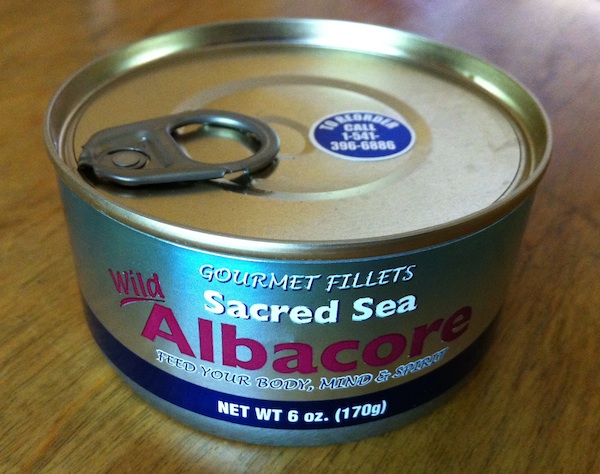
Good local brands to look for are Sweet Creek processed by Paul and Judy Fuller in Elmira, Oregon; Sacred Sea from the Goché family in Coquille; and Skipanon from the Kujala family of Warrenton.

Top photo from Wild Pacific Albacore. Read my article on the Oregon albacore fishery, which goes into more detail about how albacore is caught and processed.

Sunday, July 27, 2014

Get More For Your Money: Roast Those Carcasses!


Summer means that cooking moves outdoors, with electricity replaced by fire. Around here we're putting not just steaks and chickens on the grill but fish, usually whole salmon or tuna loins.

Whole albacore on sale.

Albacore season has just started and you'll see whole fish going on sale at supermarkets around town. Caught off our coastline, mostly by small family-owned boats using a pole-and-line method, the entire West Coast fishery has been certified as sustainable by the Marine Stewardship Council (MSC). These smaller fish (12-25 lbs.) are low in mercury and other toxins simply because they haven't spent as much time in the ocean environment as the larger, 40 to 60-lb. fish caught in the deep oceans, the ones that appear in cans on store shelves. (Read my story on Oregon albacore for more information.)

Roast that carcass, don't toss it.

So enjoy roasting those triangular loins, whether whole or sliced into steaks and seared on the outside, leaving the centers barely warm and still pink. But please, oh please, when you buy that whole fish, ask them to bag up the carcass, too, or you'll be throwing away two pounds or so of good meat, not to mention the stock you can make from the bones, fins and head (if you buy it with the head on).

Pick meat off the roasted carcass, then make stock with the bones.

And don't believe those charts meant for chefs that say the yield from a whole albacore, gutted and without the head, is 50% of the weight. From the 17-pound fish (head off) that I bought yesterday, my yield was more than 80% after removing the loins, roasting the carcass (350° for 30 min.), picking off the meat (nearly 2 lbs.!) and then making stock from the bones (2 1/2 qts.). The total weight of bones, fins and detritus that went into the compost bin was only two or three pounds. (Kind of tells you about the food waste that happens in restaurants, though, doesn't it?)

The flaked albacore from the bones will be going into salads, fish cakes, sandwiches and soups or chowders, and the stock is fabulous for paella, risottos, chowders, bouillabaisse, etc. So get the most for your money, roast those carcasses, and reap the delicious rewards!

Here's the blog post from my friend Hank Shaw that got me started roasting carcasses.

Monday, August 22, 2011

Oregon Albacore A to Z


With albacore season in full swing, it seemed like a good time to run this article, which I wrote last season for NW Palate magazine.

Wind off the ocean whipped through the rigging on his boat, and sea lions barked in the background as albacore tuna fisherman Rick Goché recalled growing up on Tillamook Bay on Oregon’s north coast.


“I’ve been fish crazy since I can remember,” he said. “When I was old enough to make my way down to the creek, I was fishing with a safety pin and a string. I can still remember when I got my first factory-made hook.”

Rick Goché's boat, the Peso II.

Goché grew up to be a fisherman; today, he fishes the Pacific Northwest’s deep, abundant waters, casting off from Coos Bay for two to six weeks at a time. It’s hard work, and definitely not child’s play. “When you’re a hundred, 200, 300 miles offshore, it’s not like you can duck into a port when the weather gets bad,” he says.

His brother, Larry (below right), fishes with him, and his son, his daughter, and his grandson have taken turns on the boat as well. He has hopes that his daughter Lauren, who will be working on tuna boat this summer, may eventually take up fishing as a career.

“Even though she won’t be on the boat,” he said, “it’ll be cool to be on the water with her.”

Larry Goché on board the Peso II.

The average age of a fishboat owner is 62 (Goché is 57—“I’m one of the young guys,” he says), and the industry has had trouble attracting younger people into a career that not only is dangerous but also requires hard physical labor and long periods away from home.

Another issue facing the industry is consumer awareness, a concern voiced by chef Eric Jenkins while he was handing out samples of hot-off-the-grill wild West Coast albacore outside a Portland-area Whole Foods market. “I’ve had a couple of people say they won’t eat fish because of the mercury,” he said.

It’s a sentiment echoed by Wayne Heikkila, a second-generation albacore fishboat owner and now executive director of the Western Fishboat Owners Association (WFOA). “[People] don’t know tuna from albacore, or skipjack from yellowtail.”

Unloading the albacore from the hold.

The tuna most of us grew up eating in casseroles and sandwiches was probably skipjack, which is caught on giant factory ships that operate in the deep, tropical oceans of the world and is sold under brand names like StarKist, Bumblebee, and Chicken of the Sea. Nearly all of those ships are longline fisheries, which tow a fishing line several miles long with thousands of hooks baited at regular intervals along its length. The problem with this method is that it produces significant bycatch—meaning that it also hooks endangered and threatened sea turtles, seabirds, marine mammals, sharks, and other fish besides skipjack.

The tuna caught in these deep waters are several years old and can weigh 40 to 60 pounds. They have absorbed mercury and other toxins, enough to cause the Food and Drug Administration and the Environmental Protection Agency to advise pregnant women, nursing mothers, and young children to limit their intake of the fish.

Those warnings have caused big headaches for the West Coast albacore industry.

That’s because the advisories don’t distinguish between the albacore caught in the deeper oceans and those younger and smaller tuna caught off the West Coast of the United States and Canada. Ranging in age from three to five years old and weighing 12 to 25 pounds, these younger albacore simply have not spent enough time in the ocean environment to contain the levels of mercury found in the larger, older fish.

Heikkila is frustrated that so much of the albacore caught off our own coast is exported to Japan for sushi, and that Northwest foodies would rather buy a can of albacore tuna from Spain (produced, ironically, from West Coast albacore that is exported to that country) than albacore caught and canned on their own coastline.

Fresh Oregon albacore just before it's sealed.

“We’re trying to get consumers to eat more of the local product,” Heikkila said. Approximately 16,000 to 23,000 tons of albacore are caught per year. “It’s crazy—we send 80% to 90% of it to other countries and then the U.S. consumer has to buy it from overseas. That money could go into local fishermen’s pockets.”

What’s more, Northwest consumers are generally unaware that these local fish are caught one at a time using what’s called a pole-and-line or troll-and-jig method. This approach employs 10 to 15 lines of nylon cord measuring six to 100 feet long that are towed behind a boat. Each line has a barbless “jig” or lure at the end that is attached to a double barbless hook. When a fish bites the jig, the fisherman hauls it by hand into the boat, allowing the fishermen to keep only “right-size” fish and eliminating bycatch.

The Goché's Sacred Sea brand albacore.

The U.S. and Canadian albacore fisheries in the North Pacific, made up of mostly small, family-owned boats like Rick Goché’s, received a boost last year when Seafood Watch, a program of the Monterey Bay Aquarium that evaluates the ecological sustainability of wild-caught and farmed seafood, listed U.S. and Canadian troll- and pole-caught albacore from the North Pacific as a “Best Choice” due to negligible bycatch and the healthy stock of albacore in the region.

But the biggest shift in public awareness may come from the recent announcement by the Marine Stewardship Council (MSC), which has certified the Canadian Highly Migratory Species Foundation (CHMSF), an albacore fishery of Canadian-based boats, and the U.S.-based WFOA as sustainable and well-managed.

“It’s a very rigorous, on-site process that looks at a fishery as opposed to a sweeping view of a species,” said Kerry Coughlin, the Regional Director for the Americas of the MSC. “It’s our view that’s how you get a very rigorous assessment process that’s accurate, and it’s how, in some cases where fisheries aren’t sustainable, you’re going to bring about change on the water.”

And when they see the blue MSC label (right) in their grocer’s seafood case or on a can of albacore, “consumers can have the assurance that it is an environmentally responsible choice,” Coughlin said. And, because they come from younger fish, the fresh loins of albacore available from July through October at most retailers contain more have more “puppy fat,” as an industry spokesperson called it.

“I think it’s moister,” Jenkins said. “It seems to have higher fat levels, particularly concentrated in the belly.” His suggestion to consumers buying a whole loin is to ask their butcher to keep the belly meat on, adding that many butchers either keep it for themselves even cut it out, which he considers a travesty.

Locally canned albacore would be almost as much of a shock to most shoppers. The major-brand tuna on their grocery shelves was caught and frozen at sea, then thawed at a cannery and cooked in big steamers, where it loses much of its natural juices and fats. It is then packed in cans and cooked again, requiring the addition of water or oil to keep it moist.

That contrasts with most local tuna, which is packed in cans when it’s fresh and cooked only once, sealing in the natural juices and not requiring the addition of oil or water to keep it moist.
Between MSC certification and a growing concern among consumers about where their food comes from, families that depend on the North Pacific albacore are seeing a brighter future for their children, and a way of life that they prize.

“On a boat, you have to have all your senses attuned to your boat and the fish and your gear, but what it comes down to is stay alive and fill up the boat,” said Rick Goché. “When I pull away from the dock and I cross the bar and I feel the ocean lifting the boat, I leave everything behind as much as possible. Sure, I miss my family, but I don’t miss all the complexities of being on land.”