Showing posts with label Skipanon. Show all posts

Thursday, September 04, 2014

Consumer Reports' Warnings on Tuna Get It Wrong


You may have seen articles in the press recently citing a study from Consumer Reports that analyzed recommendations from the FDA calling for Americans to increase fish consumption in their diets. Among other things, Consumer Reports got a little screamy over the issue of mercury levels in tuna, stating, "Consumer Reports disagrees with the recommendations from the FDA and EPA on how much tuna women and children may eat. (We don’t think pregnant women should eat any.)" [Emphasis theirs - KAB]

Fishing boat in Ilwaco, WA.

As I've stated here many times, lumping all tuna into one full-of-mercury category is wrong from both a health and a factual standpoint. And yes, I know, parsing complicated issues when speaking to the public is difficult, but facts are facts, and fear-mongering headlines negatively impact thousands of fishing families in Oregon and Washington and hundreds of coastal communities that depend on the fishing industry for their survival.

Unloading albacore in Warrenton.

The Western Fishboat Owners Association, which represents about 400 of these fishing families, responded to the barrage of bad press this way:

"The U.S. albacore troll/pole fleet is a small boat fleet of hook and line vessels generally 35-75 ft. in length, that are family-owned and operated and fish for albacore tuna from July through October off the west coast, mainly Oregon and Washington. The fishery is certified by Marine Stewardship Council (MSC) as sustainable and well managed and also appears on the "Green" list from the Monterey Bay Aquarium Seafood Watch. Our fleet lands on average 30,000,000 pounds each year with about half exported to Europe and Asia. The fleet catches 2 to 4-year-old albacore (10-25 pounds) with an average of about 13 pounds year after year. Extensive mercury testing has been [done] over the last 10 years through Oregon State University as well as by buyers and exporters. All recent mercury testing has shown very small levels of Hg [mercury] in the fish well below FDA standards of 1.0 ppm and well below Canadian guidelines of .5 ppm (The Canadian government has recently removed their 'no eat' recommendation from their local troll albacore caught off the U.S. and Canada.)"

Fresh-packed West Coast albacore tuna.

What should you do when you go to the store to shop for tuna? First, look for the blue MSC label or, better yet, read the fine print on the label. The only ingredient should be albacore tuna—though some also add salt—because it's fresh-packed, so the fish cooks in its own juices (left) eliminating the need for added oil or water. If it has oil or water, it's almost guaranteed to come from large fishing vessels that ply the deep southern Pacific ocean. These gigantic vessels catch older, much larger albacore that have lived for years in the mercury-polluted ocean waters (a whole outrage on its own).

Good local brands to look for are Sweet Creek processed by Paul and Judy Fuller in Elmira, Oregon; Sacred Sea from the Goché family in Coquille; and Skipanon from the Kujala family of Warrenton.

Top photo from Wild Pacific Albacore. Read my article on the Oregon albacore fishery, which goes into more detail about how albacore is caught and processed.

Wednesday, September 12, 2012

Food Farmer Earth: Fillet Tuna Like a Master


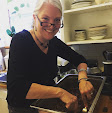
In this video, a bonus feature from my interview for Food Farmer Earth with Mark Kujala of Skipanon Brand Seafood, watch Skipanon's Shirley Tischer demonstrate how an expert fillets a tuna. Wow!

Food Farmer Earth: A Small Cannery, a Community's Pride


For much of the last century, fishing was a secure livelihood for the people of Oregon's coastal towns, but in the 70s the industry crashed. Tiny Skipanon Brand Seafood survived because Mark Kujala and his family built a microcannery and began marketing their canned fish themselves. My interview for Food Farmer Earth tells their story.

It’s amazing to imagine what it must have been like to walk along the docks of Oregon’s small coastal towns like Astoria and Warrenton in the first half of the twentieth century. Hundreds of fishing boats would chug into port after spending weeks at sea, their holds full of salmon, tuna and sturgeon. They’d tie up next to the thirty or so canneries that lined the waterfronts and unload their catches, the air filled with the shouting of dock workers and the cry of seabirds looking to scoop up any scraps.

In the 1970s, Oregon’s coastal fishing industry, consisting for the most part of small, family-owned boats, was being devastated by the rise of large foreign fleets competing for ever-decreasing stocks. Seeing the industry changing and the big canneries moving out or closing, Warrenton fisherman Norman Kujala adapted by building his own cannery on the banks of the Skipanon River in 1978.

Skipanon Brand Seafood is now run by the second generation of the Kujala family, including Paul, who fishes for salmon on the family boat called the Cape Windy, and Mark, who runs the cannery and oversees the processing of salmon, sturgeon and albacore…

Read the rest of my story about the Kujalas and Skipanon, then watch Skipanon's Shirley Tischer demonstrate how to fillet a tuna…amazing!

In this week's cooking segment, you can learn to can your own fish (in this case sardines) at home using a pressure canner. To find out more about this series of interviews with local food producers, and to get some terrific recipes featuring the ingredients discussed, consider a free subscription. 

Thursday, September 01, 2011

Why I Buy Oregon Albacore


I can't think of a better illustration of why to buy Oregon albacore than this video of a small cannery I visited on a recent trip to Astoria, Oregon.

Mark Kujala, Skipanon co-owner and the mayor of Warrenton.

The Skipanon Brand cannery, now run by the second generation of the Kujala family of Warrenton, fishes for tuna off the coast of Oregon using the hook-and-line method that eliminates by-catch, the unintended harvesting of other species. Then they bring the fish into their small cannery built by Norman Kujala on the banks of the Skipanon River in 1978.

Anna, originally from Kentucky, worked at Bumble Bee until it moved out of Warrenton.

The loins are filleted and cleaned by a small crew of local women who've been working for the family for decades. The fresh loins are then sliced, hand-packed into cans with two salt pellets and sent through the ancient canning machine. The wire cage holding the cans is lifted into a large pressure cooker that cooks the fish, which means the fish cooks in its own juice without needing oil or water to keep it moist. Then the rich broth can be added to pump up the flavor of whatever dish the fish is used in.

Is it any wonder I love this product? I'm so glad to have found out about it!

Details: Skipanon Brand albacore can be found at the Saturday Beaverton Farmers' Market, ordered online at their website or found at many stores around the state. Most markets have other brands of Oregon albacore available. They're well worth looking for or asking about.