Showing posts with label Organicology. Show all posts

Monday, February 09, 2015

Farm Bulletin: To Every Farm, a Muse


No visit to Ayers Creek Farm is complete without a demonstration of the culinary uses of the food that contributor Anthony Boutard and his wife, Carol, grow on their 140-acre farm. To their credit, their decade-long Herculean effort has been rewarded with the appointment of their very own muse. 

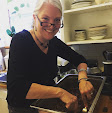
Before the Olympian deities took over and bureaucratized the Office of Muses, there were just three muses residing on Mount Helicon: Aoide (expression), Mneme (memory) and Melete (occasion). Linda Colwell is our Melete. Whether it is a ramble or some other occasion, Linda steps in and everything flows smoothly.

Linda Colwell, Ayers Creek's Melete.

When Lane Selman of the Culinary Breeding Network asked us on a hopeful afternoon in April if we could host a lunch and tour at Ayers Creek for the Organicology conference in early February, it seemed like an reasonable idea. With our lovely Melete watching over us, what could go wrong? Nothing, as it turns out, even in a week marked by torrents of rain, the sun shone and we all had a good time.

The gorgeous groaning board.

Working with Mark Doxtader and Jason Barwikowski of Tastebud, and Sarah Minnick of Lovely's 50/50, Linda showcased the fruits, vegetables and grains of the farm. While we led a tour in the fields, Linda gave a talk about the various ingredients in the lunch. One participant confided to us that he loved Linda's talk so much that he was tempted to sit through it a second time. Here is the quartet's menu:
  • Amish Butter popcorn with Aci Sivri cayenne
  • Black Radish soup
  • Green Posole made with Amish Butter hominy, pumpkin seeds, and sorrel
  • Late treviso panzanella style salad with roasted Sibley squash and kakai seeds
  • Roy's Calais Flint polenta with braised Borlotti beans with leeks and chicory
  • Oven-roasted sweet potatoes
  • Focaccia with late summer dried green grapes
  • Sprouted barley toast with roasted winter squash drizzled with honey and Ayers Creek jam
  • Winter field greens as available: rocket, chervil, kale
  • Adzuki bean ice cream between Kakai pumpkin seed cookies
  • Chester blackberry ice cream between Amish Butter and Almond cookies
Salad of winter field greens.

The Tastebud oven has welcomed guests to the Ayers Creek since the first ramble. This Christmas, we received greetings from a former Hillsdale Farmers' Market regular, now residing in Portugal, recalling that day. Sami's teenage daughter was convinced rather reluctantly to fritter away a Sunday afternoon at that ramble. The walk went well for her but the high point of the day was walking into the shade of the oaks and seeing her favorite feature of the Hillsdale market, the Tastebud oven. It always heralds a good event when Mark's truck maneuvers into position.

Thursday, January 24, 2013

Livin' in the Blurbs: Music to My Ears


I'm not a big fan of conferences, coming as they do with so-so speakers, crowded trade exhibitions and more hype than content. But one I do try to make it to every year is Organicology, a gathering of small farmers, food system activists and proponents of local agriculture.

With dynamite national talent doing the keynotes and tons of small seminars dispensing everything from highly technical information to issue-oriented topics, it's well worth the investment. This year they're offering a small farmer discount to offset registration costs and make it possible for more family farmers to attend.

Speakers include Paul Stamets, a nationally recognized mycologist and conservation activist; Curt Ellis, native Portlander and filmmaker (King Corn, Big River) who is currently Executive Director of Foodcorps (top photo); and Tom Philpott, farmer, ag blogger and columnist for Mother Jones. I'm telling you, it's going to be a great event and well worth attending.

Details: Organicology. Thurs.-Sat., Feb. 7-9. Register on website. Event held at the Hilton Downtown Portland, 921 SW 6th Ave. 1-877-378-0690.

Photo at top from CivilEats.com.

* * *

Music feeds the soul, and my friend Kat Cogswell has served up some tunefully fine meals to music lovers at joints big and small, from the Portland Jazz Festival, McMenamin's Crystal Ballroom and the Timberline Summer Concert Series to Tony Starlight's Supperclub and the White Eagle. Her voice is a little bit Sarah Vaughn, a little bit Judy Garland, swinging from jazz standards to contemporary to tight a capella harmonies. She's just listed a bunch of new gigs on her website, so if you're feeling like a fun night out listening to some fine stylings, check her out!
  • Fri., Jan. 25 with Bureau of Standards Big Band (Matthew Gailey & James M. Gregg). 8 pm; $12 with reservations. Tony Starlight's, 3728 NE Sandy Blvd. 503-517-8584.
  • Sat., Feb. 16, with Rich Turnoy and Dennis Caiazza. 7:30 pm; $5 with reservations. Arrivederci Wine and Jazz Bar, 17023 SE McLoughlin Blvd. 503-659-1143.
  • Fri., Feb. 22, with Bureau of Standards Big Band (Matthew Gailey & James M. Gregg). 8 pm; $12 with reservations. Tony Starlight's, 3728 NE Sandy Blvd. 503-517-8584.
  • Fri., Mar. 29, with Bureau of Standards Big Band (Matthew Gailey & James M. Gregg). 8 pm; $12 with reservations. Tony Starlight's, 3728 NE Sandy Blvd. 503-517-8584.
Find more of Kat's concerts on the calendar at left.

Monday, March 09, 2009

Getting Schooled


"Cucurbits were bottle-necked a long time ago."*
- John Navazio, senior plant breeder, Organic Seed Alliance

There were moments during last week's Organicology conference, as when I heard the comment above, that I felt like I was seriously in over my head. And not just because there were seminars titled "Fertilizers and Amendments for Organic Farming: Making Sustainable Choices" and "Sustainable Business Performance Measurement Tools and Reporting."

Fortunately for me, there were other topics available, too, on organic seed production (with seed guy and rabble-rouser Frank Morton, left) and the farmer-chef connection (with the irrepressible A. Boutard).

But it was definitely targeted to those seriously committed to organic and sustainable practices, with the initial keynote from Claire Hope Cummings, author of Uncertain Peril: Genetic Engineering and the Future of Seeds.

The second was from writer and journalist Paul Roberts (right), whose book The End of Food says that, because living systems can't be industrialized or commodified, our current food system is doomed to fail. And I loved it when he tweaked this very committed crowd when he stated that there has to be room to acknowledge those who may not be completely organic in their practices but are moving away from conventional methods, like the farmer who has reduced his use of pesticides and fertilizers by 70%. You could have heard a pin drop!

The final word was left to Vandana Shiva (top and left), a leader in the struggle for global justice and author of Earth Democracy: Justice, Sustainability, and Peace, as she laid out the case against the corporatization and privatization of our genetic heritage as it is expressed through seeds and culture. She believes that the ability of farmers to save their own seed is absolutely necessary for local, sustainable economies to be nurtured. And you should have seen some of the grown men crowding around after her talk and getting their "fan boy" pictures taken with her!

After three days, all I can say is that there are some truly exciting people on both sides of the plow, the pen and the plate, and I hope to be letting you know more about them in the near future. In the meantime, I'll pass on a few of my favorite bits from my notes:
  • At breakfast the first day, I knew it was a different sort of gathering when I saw hot maple amaranth and a tofu scramble on the steam table.
  • Spinach plants mature and can bolt quickly because of daylight, not heat (though heat can facilitate the process)
  • Flowering plants arrived much later than other types (like ferns) but evolved much more quickly because of their ability to produce seeds
  • The number of silks on an ear of corn is equal to the number of kernels on that ear, and the silk is the stamen of the plant, (i.e. a hollow tube that carries pollen)
  • Seed companies grow little or none of their own seed, though they may do trialing (or testing) of the seeds they sell
  • All canola labeled "non-GMO" is contaminated with genetically modified organisms
  • According to Ken Roseboro of the Non-GMO Project in Eugene, "92% of soybeans, 73% of corn and 87% of cotton is GMO"
  • The key to sustainability is developing relationships. With food, that means seed growers building connections with farmers, who connect with food producers and consumers who then connect to their larger communities and the world.
Too pie-in-the-sky? If you believe these folks, not if we take it one decision at a time, one day at a time.

* "
Cucurbitaceae is a plant family commonly known as melons, gourds or cucurbits and includes crops like cucumbers, squashes (including pumpkins), luffas, melons and watermelons. The family is predominantly distributed around the tropics, where those with edible fruits were amongst the earliest cultivated plants in both the Old and New Worlds." - Wikipedia