Sunday, August 21, 2011

Sugar Low? Have Dessert!


When life gives you lemons, as the saying goes, make lemonade. So when life gave contributor Jim Dixon of RealGoodFood some less-than-luscious apricots, he knew exactly what to do with them. 

The cool weather we’ve had keeps fruit from developing enough sugar, and the result is disappointment when you expect that sweet taste of summer. While it may not evoke the sun when eaten out of hand, a lot of less-than-perfect fruit can be redeemed with a little help. I love apricots, and this simple trick lets me eat a lot more, even when they’ve been missing the sunshine as much as the rest of us.

Olive Oil & Honey Roasted Apricots with Creme Fraiche

Cut the apricots in half and remove the pits. Arrange them cut side up on a baking sheet, drizzle with extra virgin olive oil, then enough honey so that each one gets about a teaspoon’s worth. Roast at 350° for about 30 minutes or until they get a little brown.

You can eat these warm, but I prefer to chill the fruit. Put the sheet pan in the refrigerator for a few hours, then transfer to a bowl or jar. Be sure to get the collected juices off the pan, too.

And while they’re good plain, they’re even better topped with a dollop of creme fraiche. To make your own, stir about 2 Tbsp. of Nancy’s yogurt (doesn’t matter if it’s whole milk or nonfat, but I always use Nancy’s because it’s got a lot of live cultures) into a half pint of heavy cream, cover, and let sit in a warm place overnight. Chill for a few more hours and it’ll get even thicker.

Mix a little of the apricot roasting juices into some of the creme fraiche, then spoon it over the roasted fruit. Garnish with fresh mint for company. Roast enough to have leftovers; I like them plain, too.

Photo by Jim Dixon.

Saturday, August 20, 2011

My Husband, the Car Nut


I married a car guy. He reads the car sections in the newspapers and knows what the latest consumer report says about the new models. He loves those goofy cable shows where a group of guys each gets a car and races it to a destination, or where a couple of guys take an old wreck and turn it into a giant popcorn popper.

1948 Tucker Model 48 Torpedo.

His favorite car movies? I'll bet you can guess: Bullitt. The French Connection. The Italian Job (the first one). And heaven forfend if a 1967 Mustang shows up in a movie that's supposed to be set in 1965, even if it's in the background of a shot. I've lost the thread of many a plot due to the rewinding that takes place when he's trying to identify an out-of-focus car in the distance.

1937 Mercedes-Benz 540K Special Roadster.

So when the Portland Art Museum announced they were scheduling an exhibition called The Allure of the Automobile, let's just say it was a foregone conclusion that we'd be going. I thought I'd take one for the team, put on my martyr suit and accompany him as he oohed and aahed over a bunch of antique cars. Then after the first twenty minutes of excruciating boredom I could excuse myself and hit the coffee shop while he continued ogling.

Detail of 1937 Bugatti Type 57S Atalante.

When we walked in, the first car in the exhibit, a 1961 Aston Martin DB4GT Zagato Coupe, had me cocking my head over its muscular lines and exquisite engineering. And I was dying to run my hands over the ostrich skin seats in the 1937 Bugatti Type 57S Atalante. Then there was the 1937 Talbot-Lago T150-C-SS “Teardrop” Coupe that would be so fun to drive down the Champs Elysées and around the Arc de Triomphe.

1948 Pierce-Arrow Silver Arrow.

And that's what this exhibition does to you. Even if you're not a car nut like Dave, you'll be imagining sitting beside Steve McQueen in his 1957 Jaguar XK-SS Roadster, terrorizing the residents of that twisty two-lane backroad in Los Angeles called Mulholland Drive.

Details: The Allure of the Automobile at the Portland Art Museum. Now through Sept. 11. Tickets available online.

Friday, August 19, 2011

Livin' in the Blurbs: Challenge, Celebrate, Win!

There's nothing like watching chefs go toque-to-toque for culinary supremacy as evidenced by the popularity of Iron Chef and its ilk. But if you've never seen a live version of this food fight, get yourself down to Pioneer Courthouse Square on Monday, Aug. 22, for the Country Chef Challenge at the Portland Farmers' Market. The throw-down for three of Portland's premier chefs, Anthony "Kid" Cafiero, Jason "Roundhouse" French and Cathy "Rabbit Punch" Whims, is to shop the market in 30 minutes for ingredients to make a dish of their choice, then to make that dish within 30 minutes. The top prize for best dish will be awarded by a panel of celebrity judges, and visitors will get reusable canvas bags and a chance to win a $100 gift card to each of the competing chefs’ restaurants. So do you think the tomato logo looks more like French or Cafiero? (Just asking.)

Details: Country Financial Country Chef Challenge. Mon., Aug. 22, 11:30 am-1 pm; free. Portland Farmers' Market at Pioneer Courthouse Square, SW Broadway & Morrison St. 503-241-0032.

* * *

Hillsdale Main Street was founded to  rejuvenate and invigorate Southwest Portland's Hillsdale community, and it's throwing a giant Paella Party to celebrate the neighborhood's awesomeness. Not coincidentally, it's also going to be the largest paella ever made in Oregon, with the traditional Valencian dish of rice, saffron, meats and vegetables cooked in a five foot wide paella pan that will serve 300. Chef Ted Coonfield has primary responsibility for pulling off this culinary feat, but preparing a monster like this is more than one man can handle, so he's enlisted the aid of his pals Greg Higgins of Higgins Restaurant and Bar and Chris Biard from Napa's Auberge du Soleil. The evening will include making the paella, yes, but will also feature flamenco dancers and wine tasting, with tapas, breads and desserts from Baker & Spice. So get in on this record-setting opportunity and enjoy a late summer evening in a great Portland neighborhood.

Details: Hillsdale Paella Dinner. Sat., Sept. 10, 6 pm; $75, tickets available online. Event will take place next to Korkage Wine Shop, 6351 SW Capitol Hwy. Info: 503-896-9211.

* * *

Call it soda pop, pop, soda, or soft drink, Portland's own Hotlips Soda is bent on not being just another beverage battling for your thirst, but a true People's Soda. To celebrate their 1,000,000th bottle, they're asking you to share how you enjoy your favorite Hotlips Soda flavor in a photo, drawing, recipe, video or even a song. They'll be awarding prizes from now until Sept. 9 on a daily and weekly basis, and then pick a grand prize winner to receive a case of 24 bottles of the winner's favorite soda. So if you're a fan, check the contest web page for entry details.

Details: Hotlips Soda's 1,000,000th Bottle Contest. Entry details on their website.

Thursday, August 18, 2011

Stuffing Myself for a Good Cause


Field to table. Farm to table. Plate and pitchfork. Outstanding in the field.

The table awaits.

I've been hearing those phrases everywhere this summer, and they pretty much all mean dining outdoors under the stars, feasting on fresh-from-the-farm produce and meats prepared by local chefs dedicated to seasonal cuisine. It goes without saying they're served with locally produced wines from some of the state's premier winemakers. Some of these events happen on actual working farms, some on restaurant patios, others on private lawns or at wineries.

Dinner in progress.

They're generally not cheap, costing anywhere from $100 to more than $200 per plate, serving from a dozen to a hundred folks at a time. Some are benefits for charity, others are for-profit businesses. But all of them have a interest in spreading the gospel of local food and celebrating the region's bounty.

Wood oven-baked fig and fennel seed flatbread.

Me? I'd never been to one, so when Zenger Farm asked me to attend their first-ever Farm Supper, I jumped at the chance. And not only because I knew the food would be fantastic, prepared by my friend, chef and Zenger board member Linda Colwell and the inimitable Mark Doxtader of Tastebud, with wine poured by Ben Thomas of Montinore Estate. It's because proceeds from the dinner, which totalled nearly $3,000, would go toward Zenger's work educating youth and adults about where good food comes from.

Corn spoonbread.

I arrived to find Mark hunkered over his brick oven, pulling out the perfectly browned fig and fennel flatbread and bubbling roasted peaches and cherries that would start the dinner. These paired perfectly with Ancient Heritage Dairy's Adelle cheese with its delicate ooze and creamy center, and the crisp pinot gris and Müller-Thurgau that Ben was pouring.

Tomato zucchini gratin.

There was a brief tour of the farm, which offered sweeping views over well-tended fields down to the green wetland, all of 16 acres along the Springwater Corridor. Then the twenty or so guests were seated on wooden benches lining an elegantly appointed table next to the farm's barn. The four, yes, four wine glasses looked really promising, and the first course of a bright pink Eastern European-inspired sour cherry soup (top photo) with Montinore's slightly dry, strikingly delicious gevurztraminer had me closing my eyes and sighing with pleasure.

Full plates, happy diners.

The second, main course was an explosion of summer on a plate with…get this…a large meatball-sized lamb kebab, wood oven-roasted corn spoon bread , a tomato-zucchini gratin and a frikeh, beet, carrot and purslane salad. Crazy! That was washed down with two of Montinore's premier reds, their Parsons’ Ridge and Graham’s Block 7 pinots, both insanely good, matching especially well with the smoke from Mark's oven.

Panna cotta with blackberry coulis.

I was already groaning when the dessert, softly oblique cylinders of panna cotta topped with Chester blackberries, came dancing out on sweet pastel-colored glass plates. As the sun was setting, Ben couldn't help but offer Montinore's completely over-the-top ruby port and watch as the whole crew swooned.

Tired but happy chefs.

To say the evening couldn't have been better would be true, but knowing that it benefitted this unique educational community center made it stellar. I'd highly encourage you to check their calendar for upcoming dinners and events that help support this great organization.

Tuesday, August 16, 2011

Frikeh in the Making


An excellent video just out from my friends Rebecca and Fred Gerendasy at Cooking Up a Story with a great explanation of how frikeh is made. Plus you get to see contributor Anthony Boutard of Ayers Creek Farm in action, a rare treat.

Monday, August 15, 2011

Tomato Sandwich, Tweaked


Though I'm sure he doesn't mean to (he's a bonafide sweetie), this week contributor Jim Dixon of RealGoodFood mocks my lack of ripe tomatoes.

This time last summer I had yet to pick a tomato from my garden. While the weather this year has been depressingly similar, I ate my first homegrown tomato last week. Moving the plants out to our south-facing driveway, a heat sink that’s always about 10 degrees warmer than the beds in back, is why. Whether you have just one or a basketful or buy them at the farmers market, eat ripe tomatoes like this.

Deconstructed Tomato Sandwich

If you’ve been reading my postings for long, you’ve seen this before. But keep reading, because this year’s version is a little different. For those new the to DTS, here’s the backstory.

Fresh, in season, “real” tomatoes don’t need much embellishment. Salt, extra virgin olive oil, and good bread. (And mayo, which is basically more oil and egg, if you lean that way; I think Best Foods, Hellman’s to the easterners, is just fine, though you can make your own if you want.) But a traditional sandwich gets too messy if you load it up with tomatoes. So my version devolved to a pile of sandwich ingredients and skips the assembly.

Toast a few slices of good bread. For me, that means Ken’s, New Seasons wheat levain, or Grand Central campangolo. While the bread is toasting, slice the tomatoes, as many as you can eat, and sprinkle with flor de sal. Drizzle the bread with extra virgin olive oil (that’s the new part). Put a slice of tomato on a piece of toast, add a nice dab of mayo, and eat. Repeat as long as the tomatoes keep coming.

Saturday, August 13, 2011

Equal Time for Kitties


I got an e-mail recently from the Association for Fair Treatment of Felines about the amount of time that the dogs were getting on the blog.

The threatening tone and noises being made about "cease and desist," civil rights violations and other unpleasantnesses had me going, "All right, all right already!"

So here you go, AFTF. Happy now?

Farm Bulletin: Plums and Celebrating the Slump


It is truly the height of the summer season, and it only gets better from here on out. Plums for tarts and clafoutis, berries for pie, crisp, cobbler and slump…what's not to like? Contributor Anthony Boutard shares what you'll under the Ayers Creek Farm gaily colored banner this week.

Imperial Epineuse Plums

This is a superb free stone dessert prune from the Clairac region of France. It is the first of the top quality plums to ripen with us. In The Plums of New York, U.P. Hedrick notes that the original seedling was found in an old monastery around 1870. It was brought to California by Felix Gillett around 1883, and few years later trials were planted in Oregon. Gillet touted the virtues of the prune, which he called the 'Clairac Mammoth', in the Eighth Biennial Report of Oregon Board of Agriculture (1905).

Nonetheless, it never gained a commercial foothold here, which is a pity. It has proved a reliable plum for us. The texture is very fine, and some pomologists have suggested that it may have a bit of damson in its background. The skin provides a pleasing and contrasting acidic note. Most of our plums have have had another very bad set because of the cool spring. The gages and Fellenberg (Italian) prune trees are almost bare again.

Chester Blackberries

Our good friend, Martie Sucec, gave us this old Gourmet Magazine recipe for Blackberry Slump when we started at the Hillsdale Farmers' Market. Martie was our first customer on that Bastille Day, 2002, and the first entry on this email list. That first week, we had some boysenberries, and lots of summer squash and red currants. Our daughter Caroline, who now runs Italy Hill Produce in Branchport, New York, helped us out that summer

We returned home with some summer squash and lots of red currants. After expressing her approval of our boysenberries, Martie returned the following week with a still warm-from-the-oven slump and a stack of recipes on sturdy oatmeal paper. This is our 171st newsletter and market, and while the market and our farm have both evolved, the very qualities of the market that we loved from that first day remain, exemplified by Martie's return each week. And we still have lots of currants on Bastille Day, but they sell now, part of the evolution.

The slump is simple to make. It has become a favorite among our Hillsdale customers. Last week, several people mentioned how much they enjoy the slump, so it worth reprising again this year.

Blackberry Slump
Courtesy of Martie Sucec and Gourmet Magazine

4 c. fresh blackberries (2-3 pints)
2 tsp. lemon juice (add some zest, if you like more lemony flavor)
3/4 c. sugar; depending on the sweetness of berries, or to taste
1 c. all-purpose flour
1 1/2 tsp. baking powder
1/4 tsp. salt
3/4 c. milk (whole,  2%, hemp or soy) room temperature
2 Tbsp. unsalted butter, melted

Preheat oven to 375°.

Put berries in an ungreased 5 to 6-cup casserole, gratin dish, deep dish or ceramic pie plate and sprinkle evenly with about 1/2 cup of the sugar. Sift together flour, baking powder, salt and remaining sugar into a medium bowl. Add milk and melted butter and whisk until smooth, then pour over berries (don’t worry if berries are not completely covered). Bake slump in middle of oven until top is golden, 35-45 minutes. Transfer to a rack and cool 20 minutes. Serve warm with vanilla ice cream or whipped cream.

Plum photo from Territorial Seed Company.

Thursday, August 11, 2011

Less Stress, Better Lives


It was a case of unintended consequences.

The Bush recession, in addition to throwing millions of middle class Americans out of work and decimating retirement funds, made life much harder for small farmers who depended on selling the meat from the animals they raised. That's because many smaller, local slaughterhouses closed, leaving farmers with no choice but to truck their animals hours away to a larger slaughter facility. Catering to large producers, small farmers were often crowded out of line at these large facilities.

Not only did they have to spend more time getting their animals to the slaughterhouse, high gas prices made it prohibitively expensive. As outlined in the video above, a group of farmers in Pierce County, Washington, got together and developed their own solution: a USDA-approved mobile slaughter unit.

Note: No animals are shown being killed in the video above.

Cool as a Cucumber


I'm not what you'd call a woo-woo person. Or one who believes that our path is laid out for us like some version of Prince of Persia, where we have to figure out how to jump over the pit of spikes and defeat the "boss" to finish the game. But once in awhile the timing of things seems a tad cosmic.

For instance, it was just about cocktail hour the other evening…you know, when you're supposed to be thinking about what to make for dinner but would really rather put it off for an hour…when I checked my Twitter feed and noticed that Imbibe magazine had tweeted a link to a new cocktail recipe. Hmmm, I said to myself, what could it be?

Well, my friends, it turned out that it was the Cucumber Cooler, described as a "contemporary twist on a gin & tonic." And it called for cucumbers, several of which a friend had (air quotes here) coincidentally just harvested from his garden and shared with us. So call it synchronicity, call it fate, just be sure to call me when it's ready.

Link to recipe here.

Wednesday, August 10, 2011

Thinking of Eating: Roger and Me


Can I eat an animal I've played tag with?

It's a question I've been struggling with since committing to buy half a pig from my friend Clare Carver at Big Table Farm. Twice a year for the last several years, Clare has bought two organically-certified weaner pigs from her friends Amy Benson and Chris Roehm at Square Peg Farm, and I'd promised myself that someday I'd get one.

Genuine pigtail.

This spring she got two Berkshire Cross pigs, a heritage breed known to thrive on pasture and whose meat is darker and far more flavorful than store-bought. Named Don and Roger after two of the main characters from the TV series Madmen, they're being raised inside an electrified tape corral on grass pasture. The corral is moved every few weeks in a process called rotational grazing, an especially good idea since young pigs like to root around, roll and generally tear up the ground. Their diet consists of grass, organic grain, occasional treats of the farm's organic eggs and scraps and vegetable trimmings from the kitchen.

Clare doesn't believe in moving her animals off the farm for slaughter because of the stress it puts on them and the effect that can have on the quality of the meat (see previous story here). So when Don and Roger reach 270 pounds or so they'll be killed in their pasture on the farm.

One happy guy.

Which is a problem when it comes to selling her pasture-raised, humanely treated pigs to people like me, who are looking for exactly that kind of meat for our tables. That's because the only meat that the USDA allows farmers to sell to the public must be killed in a USDA-approved facility, and there are no USDA-approved mobile slaughter units in Oregon for Clare to call on. But an exception to that rule allows her to offer her pigs to buyers while the animals are still alive in an arrangement where the buyer ostensibly pays the farmer to raise the pigs for them and pay separately for their slaughter and butchering.

Which is where I came in.

Playing in the sprinkler. Roger's on the left.

When she got her weaners, Clare sent out an e-mail to her list of interested pig-buyers offering half a pig to three buyers (she and Brian will keep one half for themselves). I responded quickly to the first-come-first-serve offer and will get half of Roger sometime in September. I plan to attend the killing and slaughter, then take my half to Portland's Culinary Workshop where co-owner Melinda Casady will guide Dave and I in butchering the meat.

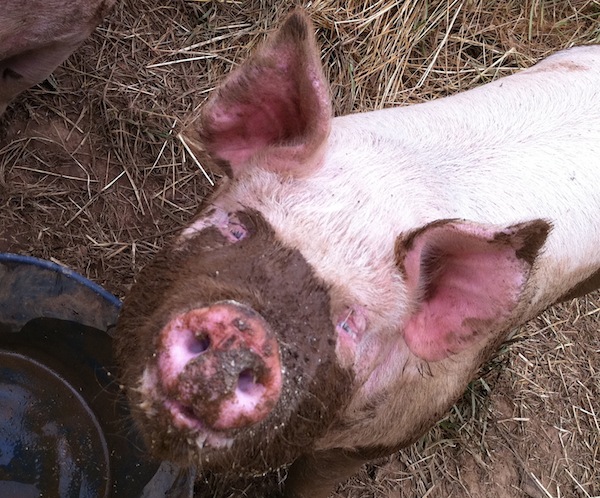
So far I've made two trips to the farm to visit Roger. On the first visit he and Don weighed in at around 100 pounds, about the size of a big dog (top photo). I'm always startled at how much like dogs they are as they run around and play with each other, obviously enjoying rolling in the dirt or grunting with pleasure as they scratch themselves against their mobile pig house, dubbed the "Winnapigo."

If this is slop, give me some, too!

They'll even play a piggy version of tag, ears pricked up at attention as you run behind their house, running around to "tag" you when you peek out, then dashing away to start again. On my second trip three weeks later they weighed around 200 pounds (above left and right). Clare turned on the hose and they ran under its arcing spray like kids playing in a sprinkler on a hot summer day.

My next visit is in a little more than a week, with slaughter scheduled for mid-September. And while I have no illusions about developing a deep relationship with Roger, I'm wondering if spending some time with him is going to change the experience of consumption in unexpected ways. Regardless, I'll be sure to let you know what happens in future installments.

Read the other posts in this series: Roger Grows Up, Saying Goodbye, The Day Finally Comes, The Meat of the Matter and Pasture to Plate.

Strawberry Fields Forever?


The information for this post came from articles by Lynne Terry in The Oregonian.

This weekend may be a test for area farmers who sell strawberries. That's because the berries from one area farm, Jaquith Strawberry Farm, were found to contain the bacteria E. coli 0157:H7, which has so far sickened 13 people and killed one.

All of the strawberries from the farm have been pulled off the market and farmers who purchased berries for resale to shore up their supplies have been notified. State health officials are asking anyone who thinks they may have purchased tainted berries to throw them out. That's because the bacteria, which at this point is thought to have come from the feces of deer, can live for some time in uncooked jam or even if frozen.

Unfortunately some area farmers' market vendors (link here) also resold the berries as their own, which is illegal, though some markets allow vendors to sell as much as 25 percent from another grower. Rebecca Landis, president of the Oregon Farmers' Markets Association, said, "The trend is toward saying no to resale." While tragic, this incident may prompt markets to forbid the practice altogether.

See the complete list of locations and vendors online, or download the list in pdf format.

Monday, August 08, 2011

Memorable Meals: Nostrana, Autentica, Tabla


The blurby nature of this grouping in no way reflects the quality of the meals at these three establishments; each was deserving of a full post on its own. Chalk it up to laziness on the writer's part.

I hadn't been to Nostrana for lunch for way too long, so when a friend that I hadn't seen for way too long wanted to meet on her lunch hour to catch up, it seemed like the perfect fit. It was a sunny, warm day and Nostrana had added a bevy of brightly colored umbrellas to the patio in front of the restaurant, as well as a bright canvas panel to block the breeze that seems to constantly flow up some invisible chute from the river. Most of the windows on the river side also slide open, so even if you're sitting inside it feels like you're dining al fresco, and diners are encouraged to adjust them to suit their tastes. And speaking of taste, there are few lunch menus in town as dependably awesome yet accessible as that found here. From salads to pizzas to the piatti lunch specials, there is almost no way you can go wrong. And splitting a salad, particularly their version of a Caesar made with radicchio or the albacore (left), and a pizza is not looked down upon. The wines by the glass, while terrific choices all, can almost double the cost of your lunch and I haven't had the courage to ask to split a glass, so I tend to stick to iced tea ($2.50).

Details: Nostrana, 1401 SE Morrison St. 503-234-2427.

* * *

A warm summer evening and meeting friends for dinner meant finding a restaurant that offered outdoor dining, wasn't too expensive and served killer drinks. Additional points were awarded for proximity to home. Fortunately, before we got to the spreadsheet stage (yes, it has happened…we're very nerdy around here), someone mentioned that Autentica has a charming patio (top photo), fabulous margaritas and wouldn't cost an arm and a leg. And, since again I hadn't been there in WTL (way too long), we made a date. We were ushered through the restaurant to a tiny back door that opened onto a spacious patio with plantings of tall cannas separating the long space into two "rooms." With the walls painted in bright, Mexican-inspired colors, we felt like we were back  in Mazatlan on the Plazuela Machado. The margaritas came almost instantly, and we dove into our guacamole, ceviche and queso fundido with handmade tortillas and chef Oswaldo Bibiano's signature trio of stunning chile salsas. Our entrées, including an enchilada platter, a filet of whole trout with a garlic epazote purée and a fall-apart tender carne asada with black-eyed peas (above right), were all crazy good, especially with a second round of those delicious margaritas. With that dinner in mind, I can't wait to try his new venture, Mextiza, scheduled to open on N Killingsworth later this summer.

Details: Autentica, 5507 NE 30th Ave. 503-287-7555.

* * *

When it's time to celebrate a major anniversary with a dinner out, we tend to go back to a favorite that never disappoints, is not outrageously priced and where we'll be treated like family. That's a pretty tall order and a very short list, and you'll not be surprised that, for us, Tabla on NE 28th is at the top of it. Not only is chef Anthony Cafiero a warm and funny guy who has a gas playing with his food, he gets that food from frequent trips to local farmers' markets. I know because I'm constantly running into him on whatever day of the week he needs to restock, loaded down with armloads of heavy bags and waving fronds. The night we went with my brother and his lovely bride, Anthony was offering his $28 three-course dinner with the likes of an appetizer of sous vide farm egg with ham, green beans garlic scapes and ricotta cream, a pasta course of Cavatelli with calamari, garlic and piquillo peppers with the Mar y Montaña (above left) entrée featuring Spanish octopus, pork chop, ajo blanco, cilantro and carrot foam. As I've mentioned before, Cafiero is still having huge fun making foams, infusions and smears without taking away from the real flavors of his market ingredients. And that's always worth coming back for.

Details: Tabla, 200 NE 28th Ave. 503-238-3777.

Sunday, August 07, 2011

Deep Blue


Couldn't resist these gorgeous hydrangeas. Thanks to my neighbors for allowing me to clip a few!

Pie-Ay-Uh, Pie-el-lah


You like potato and I like potahto,
You like tomato and I like tomahto;
Potato, potahto, tomato, tomahto,
Let's call the whole thing off!
- from "Let's Call the Whole Thing Off" by George and Ira Gershwin

Whenever I mention that I'm thinking about making paella, Dave immediately says "Puh-AY-zhuh." He's not correcting me, he's merely referring to an episode of Lynne Rossetto Kasper's "Splendid Table" where the sexy, lushly accented voice of Anya Von Bremzen discussed the art of making…well…puh-AY-zhuh, forever changing the way he thinks of that word.

Recently we had friends coming over for dinner. They're big fans of anything cooked over a fire and we were discussing what might be fun to make for them. All the major animal and piscean groups were covered and nothing was striking that special "gotta have it" chord. Then I mentioned paella, and the above-mentioned conversation ensued.

And for those who've never made it, whether on a stovetop or grill, the ingredient list may look long, but it comes together quickly and easily once the chopping and dicing is done. I just put everything in small bowls on a tray (the diced chicken and mussels wait in the fridge), have the stock in a pan on the stove, and I'm good to go when the fire's ready.

For drinks to kick off the warm summer evening Dave made the very refreshing Souracher from local bartender extraordinaire Dave Shenaut while the paella simmered. When the pan was ceremoniously paraded from grill to table, we opened a bottle of the richly colored, dry 2010 Reflection Pinot Noir Rosé from Portland's own Boedecker Cellars followed by a 2001 Luis Cañas Rioja from my brother's wine shop, Vino.

With a simply dressed salad of garden greens, no matter how you say it, I call that a successful evening.

Paella on the Grill

This is a recipe I've written about previously but have modified over the years. It calls for Spanish chorizo and mussels, but you should feel free to substitute your own favorite seafood…just don’t use Mexican chorizo, an entirely different kind of sausage. It also works well on the stovetop cooked in a paella pan or a large skillet.

1/8 tsp. saffron
1/2 c. dry white wine
3 Tbsp. olive oil
1 large yellow or white onion, chopped
4 cloves garlic, minced
1 red, yellow, or green bell pepper or combination, chopped
2 lbs. chicken thighs, chopped in 1-inch pieces
8 oz. Spanish chorizo, sliced into 1/8" slices
4 c. arborio or bomba rice2 Tbsp. smoked Spanish paprika (called pimenton)
1/2 c. green olives, cut into thirds (we use Spanish anchovy-stuffed olives)
1/2 lb. large frozen shrimp, thawed and tails removed

6-8 c. chicken or fish stock
Salt and pepper to taste
1 lb. mussels or steamer clams

Place saffron in small bowl. Pour wine on top and allow to infuse at least 10 minutes while prepping other ingredients.

Build fire in barbecue grill. Once coals are white hot, spread coals in a single layer and place paella pan on the grill about 4 inches above coals. Pour in olive oil and heat till shimmering, then add chopped onions, garlic and pepper and sauté till tender. Add chicken pieces and brown lightly, then add chorizo and sauté till warmed. Stir in smoked paprika. Add rice and stir for 2 minutes, then add saffron/wine mixture, and stock until it just covers the rice mixture. Top with shrimp and olives. Salt and pepper to taste.

Place grill cover on the barbecue and cook for approximately 20 minutes without stirring, checking occasionally to make sure rice doesn’t get too dry. Add more stock or water as needed, allowing brown crust (called socarrat in Spanish) to form on bottom and sides without burning. Before rice is completely done, add mussels or clams hinge-side down so they stand up in the pan and their juices run into the paella. Serve when shells open and meat inside is cooked, approximately 3 minutes.

Saturday, August 06, 2011

Farm Bulletin: Of Cabbages and Seed


I don't know about you, but I often find myself driving through rural areas past farms and fields, and unless it's some easily identifiable crop (like corn), or has a distinctive smell (like mint), I'm pretty clueless as to what the farmer is growing. In this bulletin, contributor Anthony Boutard of Ayers Creek Farm gives an idea of what we may be looking at.

Through the course of the year, we make several trips down the Willamette Valley to Sweet Creek Foods in Elmira. The trip takes us down the most beautiful part of the Willamette Valley. We have a choice of 99E or 99W, both slice through fertile farmland. Late last summer, we noticed a small cabbage field just south of Alder Swale outside of Amity. By the time we traveled down to make our preserves in late October, the cabbages had headed up nicely. Fifteen years ago, we might have assumed those cabbages would be shipped up to the Steinfeld's sauerkraut plant in Scappoose. However, in 2001, the company decamped to Illinois. The previous owners of our farm grew pickling cucumbers for the company, and one reason we own our farm now is the gradual withdrawal of Steinfeld's from Oregon in the late 1990s. 

Seed radishes interplanted with grass in Gaston.

At the end of March, we visited our friend Alice Doyle at Log House Plants in Cottage Grove. Alice has become the nation's leading expert on grafting tomatoes. As with other fruit crops, the grafter matches the tough, almost wild nature of a specially bred root stock, with a scion producing high quality fruit. New techniques have revived this old method of improving fruit grown as an annual, in particular, the development of a soft, silicone grafting clamp coupled with better characterized plants for root stock developed in the Netherlands and Israel. On the way back up 99W, we passed the cabbages and they were in full bloom. No cabbages had been harvested and field was carefully tended, indicating that the farmers were interested in something other than slaw or crocks of kraut.

Swathing cabbage stalks.

Passing the field in July, seed pods had formed and the plants were carefully staked to prevent the stalks from breaking. By now it was obvious that the field was planted as a seed crop. On Wednesday, another trip down the valley, and the stalks were cut and laid in rows, a process called swathing. This allows the seed to mature, cure and dry in the pod. Left on the plant, the pods would ripen, dry and shatter, spreading the seed in the field. Swathing makes the harvest of the seed manageable. Each plant produces about a half pound of seed. Our guess is that the seed crop is a valuable F1 hybrid. There are cabbages which do not produce viable pollen, called "male sterile" in the trade, and they are inter-planted with a pollen-producing variety. The resulting seed produced by the male sterile plants will be a controlled hybrid with carefully defined characteristics. The pollen bearing plants are removed from the field, leaving just those bearing the desired F1 hybrid seeds. The first male sterile cabbages were discovered in the 1940s. As with Alice's grafted tomatoes, carefully matching the characteristics of the pollen and seed bearing plants is important, and the heart of hybrid production.

Field of coriander in flower.

All through the southern Willamette Valley, there are seed house offices. The seed houses, headquartered in the Netherlands, Denmark, Canada and elsewhere, contract with growers to grow the crop. If you open a seed catalogue and order beet, spinach, chard, coriander, radish, or cabbage seed, chances are the seeds originated in the Willamette Valley. In particular, the valley is well suited to growing winter annuals. Just down the road from us, a farmer is growing a large field of French Breakfast radish seed (top photo). The pretty little cylindrical radishes are now in full flower. The field is growing two crops at once. Radish and grass seed were planted together, and when the radish seed is harvested the grass will continue to grow and produce a seed crop next year. Just south of Halsey, there are several large fields of coriander in full bloom, with the characteristic fragrance of cilantro, as it is also known.

Spinach raised for seed.

Radishes, cabbages and other members of the Brassica family, along with coriander, are insect pollinated. Spinach, chard and beets are wind pollinated, and are naturally dioecious, with pollen and seed borne on separate plants. If you pass a field with a distinct alternating pattern of a two or three rows of smaller plants, and ten to 15 rows of larger plants, it is probably one of these three crops. The larger plants produce the seed. This year, there are a lot of spinach seed fields planted in the valley. Hybrid seed corn, also wind pollinated, is planted with a similar alternating pattern. The plants destined to produce seed are detasseled. 

To keep the various varieties true to type, seed producers must isolate their fields from similar crops. The distance varies by crop and pollination method. To sort it all out, the normally secretive seed companies use a pinning map posted on the neutral ground of the local extension office. Seed production is a challenging and exacting form of industry. We produce a substantial amount of our own seed on the farm, and we will stress again that the reason is quality and variety choice, not economics. Buying seed is cheaper and easier, and we are grateful for the good seed breeders out there.

Photos by Anthony Boutard.

Wednesday, August 03, 2011

Getting Noticed


It was an odd day. First I get an e-mail from the Oregonian asking me if I'd be interested in participating in their online News Network program. Then a shopping website for young fashionistas decides to feature GoodStuffNW in their monthly Best of the Web roundup. And, last but not least, the publisher of a site for alt-DIY types, Punk Domestics, wants to repost my write-up about making nocino. As Gomer Pyle would have said, "Goooooooooolly!"

Monday, August 01, 2011

You Won't Miss the Meat


Summer grilling isn't all about searing big hunks of animal flesh, and contributor Jim Dixon of RealGoodFood whets my appetite for the tsunami of summer vegetables that are ready to flood local gardens and markets.

Even thought what we longingly call summer seems to be slipping by quickly, the last few days have been beautiful, and the warm weather leads to sitting outside in the evening for hours. I made dinner for old friends tonight, and this dish, improvised from the vegetables I’d planned to be a sort of ratatouille, was just right.

Summer Ratatouille with Grilled Vegetables, Tomatoes & Capers
 

Let me first repeat what’s become my rule for grilling vegetables: do not use any oil before grilling. I’ve yet to find plant material destined for a hot fire that needs it, and the oil just burns. Leave the vegetables dry.

Slice an eggplant into rounds, summer squash into long halves, a couple of bell peppers (any color, but red or yellow are best) into quarters, and a couple of leeks in half lengthwise. Grill them over hot coals, turning as often as necessary to get nice and brown. Remove to a platter when done, then cut into smaller chunks (quarter the eggplants, etc., just to make serving easier; or not). Top with a few good tomatoes, cut into pieces about the same size as the grilled vegetables.

Pour on a quarter cup or so of Katz Late Harvest Zinfandel or one of the other amazing Katz Orleans method vinegars, drizzle generously with your best extra virgin olive oil, sprinkle with flor de sal and toss on a couple of tablespoons of salt-packed capers, rinsed and soaked in cold water for 15 minutes. If you’ve got some fresh oregano or other herbs in your garden, sprinkle some over the top. Best, I think, at room temperature.

Growing Food, Building Community


Growing up in a largely rural state like Oregon, you'd think people would be all been there, done that about where our food comes from. I was lucky growing up with relatives who were cattle ranchers and allowed their crazy-about-horses city girl niece to go on cattle drives and hang out at the ranch during vacations. At least it gave me some idea of the work involved in producing the food that appeared on our family table.

Students on a farm tour at Zenger Farm.

But here in DIY Portland there are kids (and many adults) who couldn't tell you what a brussels sprout plant looks like, or point to the part of a live chicken that hides the drumstick. It's not a stretch to say that the closest a lot of city folk get to actual farm animals is a petting zoo at the pumpkin patch.

The wetland at Zenger Farm.

Fortunately we have a place like Zenger Farm, a unique partnership between the City of Portland and a non-profit organization that encompasses a six-acre working organic farm and a 16-acre wetland inside the city limits. Originally owned in the 19th century by Jacob Johnson, a sawmill operator and Johnson Creek's namesake, a portion of the original 320-acre property was bought by Ulrich Zenger, a dairy farmer and proprietor of Mount Scott Dairy. His son, Ulrich Zenger, Jr., sold the land to the City of Portland in order to protect it from commercial development and preserve the Johnson Creek Basin and Watershed.

Greenhouse at Zenger Farm.

Currently it's a working urban farm with a CSA, and sells its produce at area farmers' markets as well as to local restaurants. It also coordinates matching money for food stamp recipients to be able to buy, cook and eat local foods and is piloting an innovative SNAP (food stamp) CSA model program. Recently Zenger added Furey Field, a 5-acre community garden space adjacent to the farm that will become 1,000 new garden plots for low-income households in the surrounding Lents and Powellhurst-Gilbert neighborhoods.

As if all that weren't enough, it also holds public workshops and summer camps to teach young people and adults that healthy food comes from healthy soil, which can be anywhere—even in the city. And all of the money raised by all of these activities goes right back into programming, making it a truly worthy endeavor.

To celebrate all this work, and just because its a great time of year to be outside on the farm, Zenger is holding two Farmhouse Suppers on August 13 and 14 at the farm. Intimate, with only 20 people each evening and dinner provided by the estimable Mark Doxtader of Tastebud and wines made by Ben Thomas of Montinore Estate Winery, it should be a summer night to remember.

Come if you can and, if you can't, be sure to plan a visit to Zenger Farm for a tour of the amazing work they're doing on our behalf. It'll make you even more proud of your city!

Details: Farmhouse Suppers at Zenger Farm. Aug. 13 and 14, 5:30 pm; tickets $100, reservations required. Zenger Farm, 11741 SE Foster Rd. 503-282-4245.