Showing posts with label winter squash. Show all posts

Tuesday, January 23, 2018

In Season: Eating Well in Winter


Despite what you think, true winter in the Pacific Northwest, at least as far as most of the country is concerned, is a fleeting thing. Yes, we may have a few freezes and snowstorms, but not like New England where snowplows—what are those, you might ask?—pile up banks of the stuff that last well into spring. And thank goodness we don't have the hurricanes, tornadoes and extreme flooding that many areas experience on a regular basis.

My six-foot-tall mother-in-law next to a snowbank in northern Maine.

Of course, with the unknowns brought on by climate change (and our denial of it), all of that could change in the future.

But this year, at least according to produce guy and self-described Fruit Monkey, Josh Alsberg of Rubinette Produce, we can look forward to spring things like nettles, wild mushrooms and fiddleheads, plus herbs like sorrel and chervil, to start appearing as early as March, a mere eight weeks away.

Until then? "Roots and citrus!" says Alsberg.

Beets, yes, but don't waste those greens!

By which he means colorful varieties of beets—red, gold and stripey Chioggia—as well as the knobby Gilfeather turnip, a half-rutabaga, half-turnip hybrid that is a favorite of local chefs, tracing its lineage to Gilfeather Farm in Wardsboro, Vermont. Rutabagas, turnips, celery root and storage potatoes will also be appearing on farmers' market tables over the next few weeks, as will onions, kohlrabi and locally grown white and purple daikon. Winter radishes will also be available, like the watermelon radishes from Black Locust Farm and black radishes from several farms, including Sauvie Island Organics.

There are plenty of seasonal greens available, too. Think mustard greens, cabbages, beet greens, kale, collards, local chicories and gorgeous, deep red heads of radicchio. Gathering Together Farm and Groundwork Organics are growing Kalettes, purple-green, rapini-like florets that are a hybrid of kale and brussels sprouts, with a flavor that shines when roasted or stir-fried.

On the citrus front, I have big bowls of tangerines and Meyer lemons sitting on my counter right now, as fragrant as any store-bought potpourri or essential oils (and not as toxic to pets) and they're edible, to boot! The Meyer lemons will be used for my yearly batch of preserved lemons, to be parceled out in savory dishes, relishes and salads over the next few months, and if I can manage to spare a few, maybe some lemon sorbet.

Alsberg is in hog heaven right now, gleeful at the prospect of citrus season. Several varieties of mandarin oranges and tangerines are beginning to appear, varieties like Shasta Gold, Murcott, Pixies and the teensy Kishu, with blood oranges, navel oranges and Cara Cara navel oranges rolling in now. He's also starting to see a rainbow of grapefruit on distributors' lists, and said that word on the street is that the white grapefruit called Mellow Gold is super juicy and sweeter than most. Pomegranates and kumquats have been in stores since Christmas, and we should be seeing local kiwis making an appearance soon.

Kabocha squash is a personal fave.

Winter squash is starting to clear out of his lists, but he said local growers should have plenty of kabocha, Kuri, butternut and acorn squash through mid-February. After that, though, he warns that the squash you see in stores will be from Mexico. "Enjoy them now" is his mantra. Look for recipes in my Squash Chronicles series.

Rubinette Produce is a vendor inside Providore Fine Foods, an advertiser on this blog. Josh gives his advice quarterly on what's coming in from local farms and what we can expect to see on store shelves.

Tuesday, November 01, 2016

Grate Your Winter Squash!


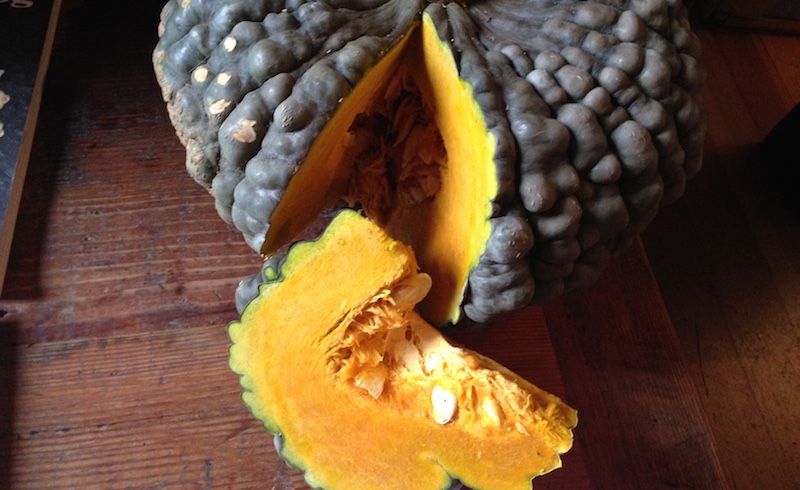
Being a winter squash fan myself, I can't get enough of these thick-skinned beauties when they begin appearing in the farmers' markets. The ubiquitous Hubbard and acorn squashes are okay, I guess, but I like to wait for the giant Sibley to turn from blue to peach as it cures, or admire the sculptural bronze beauty of a Musquée de Provence. Even a warty Marina di Chioggia, with its bumpy blue-green skin, makes a stunning centerpiece until its time to serve it. This week Jim Dixon of Real Good Food gives some suggestions for doing just that.

Grating winter squash is such a good way to take advantage of the abundance of squashes available in stores and at the farmers' markets right now. While smaller, thin-skinned squash like Delicatas can be cleaned, sliced and cooked without peeling, the bigger, pumpkin-y squashes require a bit more processing. These Cucurbita maxima (usually, but not always, the big ones; Delicatas and similar are C. pepo) need to be split with a big knife, cleaned of the seeds (save for roasting) and cut into manageable pieces. Even a smallish, three-to-four-pound squash gives you enough for a couple of meals.

So after you roast a few slices and make something like winter squash caponata, you'll probably have raw squash left over. Time to grate. While you can use a box grater, a food processor works much better. Besides being fast, the grating disk gives nice, uniform shreds. Try cooking a handful in hot olive oil until they get a little brown and eating with just good salt. I use it raw to make a celery root and squash remoulade; mixed with potatoes (or by itself), grated winter squash makes a great latke. And there's always fritters. You can freeze the grated raw squash, too.

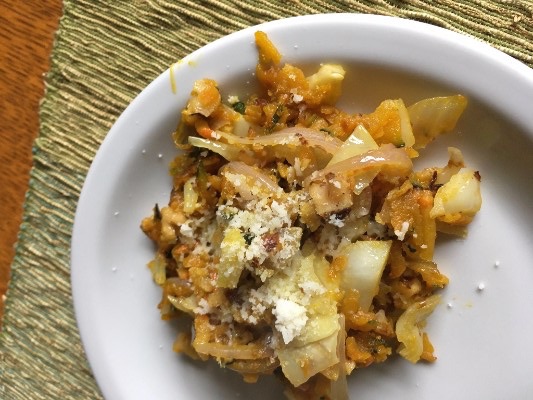
Winter Squash and Cabbage with Walnuts

I've made this using cubes of winter squash (cut about 1/2 inch, cook in oil until brown and slightly tender), but I like it better like this. To get started toast a handful of walnuts, chop coarsely, and set aside.

Cook a couple of cups of grated winter squash and a good pinch of salt in fairly hot olive oil until it starts to brown. Add a sliced red onion and a couple cloves of chopped garlic, cook until it softens, then add about a quarter head of chopped green cabbage. Sage and squash are a classic combination, so add 6-8 fresh sage leaves that you've chopped. When the vegetables are tender, remove the pan from the heat and stir in a tablespoon or two of Katz Trio red wine vinegar, the walnuts, and about 3 tablespoons of grated Parmigiano Reggiano. Grind some black pepper over it, too.

You can eat this as a vegetable side or toss it with some shaped pasta.

Sunday, December 11, 2011

A is for Aceto Balsamico


For those of us who wonder why in the world anyone would pay what seems like an outrageous price for some fancy Italian balsamic vinegar when there are plenty of cheaper options available on store shelves, contributor Jim Dixon of RealGoodFood provides an explanation proving, once again, that you get what you pay for.

Among the many amazing things we did during our month in Italy was meeting Laura and Deeana, the two women who operate Profumi Estensi, my balsamic vinegar supplier (and a special thanks Leslie and Manual from Viridian for the connecting us). While we’d emailed for a few years, this was our first face-to-face, and both Judith and I felt it was a high point of the trip.

Not only did we really, really like Laura and Deanna (and their families, who fed us and showed us Modena), but we came away with a much better understanding of the amount of hard work, deep-seated knowledge, and just plain magic that goes into aceto balsamico.

Most of what’s sold as balsamic vinegar is just red wine vinegar sweetened with caramelized sugar and has no relation to the real stuff. But it’s cheap to make and generates nice profit margins for manufacturers willing to capitalize on gullible shoppers.

Real balsamic vinegar begins with the freshly pressed juice of Trebbiano grapes. The juice or must is cooked down to about 30% of its original volume, then it begins the slow fermentation process in a set of barrels made from different woods called a batteria (photos, top and left). Each year, if the vinegar maker thinks it’s good enough, some of the vinegar from the last barrel in the batteria is removed. That barrel is topped up from the next oldest, and the process moves up the line with some of the newly reduced must going into the first barrel. A batteria may only yield a few liters of vinegar every year.

Profumi Estensi works with vinegar makers who produce balsamico on a very small scale, primarily for their family and friends. They’re willing to sell a little to offset their costs, which can reach hundreds of euros every year. We visited one and climbed the steep ladder up into the attic to see the acetaia (ah-che-taya or vinegar works). Hunched under the low ceiling, Judith and I followed Sergio as he flipped back the cloth squares covering the evaporation holes on the tops of the barrels, dipping spoons into the thick balsamico.

Only a handful of people ever get to see a family acetaia, and we felt incredibly privileged. Sergio inherited some of his barrels from his father, and he grew up learning how to mix vinegar from the different barrels in the batteria to get the complex flavor of true aceto balsamico. Watching him move among the barrels and seeing his eyes light up as he talked about the vinegar, we both wondered how he could bear to part with a single drop.

Roasted Zucca with Balsamico

Laura and Deeana served us this in Modena. The simple squash highlights the balsamico, and the vinegar transforms the humble vegetable. Use one of the larger, pumpkin-like winter squash; they’re a bit dryer than butternut, delicata, or acorn.

Cut the squash into slices about one inch thick; leave the peel attached. Arrange on a sheet pan that’s been drizzled with a bit of extra virgin olive oil, sprinkle with a bit of flor de sal, and roast at 350° for about 30 minutes or until the squash is tender.

Let each diner dribble a few drops of balsamic on their plate. Gently daub each bite of squash in the vinegar and eat. Or if you’re feeling flush, drizzle each slice with balsamic before serving.

All photos by Jim Dixon from his travelogue, Italia Redux.

Sunday, October 16, 2011

Enlightenment in a Squash


People are so self-involved. They think that ball games in faraway cities are won or lost by whether they put on their team hat back-to-front or front-to-back. Or if they wear their great-aunt Neddra's cameo necklace to their next internet date they'll be more likely to find their ideal mate. Or, like me (Self-involved? A blogger?), all I had to do was admit, at long last and after much kicking and screaming, that it's fall-going-on-winter. Then the sun could come out and we could have a few precious days of sunshine.

The come-to-Jesus, can't-deny-it-any-longer moment came when I was at my local grocery store and saw a pumpkin display out front. (It may also have been helped along by the jeans, boots and two layers of coats I was wearing.) Most of the squash were the large orange orbs that beg to be carved into humorous lanterns…I particularly like the ones that looks like they're throwing up seeds and pumpkin guts…but there was one flattened, bronze beauty that called my name, a Musquee de Provence weighing around ten pounds or so.

It was begging to be baked and made into fall's perfect meal, a squash soup. And that's what I told the woman ahead of me at the checkstand when I heaved it onto the conveyor belt and she asked what I was planning on doing with it. Once home, I scooped out the pulp (after making my son look at "the vomiting pumpkin!" and getting an eyeroll for my trouble), chopped it into wedges and baked it.

I'd made a Thai-inflected coconut squash soup before, so something more savory seemed in order this time. Earlier I'd noticed my neighbor's sage plant looked like it wouldn't miss a few leaves, so those went into the pot along with an onion, some garlic and chicken stock. There were some piquillo peppers sitting in the fridge that would make a nice drizzle on the top, so while the soup cooked I made a little sauce with those.

Ladled into bowls with some of Dave's bread, these made a perfect fall dinner. And you know what? Make of it what you will, but the next day the sun came out.

Luscious Squash Soup with Roasted Piquillo Pepper Purée

For the soup:
8 c. baked winter squash (see recipe, below)
2 Tbsp. olive oil
1 onion, chopped
3 cloves garlic, shopped
A dozen fresh sage leaves
4 c. chicken stock
Salt and pepper to taste

For the pepper purée:
1 c. roasted piquillo peppers (or other roasted red pepper)
1 Tbsp. olive oil (or the oil from the jar of piquillo peppers)
2 cloves garlic
1/4 tsp. red pepper flakes or 1small dried red pepper
Salt to taste

Preheat oven to 400°. For a large squash or pumpkin, halve the squash and scoop out the seeds and pulp. Slice into wedges and place on aluminum foil on large baking sheet. Bake for approx. 1 hr. or until a fork can easily penetrate the flesh. Separate the flesh from the skin and place in bowl. Set aside.

Heat oil in large soup pot on stove. Sauté onion and garlic till translucent. Add 8 sage leaves, then the squash and stock. Stir to combine, then, using immersion blender (or working in batches with processor or blender), blend until smooth. Bring just to a boil, reduce heat to maintain a simmer and cook for 30 minutes or more. If desired, briefly fry extra sage leaves in hot oil for garnish.

For the pepper sauce, place all ingredients in blender and blend until smooth. Drizzle over soup and serve more alongside.

Saturday, January 15, 2011

Pancakes 101


Good cooks become good cooks over time, developing recipes through trial and error, experimenting with ingredients and methods until they finally find the mix that works for them. Contributor Jim Dixon of Real Good Food has done just that with pancakes, and this week he shares two of his favorite recipes with us.

My pancake touchstone is the recipe in my 1943 Joy of Cooking. A couple of eggs, milk, salt and flour, the batter leavened with double acting baking powder. When our boys were young I made it with buttermilk, Nancy’s yogurt and a blend of white and whole wheat flour. We ate them with jam and yogurt mostly, sometimes fake maple syrup. My approach has evolved a bit over the past couple of decades.

Pancakes

For basic pancakes you need three mixing bowls. In one combine about a cup and half of whole wheat flour (or mixture of unbleached white, white whole wheat, etc.) with a teaspoon each of baking powder and salt. Blend well.

Use the other two bowls to separate two eggs. In the bowl with the yolks, blend in about a cup of buttermilk (or milk and yogurt mixed, or just milk). Set the whites aside for a minute.

Make a depression in the flour mix in the dry bowl, pour in the milk blend, and mix gently until combined. It should be fairly thick, but not that it won’t pour, so add a little more milk if necessary, but don’t mix any more than you need to.

Use a manual eggbeater to beat the whites to soft peaks, then gently fold them in to the batter.

Your griddle or skillet should be heated already (low heat, preferably cast iron). Drop spoonfuls of batter onto the griddle; keep them small and the cakes will be easier to manage. Don’t crowd them, either.

Ignore them for about 3-4 minutes, then look to see if the edges are drying out and small bubbles are forming on the top. When the bubbles on top begin to open, gently slide a thin metal spatula under the edge of the first cake. Lift it a bit to make sure it’s brown, then loosen the edges before flipping it over. Flip the rest, cook for another 3-4 minutes, then remove to a warm plate for eating.

After I started getting the incredible corn meal produced by Carol and Anthony Boutard at their Ayers Creek Farm, I made corn cakes by substituting the corn for some of the flour. These are also delicious, especially with the addition of some chopped cooked bacon, or, even better, candied bacon.

But after making some fritters from cooked winter squash and polenta, and liking how the squash blended with the corn, I thought the same combination might work with pancakes. It does.

Winter Squash Corncakes with Bacon

In one bowl, combine the dry ingredients: 1 cup good cornmeal (Ayers Creek, Anson Mills or similar whole grain ground corn), 1/2 cup whole wheat flour, 1 teaspoon each baking soda and salt. Add about a half cup of chopped, cooked bacon.

Separate two eggs. To the yolks, add a cup of cooked winter squash, and a cup of milk (or buttermilk or yogurt or a mix). Blend well, then combine with the dry ingredients. Add more milk if the batter is too thick to pour. Beat the whites to soft peaks and fold in.

Cook as described above. I like to eat these with maple syrup and creme fraiche.

Top photo: For a great topper, check out this recipe for Braised Apples, Maple Syrup and Bourbon.

Monday, December 01, 2008

In Season: Souping It Up


First, a confession. I can only handle about half an hour in a mall before my eyes glaze over and I start drooling and babbling incoherently. In fact, it's so bad that my friends are trained to guide me to the exit at the first signs of VOS (visual overstimulation).

So when I went to the farmers' market a couple of weeks ago, as usual, my brain started whirling with possibilities. A chiffonade of lacinato kale salad with salt and lemon. Apple crisp with eau de vie-soaked currants. A medley of roasted root vegetables served alongside roasted chicken.

But it was the stunning color of the Musquée de Provence squash (top photo) that pushed me over the edge and into a full-blown attack. With a burnished copper skin and its flesh a deep orange-red, this squash was going to find its best and highest use as a main course for dinner that night (left), though its fabulous color would also make a gorgeous side dish chunked and drizzled with sage butter.

See what I mean about the VOS? Fortunately, all it took in this case was the application of a fresh berry tart from the stand across the aisle and I was on my merry way.

Roasted Squash Soup with Lime Creme Fraiche
Adapted from From the Earth to the Table: John Ash's Wine Country Cuisine

For the soup:
3 Tbsp. unsalted butter or margarine
3 c. yellow onions, chopped
1 Tbsp. minced ginger
3 c. squash, roasted
6 c. chicken or vegetable stock
1 Tbsp. Madras curry
1 Tbsp. honey
1 c. half-and-half or heavy cream (I substituted 1 c. tofu sour cream)
3 Tbsp. dry sherry
Salt and pepper to taste

For the creme fraiche:
1 c. creme fraiche (or tofu sour cream)
2 tsp. lime zest, finely grated
1 Tbsp. lime juice
Salt and pepper to taste

In a large sauté pan, melt the butter and sauté the onions and ginger until very soft but not brown. If using a food processor, transfer the onion-ginger mixture and the roasted squash to the processor and process till smooth, in batches if necessary, then add remaining soup ingredients. If using an immersion blender, stir together the onions, squash and remaining soup ingredients and blend until smooth. Bring to a simmer and cook for 10-15 minutes, stirring occasionally. Season to taste with salt and pepper.

To make the creme fraiche, in a medium bowl mix the creme fraiche, lime zest and lime juice. Season to taste with salt and pepper. Refrigerate for at least 1 hour for flavors to develop.

Ladle the soup into warm soup bowls. Garnish with a drizzle of the lime creme fraiche.

Photo of Musquee de Provence squash from I Love Farms.