Showing posts with label tomatillo. Show all posts

Saturday, July 08, 2017

Camp Stories: A Prescription for Peace of Mind


Feeling overwhelmed at work? The insanity of current politics stressing you out? Can't handle the barrage of social media a minute longer?

The Rx I'm recommending won't be found in a pill or a bottle, or by turning off the lights and pulling the covers over your head. I'm not even advising you to shut down your computer and turn off your devices.

Simply go where none of those screens will work, where your coworkers can't find you, where there's no news but the sun transiting your campsite, the trees shifting in the breeze and the sound of a creek chattering in the background.

For years we've been avoiding the war zone that erupts in the city over the Fourth of July by heading to a small national forest campground where fireworks and nighttime noise are strictly verboten, where our dogs don't need to be drugged and we can sleep in the dead quiet of a night so dark you can't see your hand waving in front of your face. But the real benefit, one we appreciated even more in this seemingly daily onslaught of "can you top this" craziness on the national political scene, is the peace, the quiet, the lack of demand for our attention other than cooking meals, washing dishes and the occasional call to sit by the creek and read a book.

Imagine that!

This year we managed to reserve a prime creek-side campsite at one of our favorite campgrounds, the aptly named Paradise Creek in the Gifford Pinchot National Forest just north of Carson, Washington. Small at just 42 sites and basic—vault toilets, dirt sites and a handled pump for water—it discourages large RVs and provides a modicum of simple activities like biking around the campground, playing in the creek and a few hikes nearby.

I'd made and frozen a batch of my Coney Island sauce and picked up some smoked dogs from Old Salt Marketplace, and then froze a pot of pork shoulder braised in tomatillo salsa—freezing as much as possible helps keep things cold as well as saves room in the ice chest—that we could warm up for dinners. A couple of steaks, Dave's scone mix to stir up and bake, breakfast and lunch fixin's and cocktail makings and we were set for our four-night stay.

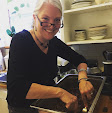
Our neighbors Chad and Ann joined us for the second day, bringing their dogs and what turned out to be a spectacular camp dinner of shrimp, andouille sausage, corn and potatoes cooked in foil packets on the campfire coals (left and top photo). This is one I'll be making again here at home, since it's perfect for cooking on charcoal in the Weber. With a salad on the side and an ice-cold glass of rosé to sip, it's the definition of summer.

Good food, good drink, good friends, the basic necessities of life and a beautiful setting; it's a prescription for a good, stress-free life. I can't recommend it highly enough.

Shrimp, Andouille Sausage and Corn Campfire Packets
Adapted from Creme de la Crumb

1 lb. potatoes, cut into 1" cubes
2 ears sweet corn
1/2 lb. andouille sausage, sliced into 1/4" rounds
1 1/2 lbs. shrimp
1 Tbsp. minced garlic
3 Tbsp. olive oil
3 Tbsp. Old Bay seasoning (or make your own)
1 Tbsp. salt
Lemon wedges

Bring a medium saucepan of water to boil. Add potatoes and parboil 5 minutes. Drain.

Shuck the ears of corn and slice each one crosswise into four rounds. Stand each round on end and slice in half lengthwise. In large mixing bowl combine potatoes, corn, sausage and shrimp with garlic, olive oil, paprika, Old Bay seasoning and salt.

Cut four 12" squares (or so) of aluminum foil. Divide the shrimp mixture into quarters, putting each on a piece of foil (you can redistribute the number of ingredients in each packet to even them out). Seal the packets and place on coals. Cook for 10 minutes, turn them over and cook another 5-6 minutes. Take one packet out and test for doneness. Serve one packet per person with lemon wedges for squeezing over the top.

Find more great campground and recipe suggestions in the Camp Stories series.

Friday, September 09, 2016

Farm Bulletin: A Cur From The Pound


I have learned from contributor Anthony Boutard of Ayers Creek Farm that farming is much more than just planting seeds in the ground, harvesting the crops and selling the results in the market (read any of his Farm Bulletins collected here over the years). Here he discusses a crop that appeared accidentally but has become a staple of the farm.

Konrad Lorenz, the founder of ethology (the study of behavioral patterns), recommended bringing home a cur from the pound rather than seeking out a pedigreed dog. He noted that mixed breeds have more genetic rigor, and have more interesting characters, than so-called pure breeds. Several years ago, staff's tomatillos escaped their garden and wound up in our cornfields and pretty much everywhere else. Tomatillos are obligate out-crossers; they typically don't self-pollinate. Freed from genetic bondage, any well-defined varieties soon become a chaotic mix. Tomatillos never interested us until we tasted staff's sauces; they were simply more flavorful, with lots of character and a sweet touch.

Tomatillo flower.

Mirroring Lorenz's observation about dogs, Zenón and Abel noted that topsy-turvey genetics of the cornfield tomatillos made their sauces more flavorful than uniformly big green, unripe fruits found at the supermarket, which they treat with distain. As you look at the tomatillos we grow, it is not unlike looking at the mix of dogs in a pound. There are tiny fruit, big fruit, yellow fruit, green fruit, purple fruit, pale white fruit. Some fruit remain demurely enveloped in their husks, while the gibbous fruit have split their shirts open, some of the plants reach almost four feet high while others sprawl barely three inches above the soil. It is a feral mix, and we keep it that way with staff's help.

Desiccated tomatillo husk with seeds.

But flavor is more than simple diversity, they told us, the tomatillo must be harvested when it is ripe and sweet, not immature like a cucumber. The tomatillo must fall off the plant. The ripe fruits are stored on the kitchen counter within their dry husk and never, ever refrigerated. We use a mesh colander which allows for air movement around the fruits. Stored this way, ripe fruit lasts into March or longer. In early August, Zenón brought us a tomatillo harvested last September that had escaped his attention, and it was still good. We will add seeds from that fruit to next year's planting, another genetic bauble to consider and admire.

As we noted in describing our work with the Astiana tomato, every crop needs its own design brief, a list of specifications so the crop does what is desired and remains profitable to grow. For some crops we are veritable genetic martinets, making sure they remain on straight and narrow path with military precision. For dry beans and soy, as well as squash, seed pumpkins and popcorn, this sort of strict attention is essential, any lapse in discipline and we would be out of the business. On the tomatoes and flint corn, our brief is a bit more relaxed, tolerating or even selecting for a smattering more of diversity. We like to have orange ears in the corn because they are pretty and create no commercial liability. Likewise those peculiar horns and creases on the tomatoes are tolerated because they are funny and have no effect on flavor. Then there are the cornfield tomatillos and migration barley where a beautiful anarchy takes shape and we stand on the edges of the genetic scrum as referees. We are simply making sure no deleterious traits get out of hand and some of the best traits defining the population's character are not lost in the scrum, the drunken walk of evolution.

Saturday, September 06, 2014

Farm Bulletin: The Tomatillo, Examined


Walking by a display of vegetables in the farmers' market, most of us glance at the bin, the price and our shopping lists, perhaps sneaking in a squeeze or poke, and move on. Contributor Anthony Boutard of Ayers Creek Farm begs us to pause and appreciate the unique story that each one has to tell.

"Ecce Edwardus Ursus scalis nunc tump-tump-tump occipite gradus pulsante post Christophorum Robinum descendens."

And so begins the story of Winnie-the-Pooh in the tongue of Virgil and Ovid, as translated by Alexander Lenard (E.P. Dutton 1960) in his Winnie Ille Pu. As hard as it is to imagine anything but a living, vital language telling the tale of a stuffed bear, the faithful were challenged when Vatican II recommended delivering the Mass in the vernacular instead of Latin just five years after its publication. With Latin on the verge of dying, solace was found in the fact that new plant species were still described in Latin. That final bastion of life for the ancient language is now under siege, with some taxonomists proposing the use of English for botanical descriptions. 

Tomatillo flower.

The language of the Mass must deal with love and hate, suffering and bliss, betrayal and redemption. Consequently its Latin is heavily salted with words derived from Greek, a language that handles those subjects well. Latin is the language of laws and strategy. In that respect, it is a fine language for the sciences. Botanical Latin is descriptive and of the present tense. Little need to worry about verbs anyway as the specimen is dry and taped to a herbarium sheet. Nonetheless, the naming of organisms can get a bit litigious. In a form of scientific primogeniture, the person who first publishes an account correctly describing and naming a plant prevails, no matter how wonderful, familiar, pertinent or worthy subsequent names are. So there is a breed of scientists who make it their life's work to shake up the existing order. 

Jean-Baptiste Pierre Antoine de Monet, Chevalier de Lamarck.

Such is the case of the tomatillo. The great French scientist, Jean-Baptiste Pierre Antoine de Monet, Chevalier de Lamarck published a description of the plant, naming it Physalis pennsylvanica. His Portuguese contemporary, Félix de Avelar Brotero, gave it the name Physalis ixocarpa at approximately the same time. Both names have been used over time, but Brotero was a nose too late in the opinion of the modern publications department. So this lovely fruit, essential to Central American cooking and largely ignored in the Northeastern United States, is named after a state where it has no substantive connection. With such a fancy name, you would think the Chevalier would have been a bit more creative. An essential part of Mexican cooking is stuck with the name of the cheesesteak's home. 

The developing fruit.

Brotero's epithet, ixocarpa, on the other hand, is an intriguing fusion of Greek and Latin. Most cookbook authors and gardeners dully repeat that it means "sticky fruit" without further inquiry. In Latin, carpa means fruit, that's true. The ixo is a bit more of a puzzle. In neither Latin nor Greek does it correspond to the word "sticky." In fact, the letter x is not a Roman letter per se; it is a number. In our alphabet, it can represent one of two Greek letters, xi or chi. Brotero's x works both ways. 

Using the Greek character xi, it is the prefix to a complex of words referring to birdlime. This sticky substance was rendered from the bark of holly or the berries of mistletoe and smeared on the branch of trees where birds roosted. They were then captured by the likes of Mozart's bird catcher, Papageno, and sold for food or ornament. The name comes obliquely to sticky, but arrives well.

The desiccated husk forms a basket to hold the seeds.

If we treat it as the character chi instead, the word is a prefix to a complex of words referring to fish, notably dried fish skin, or a basket for carrying fish or trapping fish. The husk is certainly reminiscent of dried fish skin, and when the soft tissue of the husk and fruit rot away, leaving just the vascular tissue, it forms a basket containing the seeds that look just like so many fish in a carrying basket or fish trap. The wind blows these little baskets around the farm and, as they roll about, the seeds drop out bit by bit.

The husk develops from the base of the sepals. When the flower is pollinated, the yellow petals fall off and a special growth tissue, or meristem, at the base of the sepals starts to grow. It keeps pace with the developing fruit inside until just before ripening. The ripe fruit tears through the husk, at which point it is ripe. Zenón refers to it as taking its shirt off, and that is when they are best harvested. If they fall to the ground, they are deemed ripe as well. As he puts it, the fruit is essentially sharp-flavored, but it should have a distinct sweetness alongside the acidity. 

The dried husks distribute seeds.

Having tried the Brand X tomatillos and being fundamentally New Englanders, we were leery of the fruit initially. With staff's expert guidance, we now feel comfortable with tomatillos. For sauces, we use tomatillos both raw and cooked. They are a basic ingredient in a pozole verde, and we roast them with other vegetables. Staff have a strong preference for the purple types which are more flavorful. That's helped assuage our leeriness as well. They also taught us to keep the fruits in a dry place, where they will last in good shape until March. In fact, purple fruits that last until March are the two primary selection criteria for seed production. 

Both born in 1744, Lamarck and Brotero contributed a great deal to science. Lamarck is worth a special note because he was one of the earliest scientists to question the immutability of species, and suggest that organisms could change over time, a process later called evolution. His proposed mechanism was mocked and ultimately dismissed in favor of Darwin's theory of natural selection. As we understand the evolutionary process better, Lamarck's ideas have gained greater respect. Nonetheless, he will still have the albatross of naming a great Mexican fruit after the American cheesesteak capitol hanging around his neck.

Photos by Anthony Boutard.

Tuesday, June 09, 2009

Truly Verde Enchiladas


Apologies to Al Gore, but reducing your carbon footprint is so last year. Anyone who's been even vaguely listening in the last few months is hearing the growing chorus of voices from the likes of Michael Pollan, Barbara Kingsolver and, most recently, New York Times columnist Mark Bittman about bringing green to the table. And they're not just talking parsley.

The chicken mixture with extra roasted tomatillos (at top in photo) for a future batch!

Even Monsanto is trying to (falsely) jump on the bandwagon with a new tagline that trumpets the giant agrichemical, GMO-promoting corporation as "committed to sustainable agriculture." Though I almost threw an (organically grown) tomato at the radio when I heard that on NPR's business show, Marketplace, yesterday. (Don't they vet those sponsor taglines for accuracy?)

But I digress. The point of this post is to share a recipe for chicken verde enchiladas that I stitched together, Frankenstein-like, from a recipe from my brother's friend Shauneen (about 75%), a recent batch of tomatillo salsa from Mark Bittman (15%) and my own messing around (10%, if that).

Assembled and ready to go in the oven.

And yes, nearly all of the ingredients are organically grown (though not necessary certified). The brilliant thing about Shauneen's recipe was that it called for a roasted deli chicken instead of a) roasting it just for this recipe, way too much trouble for me, and b) using leftovers, still a good idea but we often don't have enough remaining.

To make it Dave-safe, I used extra-sharp cheddar (a serious transgression, I know, but fake cheese is worse) and tofu sour cream (from Tofutti, my fave fake product) for garnish. Otherwise, like I said, totally green!

Chicken Verde Enchiladas
From a variety of sources (see above)

For the roasted tomatillo chile salsa:

1 lb. tomatillos, husked and rinsed
1 yellow onion, peeled, sliced and quartered
4 garlic cloves
2 ancho chiles, roasted, skins removed, stemmed and seeded
2 tsp. ground cumin
1 tsp. salt (plus more to taste)
1/2 c. chopped cilantro leaves
1 lime, juiced

For the enchiladas:
2 Tbsp. vegetable oil
1/2 med. onion, diced
3 garlic cloves, chopped
1 1/2 tsp. ground cumin
1/4 c. all-purpose flour
2 c. chicken stock
1 roasted chicken (from the deli, about 3 pounds), boned, meat shredded
Salt and freshly ground black pepper
10 lg. (approx. 8" diam.) flour tortillas
1/2 lb. Monterey Jack cheese, shredded
2 c. sour cream
Chopped tomatoes and cilantro leaves, for garnish
Guacamole, optional

Preheat oven to 400 degrees F. On a baking tray, roast tomatillos, quartered onion and garlic for 15 minutes. Transfer the roasted vegetables and any juices on the bottom of the tray to a food processor. Add the roasted chiles, cumin, salt, cilantro, and lime juice and pulse mixture until well combined but still a little chunky. Add more salt to taste.

Meanwhile heat the vegetable oil in a large, deep frying pan over medium heat. Add the onion and cook until soft and caramelized, about 5 to 7 minutes. Add the garlic and cumin then cook for a further minute. Sprinkle on the flour and stir to ensure the flour doesn't burn, then very gradually add the chicken stock to make a veloute. Continue stirring over a low simmer until the flour cooks and the liquid thickens. Turn off the heat, add half of the roasted tomatillo chile salsa and fold in the shredded chicken meat. Season to taste with salt and pepper.

Lower the temperature of the oven to 350° and begin assembling the dish. Take a 9" by 12" baking dish and smear the bottom with some of the reserved tomatillo salsa. Take the flour tortillas and coat each tortilla lightly with the reserved salsa mix. Put a scoop of the shredded chicken-enchilada mix on top of the tortilla followed by a sprinkle of the shredded cheese. Fold the tortilla over the filling and roll like a cigar to enclose it. Line up the tortillas in the baking dish and continue to do the same with all the tortillas. Finally pour over the remaining salsa, spread evenly and top with the remaining shredded cheese. Bake uncovered for about 30-45 minutes until bubbly and cracked on top. Garnish with cilantro and tomato.

Serve hot with sour cream and fresh guacamole, if desired. (Chipotle sauce also adds a nice smokiness.)

Wednesday, September 17, 2008

In Season: Tomatillos, Cilantro and Peppers, Oh My!


This is high season for all the glorious ingredients that go into fresh salsas, from red to green to even (if you throw in chopped papayas and mangoes) yellow. It's all I can do to not snatch up armloads of the little green orbs of tomatillos and bring them home to cook down into a fantastic sauce for chicken enchiladas. Or roast up a pile of dark green poblanos for some classic chiles en nogada. But then there's always the freezer option...hmmm!