Showing posts with label soil. Show all posts

Sunday, November 22, 2015

Farm Bulletin: 2. Vivace—Lively


If you shop at the farmers' market, you may notice a difference in the taste of the same crop grown on different farms. In winemaking this difference is known as "terroir," defined as "the taste of the place." For instance, carrots from DeNoble Farms on the Oregon coast might taste different from those grown at Gathering Together Farm in the Willamette Valley. Contributor Anthony Boutard of Ayers Creek Farm gives us an insight into some of the factors that might affect this difference in flavor from farm to farm.

Liveliness in vegetables is often elusive, a flatness in flavor that you can't quite put your finger on. It is easy to blame shipping distance, time on the shelf or variety. True, all of these can have a deleterious effect. Equally important is a good array of nutrients made available to the growing plant.

Castroville sign.

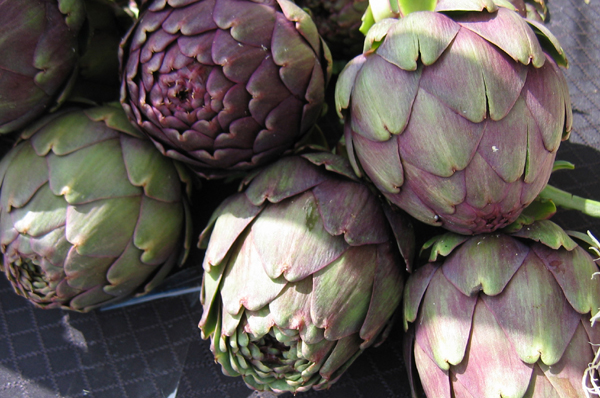
Many of us were introduced to artichokes grown in the coastal area around Castroville, California. In 1980, we visited Carol's sister Sylvia, then living in San Francisco, and she brought us down to Castroville where we saw the artichokes and enjoyed a perfect artichoke soup at a restaurant in the town. We'd fallen in love with artichokes as children, at that time  an expensive and seasonal treat, so we were eager to see them growing.

About two decades ago, in the mid-90s, the flavor of California artichokes struck us as flat as a cardboard carton, and we stopped eating them. We shrugged off our disappointment, thinking it was a decline due to the newer types which are treated as annuals. A symptom of the yield-over-flavor mentality.

Horseradish benefits from sodium added as a soil amendment.

Both of our fathers told us stories about the quality of food grown near the sea and the importance of salt in their flavor. Cecil Boutard told us that certain crops benefitted from salt applications, especially those that originated in coastal environments like asparagus and seakale. Peter Black, Carol's father, told us about the lamb he ate at Mont St. Michele where they graze on land inundated by the tide. From then onwards, every other meal of lamb was, as he recounted, a mere shadow of that perfection. We took their observations to heart, and over the past decade we have applied over 20 tons of sea salt to our soil or as foliar spray.

Early authors recommended the use of sea salt as a manure for certain crops, underscoring the observations of our late fathers. John Wilson in Our Farm Crops (1859), recommended its use if crops of maritime origin are grown more than 20 miles from the sea. His advice was based on carefully quantified yield trials. Still, most farmers we know recoil at our use of salt, grimace and usually mutter something about the salting of Carthage. That story never made sense to us given the fact that salt was too valuable to waste, even as a matter of revenge. Anyway, the proof is in the pudding: tons of salt later and we are still growing crops with no Carthaginian devastation. Even the crop that receives the most heavy applications of salt, horseradish, still needs weeding and the soil is still full of worms and other organisms.

Lycopene content is increased in tomatoes.

Last January, the journal Science (243:472-473) published an article titled "Ecosystems say 'pass the salt!'" The gist of the article, which opened with the standard reference about the destruction of Carthage, is that sodium is a limiting nutrient in non-coastal ecosystems, and additions of salt stimulate the soil's flora and fauna. The work was done in the tropics, but has application in our wet ecosystem. The investigation of sodium was initiated by the observation that ants offered both salt water and sugar water were attracted to both pretty much equally. Interestingly, sodium is simply never discussed when discussing plant nutrition or soil health. Soil and foliar tests do not include sodium, or a host of other important functional elements for plants. An essential but ignored element in agronomy.

For organic farmers, especially in the Willamette Valley where the rain washes the sodium and many other elements out of the soil, the advice to use salt is sensible. Non-organic farms rely on salt-based fertilizers and have to be very concerned about the salinization of their soil, which is probably why salt disappeared as a soil amendment in the early 20th century. Soil amendments used for organic agriculture are typically very gentle and do not pose the same risk of salinization. It must also be stressed that the use of salt as a soil amendment is crop specific. Chicories, turnips, radishes, kale, celery, tomatoes and artichokes are examples of crops that benefit. Crops such as cane berries, melons and grapes do not tolerate the chloride ion in salt well, so we never apply it directly to these crops, though the annuals benefit in the rotation plan. Unfortunately, there is not a lot of research on the subject of sodium and plant health, and we are left to follow our hunches. Sea salt is also a source of dozens of trace minerals needed by animals and plants.

Turnips from Ayers Creek Farm.

Based on the work of an Israeli researcher at Ben Gurian University and their own test plots, Rutgers published a couple of bulletins on the use of salt in growing better-flavored tomatoes. Their observations mirror our work. It must be stressed that adding salt as a sodium supplement does not make the food salty, it amplifies certain flavor components, otherwise produced at lower levels by the plant because they are not essential to reproduction. In the case of tomatoes, the result is a significant increase in lycopene content. The expansion of artichoke production inland, away from the coastal areas, affected the flavor. Fortunately, you can buy coastal artichokes here in Oregon, and for a brief time from the fields of Castroville. We always ask the produce manager if we can look at the box.

Coaxing flavor and liveliness from vegetables has an element of alchemy where you are working with unseen elements, as well as a chess game where you need to understand how the board will change several moves ahead. Farmers are working from their own observations. The needs of individual crops vary. The crop may be a seed, fruit, root or leaf. Our farm is a mosaic of soil types and sometimes we misstep. Our use of sea salt is just one element of nudging the flavor and quality of our crops higher. Albert Howard's Agricultural Testament is an elegant work that places emphasis on the health of the entire farm unit, including its people, and not on individual problems. In one chapter, Howard warned against the fragmentation of the agricultural sciences. The farm is an ecosystem as well as place of production, and learning about the processes in unmanaged systems is useful, even if the author propagates that old slur against the Romans.

Read the first installment in this series, Allegretto—Sprightly Cheerfulness.

Castroville sign from Wikipedia.

Saturday, August 08, 2015

Farm Bulletin: The Dirt on Dirt


The human brain has a deep affinity for names. Soon we will start harvesting the nameless grape which we call a "grape with no name," what a surprise. A nod to both a song and a restaurant from decades past located on Commonwealth Pier in Boston. Run and staffed by descendants and family of Portuguese fishermen, the restaurant had no name, no sign and no menu. Enter the only blue doorway on the pier, and when it is your turn in the line, look for an opening among the long tables covered with checked oil cloth. Two choices for lunch, the day's seafood chowder and the day's fried seafood. It was the toughest choice ever put before us.

Our nameless grapes (green grapes in top photo, center), so named, elicit opposite reactions. At Higgins, Greg and Patrick gamely put it on the menu as a "grape with no name" whereas Josh and his staff at Food Front display them as "Boutard grapes." Despite our entreaties that food should be defined by how it falls on the palate, Josh told us a nameless grape is just too much for people to swallow. Heidi's son, Jack, calls them Anthony grapes. We will leave them nameless, but we appreciate the dedications.

Human brains have a similar affinity for measurements. One such measurement that draws the attention of farmers is soil pH. It is a number that comes with a decimal point. Attach a decimal point to any number and it immediately takes on a hypnotically greater significance than one without. It is also a logarithm, but that never grabs people to the same degree as a decimal. The other alluring quality of soil pH is that it can be changed simply and reliably if deemed not optimal, typically raised at little cost by the application of agricultural lime. Synthetic fertilizers tend to acidify the soil, reducing nutrient availability, and lime acts as an antacid of sorts, as well as providing the element calcium. Plop, plop, fizz, fizz…

Under certified organic agriculture, synthetic nutrient sources with their acidifying behavior, as well as synthetic disease and pest controls, are prohibited. Indigestion solved? Not if you consider pH alone. On occasion we have had our soil tested, and the test results always included the pH as a perfunctory service. The results are all over the map, from 4.9 to about 7.1. It is a labile character of the soil, shifting with the seasons and crops, and its measurement is generally not particularly informative. In an organically managed soil, the bacteria, fungi, microfauna and the crops themselves all influence pH. So our soil might be acidic enough to warrant adjusting in a synthetic regime, but not under organic management.

But what about the calcium? Don't we need to add lime anyway, and the pH will tell us how much is safe to add because excess lime can damage the soil and inhibit plant growth? There are six elements plants need in substantial quantities: nitrogen, phosphorus, potassium, sodium, calcium and sulphur. We have to amend our soils to maintain sufficient levels of these elements; this is especially important on a commercial farm where we are hauling into market substantial quantities of these elements in the form of food.

On an organic farm, calcium and sulphur are especially important because they are the building blocks for the plant's defenses against diseases and insects. Calcium is a key element for cell wall strength—most of the plant's calcium actually resides in its cell walls—and sulphur is a building block for the crop's internal chemical defenses. On a farm where the crops have external chemical defenses against disease and insects, that is, synthetic fungicides and insecticides applied by the farmer, the cultivator need only provide just enough calcium and sulphur for basic biological functions. Organic farms have spiders, dragonflies and a host of other predaceous arthropods helping to control the insect populations, as well as beneficial bacteria, yeast and fungi that ward off disease, but we need strong plants as well. Consequently, crops grown under organic management need more calcium and sulphur available in the soil, in fact nearing an excess under conventional nutrient interpretations.

As mentioned above, agricultural lime, calcium carbonate (CaCO3), is problematic as a calcium source. It can damage the soil's structure and chemistry. Although it is cheap, a 50# bag of lime costs about $4.15, it is not the best deal. Another good source is gypsum, but it does cost about 50% more, at $6.05 for a 50# bag. Even though it is nominally more expensive, we use gypsum exclusively, and never use lime. Generous applications of gypsum do not harm the soil, in fact the mineral improves the soil's texture, nor does it change the pH significantly. This is important because many fungi and bacteria thrive in certain pH levels, and changing the pH suddenly and significantly without a very good reason can alter the microbial ecology of the soil unproductively.

Gypsum is calcium sulphate (CaSO4). The best reason for using gypsum from the perspective of an organic grower is that you get both important elements, calcium and sulfur, and pay just 50% more. A very good a deal, especially when you factor in the costs of transportation and spreading the amendment. The other problem with lime is that the carbonate anion is at best valueless, possibly harmful, absent terrestrial indigestion; plants fix their own carbon from the air through photosynthesis so it is completely non-nutritive. We use gypsum for all our crops, annual and perennial, and buy more of it than any other amendment.

A cautionary note on gypsum sources. It is best to avoid recycled gypsum because some older wallboard contained trace amounts of mercury as an anti-fungal agent, or fungicides. The Organic Materials Review Institute (OMRI) tests and certifies materials used in organic agriculture. On bags of gypsum and other amendments, it is best to look for the statement "OMRI Approved" or "OMRI Listed." We also use a small bucketful of gypsum to mark yellow jacket nests so no one walks into them. We toss it over the hole and they dig their way out unharmed. They are valuable predators and scavengers, worth keeping so long as we know where they are.

Too often, organic agriculture is characterized in the negative, especially the absence of synthetic pesticides. Once you settle in as an organic farmer, success comes with managing the soil ecology so that you build strong crops that coexist with the benefits and the challenges that nature delivers. Book 18 of Pliny's Natural History is his discussion of farming. The book opens with a rambling plea regarding stewardship of the earth—he was no Homer or Sappho—but as you read it the fundamental spirit of organic agriculture is apparent. He laments the tendency of farmers to treat their fields like a battlefield, deploying poisons and other measures against nature. He urges us to farm in a manner that thanks nature for bringing us into world, and treats her as our benefactor in a shared enterprise with the full measure her creation. It is apt advice 2,000 years later.