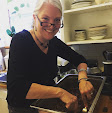
Showing posts with label scones. Show all posts

Wednesday, August 10, 2016

Camp Stories: Brotherhood of the Travelin' Scones


It's no secret that the muse of Good Stuff NW and, frankly, much of the rest of my life, is my life's partner-in-crime, my husband of 35 years—almost 40 if you're counting from the time we began dating—the meat smoker, baker and cocktail-shaker who makes so many things so delicious around here. Early on we were avid backpackers, but our camping gear has ballooned to include glassware and a cast iron Dutch oven, to which was recently added a cast iron griddle so Dave can make even more incredible breakfasts over the campfire.

Heating the Dutch oven.

Baking has become a consuming passion for him, which means that every two weeks he's making six loaves of the most delicious sourdough bread from a starter he made himself—friends, feel free to chime in here with kudos—inspired by the amazing book by Chad Robertson, Tartine Bread. That means four loaves of white-with-a-pinch-of-wheat, and two loaves of whole wheat or whatever flour he's experimenting with (bags of barley and buckwheat have been seen lurking in the pantry lately).

Checking…

Whether it's a bread weekend or not, he's always got some additional baking he wants to do. And that includes weekends we're not even at home. No matter where we go now, from the forest to a beach house with a passle of friends, he brings along his flour, a dab of sourdough starter or some ingredient he needs to make bread or rolls or scones or pancakes or…you name it…whatever is possessing his attention at the moment. And, guaranteed, if he makes it, it will be good.

This is roughing it?

One of his go-to recipes at the moment is one for breakfast scones with currants or dried cranberries or whatever dried fruit hasn't been gobbled up in our family's constant foraging for snackage. Warm and fragrant, with a touch of sweetness that begs for a smear of honey or jam, that sunrise shape when it comes steaming out of the oven defines a perfect morning served with butter (or, in his case, a pat of margarine) and a hot, strong cup of coffee.

Currant Scones

3 c. (13 1/2 oz) whole wheat flour (or 2 c. all-purpose, 1 c. whole wheat)
5/8 oz. (20 g) cane sugar
3/4 oz (22 g) brown sugar
2 Tbsp. baking powder
1/2 tsp. salt
8 Tbsp. unsalted butter or margarine
1 c. milk
2 eggs
1/2 c. currants
Extra flour for forming dough

In a gallon zip-lock bag or other container, mix flour, both kinds of sugar, baking powder and salt. Bring along butter, milk, eggs and currants separately, along with parchment paper. If baking in a lidded Dutch oven (footed or one with a trivet/lid lifter), bring briquets and, if available, a laser thermometer. Good heavy welding gloves also come in handy for manipulating the hot cast iron. As a friend said, "Every project requires a tool budget."

To make the scones, put the dry ingredients in a mixing bowl and add the butter or margarine in 1/4" slices. Cut in with a fork or pastry cutter until the mixture is the texture of cornmeal. Stir the currants into the mixture. In a separate bowl, whisk the milk and eggs together. Stir the liquid into the dry mixture and mix until all the flour is moistened. Turn out the mixture onto a floured surface. Knead until the dough is smooth, about 25 kneads—this is a bit more handling than with biscuits. Form the dough into a ball.

Place the ball on a piece of parchment paper,and flatten it with your hands to form a round disk about 10" in diameter. With a bench scraper or a knife slice into  into wedges (we usually make 12 from this recipe) but don’t separate the wedges.

For baking in an oven:
Preheat oven to 375°. Put parchment paper on a baking sheet or rimmed baking pan. Form disk and cut wedges. Place in oven and bake until golden brown, 22-24 minutes.

For baking in a Dutch oven using briquets:
In a chimney starter or in the campfire, place a pile of briquets using this guide to determine the number of briquets needed. On a cleared space on the ground near your campfire ring—make sure there are no flammables nearby and that no people or pets will stumble into the dutch oven—spread about one-third of the briquettes evenly below the Dutch oven and two-thirds on the lid. After 30 to 45 minutes of preheating, remove the lid and, using the laser thermometer, check the temperature of the bottom of the oven. It should be between 350-375°. If it isn't up to temperature, remove any briquets that have burned out and replace them with fresh ones. Once the oven is up to temperature, lift the parchment with the scones (see oven method, above) and place them in the oven and cover with the lid. Every 10 minutes or so, turn the top lid a quarter turn to the right and the oven itself a quarter turn to the left for more even baking. Baking time may vary from a home oven, but check it at about 20 minutes and gauge timing from there.

Wednesday, July 16, 2014

Camp Stories: Return to Paradise


It was the Fourth of July and at 10 o'clock at night it was pitch dark and instead of sounding like a war zone, with booms, cracks, flashing lights and sulphurous clouds of smoke drifting across the battlefield of competing patriotic displays, all we could hear was the quiet burble of the Wind River as it rushed over rounded stones on its way to join the Columbia.

Camp cocktails? Yes, please!

Rather than having to drug our dogs, or watch them pant and shiver and pace through the conflagration—"Go outside? No thanks, I'll just hold it till tomorrow."—they were bedded down quietly at the other end of the tent we'd pitched at Paradise Creek campground in the Gifford Pinchot National Forest north of Carson, Washington.

Our annual pilgrimage, which had ballooned in past years to 14 people in five campsites but this year, for various reasons, numbered only five members in two sites, was a much simpler affair but no less delicious (or fun). While a big group of good friends has always been a blast, fewer people meant much less coordination, and led to simpler packing—salami and cheese instead of dozens of fresh oysters—and much more time reading in beach chairs streamside.

Cast iron-baked scones.

I'd wanted to try my hand at a campfire paella and Dave was itching to use his cast iron, footed Dutch oven to make scones using a perforated cast iron trivet to prevent scorching (left). And of course we had the usual fixings for negronis and martinis to help smooth any bumps in our mattresses at night.

The paella (top photo) was amazingly simple, since I used the frozen stock in place of one of the bags of ice in the freezer chest, and had simplified the list of main ingredients to chicken, frozen shrimp, olives and chorizo. Thanks to Dave's expert fire-building, the split dry fir from the "Camp Wood!" guys down the road burned down to a lovely bed of coals. A little sautéing over the fire, then adding the stock over the top and a half hour later—just enough time for a cocktail, thank you—dinner was ready.

Breakfast of champions.

The scones were a tour de force, and even Dave admitted that he was as surprised as anyone that they turned out so well. He'd mixed the dry ingredients at home, then added the rest at camp. Then it was flattening the dough, cutting it in segments, and putting it on parchment paper on the trivet in the bottom of the preheated Dutch oven. There was a little concern that the oven hadn't gotten up to temperature, but when the time was up he opened the lid and that flattened disk of dough had turned into perfectly light and fluffy scones. Needless to say, there was much oohing and aahing around the breakfast table.

And me? I'll take these kind of fireworks over the other kind any time.

For an idea of how to make paella on a campfire, check out my recipe for paella on the grill.

Sunday, April 29, 2012

Jammer-rama!


My husband, as I've intimated many times in the past, is a baking maniac. Most weekend mornings the dogs and I stumble downstairs to find him measuring flour on his digital scale to feed his sourdough starter for bread, or to make the biscuits, scones, pancakes, waffles or whatever else has tickled his fancy. As I get the dogs' breakfast bowls lined up, I'm careful not to impede his progress, though they seem to delight in milling around our feet, making us dance to avoid a floury, kibble-and-fur-strewn catastrophe.

Just about the time they've finished gobbling their breakfast, I'm sitting down to a cup of coffee and the paper, the smell of baking goodness emanating from the stove, mixing with whatever tunes Townes or Eliades or Gillian is playing for us that morning.

Not content to rest on his laurels, lately Dave's put a new spin on his morning repertoire with the addition of some lovely, jam-studded biscuits known to Grand Central Bakery fans far and wide as jammers. The recipe is from the The Grand Central Baking Book by Piper Davis and Ellen Jackson, a tome widely admired by those with flour in their blood as well as those of us who weren't born with rolling pins in hand.

Grand Central Bakery Jammers
Adapted from The Grand Central Baking Book

Makes 10 to 12 jammers

4 c. all-purpose flour
3 Tbsp. granulated sugar
2 tsp. baking powder
1 1/2 tsp. salt
1 tsp. baking soda
1 c. (2 sticks) cold unsalted butter or margarine
1 1/4 to 1 1/2 c. (10-12 fluid oz.) buttermilk, milk or lactose-free whole milk
About 3/4 c. good quality preserves or jam

Preheat the oven to 350°. Lightly grease a baking sheet or line it with parchment paper.

Measure the flour, sugar, baking powder, salt, and baking soda into a bowl with high sides or the bowl of a stand mixer and whisk to combine. Dice the butter (or margarine) into 1/2-inch cubes. Use your hands or the paddle attachment of the stand mixer on low speed to blend the butter into the dry ingredients until the texture of the flour changes from silky to mealy. There should still be dime to quarter-size pieces of butter remaining. If you’re preparing the dough the night before, cover the bowl with plastic wrap and chill overnight; otherwise proceed with the recipe.

Make a well in the flour mixture and pour in 1 cup of the buttermilk (or milk) in one addition. Gently mix the dough just until it comes together; it will look rough. Scrape the dough from the sides and bottom of the bowl, then add another 1/4 cup buttermilk and mix again to incorporate any floury scraps. The majority of the dough will come together, on the paddle if you are using a stand mixer. Stop mixing while there are still visible chunks of butter and floury patches.

The dough should come out of the bowl in 2 to 3 large, messy clumps, leaving only some small scraps and flour around the sides of the bowl. If the dough is visibly dry and crumbly, add up to 1/4 cup more buttermilk, 1 tablespoon at a time, mixing no more than one rotation after each addition.

Turn the dough out onto a lightly floured surface. Use the heels and sides of your palms to gather the dough and gently pat it into an oblong shape 1 1/2 to 2 inches thick. It won’t look smooth or particularly cohesive; that’s okay. Use a biscuit cutter (or empty, clean tin can or wine glass) to cut the jammers into circles at least 2 1/2 inches in diameter. Layer the leftover scraps on top of one another and gently pat them out to a thickness of 1 1/2 to 2 inches and again cut into circles.

Use your thumb to make an indentation the size of a fifty–cent piece in the middle of each biscuit. While gently supporting the outside edge of the biscuit with your fingers, use your thumb to create a bulb–shaped hole that’s a bit wider at the bottom and that goes almost to the bottom of the biscuit (think pinch pot). Try to apply as little pressure as possible to the outside of the biscuit, to avoid smashing the layers, which are the key to flaky jammers. Fill each indentation with 1 tablespoon of jam and put the jammers on the prepared baking sheet with 1 1/2 inches between them.

Bake for 35 to 40 minutes, rotating the pan halfway through the baking time. The jammers should be a deep golden brown.

Sunday, April 01, 2012

A Scone, a Scone, My Kingdom for a Scone!


Scones are a recurring theme on Sunday mornings here at GSNW Central, aka our house, where nothing short of the apocalypse could keep us from reading the New York Times (print, please!) and slurping down copious amounts of (half-decaf) coffee.

Dave's always been in charge of breakfast on this holy day, and his favorite currant scone recipe has served us well. But lately he's been looking around for a new challenge, and he ran across a recipe that called for toasting oats in the oven, then folding them into the dough. It makes a cakey, slightly crumbly scone that plays nicely with coffee and the New York Times. Enjoy!

Toasted Oat Scones
Adapted from an America’s Test Kitchen recipe

1 1/2 c. all-purpose flour
1/3 c. sugar
2  tsp. baking powder
1/2 tsp. salt
10 Tbsp. cold butter or margarine
1 1/2 c. rolled oats
1/4  c. cream
1/4 c. milk (or replace milk and cream with whole milk)
1 egg
1 Tbsp. sugar

Spread oats on shallow pan and place in 375 degree oven for 8-9 minutes, until they begin to turn toast, browning slightly. Remove from oven.

Preheat oven to 450 degrees.

Pulse flour, sugar, baking powder and salt in processor to mix. Cut butter into bits and add to ingredients in processor. Pulse 12-14 times until mix has coarse cornmeal texture. Put mixture into large bowl. Reserve 2 Tablespoons of oats in a separate bowl. Put rest of oats into large bowl with other ingredients.

Put cream and milk into a separate bowl. Add egg and whisk until well combined. Reserve 1 tablespoon of the liquid in another bowl. Toss dry ingredients briefly. Add liquid. Mix gently with spatula, then use hands to knead gently to form into a mass. Put half the reserved oats on a flat surface like a counter. Place dough on top of oats. Sprinkle the rest of the oats on top and press into a 7-inch diameter circle, 1 inch thick. Cut into 8 wedges. Place on parchment-lined baking sheet. Glaze with egg-cream-milk mixture. Sprinkle sugar on wedges. Place in oven. Check at 11-12 minutes, baking as long as 14 minutes until slightly browned. Rest on baking sheet for 5 minutes, then put on cooling rack for half an hour.

Friday, January 07, 2011

Some Lazy Sunday


Growing up in an Episcopalian family, Sunday mornings were for church, immediately followed by a quick change into more comfortable clothes. But in this largely un-churched age (especially here in Oregon) people use it as an opportunity to get projects done around the house. Painting the basement? They'll run to the paint store for supplies in the morning and finish up by nightfall. Digging up the parking strip and planting 100 feet of garden next to the house? We'll hear the rototiller chug to life at 8 am and the summer's crop will be in the ground by late afternoon. Staked and fertilized, too.

All this busyness makes us look like the layabouts that, to be completely honest, we truly are. Sunday mornings around here are spent in bathrobes that are rarely doffed before noon. Not that there's any lack of activity, mind you. There's coffee to be made, dogs to be fed, newspapers to be fetched from the front porch and read, plus NPR to be listened to (and commented on).

And even though the days of the big breakfast should be long gone, there's nothing Dave likes better than to fire up the oven and bake his signature sourdough biscuits, or make English muffins that go ever-so-perfectly with a cheese omelet.

Lately he's been experimenting with some new scone recipes, and found one that's become his current favorite. Any leftovers freeze well and are terrific for a hurried mid-week breakfast. But if you drop by our house some Sunday morning expect to be met by a couple of sleepy-eyed, slipper-clad lazybones with papers in hand. Though if you pour a cup of coffee and sit down with one of these scones, you might just find a new groove for your Sunday morning.

Lazy Sunday Scones
Adapted from Bakingby James Peterson

3 c. flour
5 Tbsp. sugar
1 Tbsp. plus 1 tsp. baking powder
1/2 tsp. salt
1 c. cold butter or margarine
1 1/4 c. milk

Preheat oven to 375°.

Mix dry ingredients in processor. Add thin slices of margarine and pulse until mixed. Add milk and process until mixed. Turn out onto floured surface. Gather and knead about 10 times (not too much or scones will be tough). Roll until about 1/2 inches thick. From one side, fold one-third of the dough up, then do the same from the opposite side. Turn a quarter turn and fold the ends up similarly. Place on plate and put in freezer for five minutes.

Remove from freezer. Roll out again into rough rectangle to about 1/2 inch thick. This time roll up starting on short edge. Roll out rolled dough into rectangle with long sides and short ends, to about 1/2 to 3/4 inches thick. Cut dough into rectangles, then wedges to desired size. Place on baking sheet. Lower oven temperature to 350°. Bake until golden brown, about 25-30 minutes.

Sunday, March 08, 2009

Scones for Breakfast


I'm as guilty as anyone. Taking things for granted, not realizing how lucky I am to have a roof over my head, terrific friends, good food and drink. Not to mention a wonderful family and the best husband anyone could ask for.

Sound maudlin? An eye-rollingly yawnable moment? Well, my friend, let me give you a little slap-upside-the-head reality check. After a great dinner with friends J&K last night and way too much good food (look for a post in the near future on the meatloaf we had) and wine, I woke up this morning to coffee made and Dave doing the dishes. Then he started making breakfast featuring his better-than-anything currant scones and cheese omelets.

Are you jealous? And do I feel lucky? Yes I do!

Dave's Currant Scones
Adapted from "Biscuits and Scones" by Elizabeth Alston

2 c. all-purpose flour
2 tsp. baking powder
1/2 tsp. baking soda
1/2 tsp. ground nutmeg
1/2 tsp. salt
2 Tbsp. sugar
8 Tbsp. frozen butter or margarine, cut up
Yolk of 1 lg. egg
3/4 c. milk (or buttermilk or plain yogurt)
1/2 c. currants
White of 1 lg. egg
Additional sugar for sprinkling

Preheat oven to 375°. Put flour, baking powder, baking soda, nutmeg, salt and sugar into bowl of food processor and pulse once or twice to mix. Add butter pieces and pulse until mixture looks like cornmeal.

Add egg yolk to milk in a measuring cup and whisk with fork to blend. With processor running, pour in milk egg mixture until combined. Dough will be wet and sticky. Turn out onto floured board and sprinkle on currants. Give 10 to 12 kneads until currants are distributed evenly. Divide dough in half and press into 6" circle about 1/2 " thick. Cut in sixths and arrange on cookie sheet. Repeat with second half of dough. Brush with egg white and sprinkle with sugar. Bake 18 to 22 minutes until golden. Cool on wire rack.