Showing posts with label pesto. Show all posts

Thursday, April 13, 2017

Pesto From Carrot Tops Is…Well…Tops!


This time of year my craving for greens is practically insatiable. I'm coming home from the market with bunches of raab (or rapini or rabe) from multiple different vegetables—turnips, kale, mustard greens—and foraging through the aisles for nettles, fiddleheads…well, you get the picture. And since these days I only buy carrots with their tops still attached because I had one too many woody, flavorless carrots from the cheap-for-a-reason bulk bin, I've been giving their frilly green appendages the same lustful looks as their cousins the brassicas.

Using those tops is also a great way to keep perfectly good food out of the compost bin, so the other evening when I was casting about, as I usually do, for what-can-I-feed-my-family ideas by digging through the vegetable bin, I came across a few stalks of parsley along with the carrot tops, and decided to throw them into the blender with walnuts, a little salt and a couple of cloves of garlic. Stirring in a pile of shredded romano, the pesto got tossed with pasta and laid on top of a bed of arugula, then "garnished" with slices of a couple of seared pork loin chops I'd found in the freezer.

One-dish dinner, and it looked (and tasted) like a restaurant meal. I could get used to not wasting food!

Carrot Top Pesto

Carrot tops from one bunch of carrots, frilly greens stripped from stems
1/2 c. parsley leaves, stripped from stems
1/8 c. walnuts
2 cloves garlic
1/3-1/2 c. olive oil
1 c. romano cheese
Salt to taste

Place carrot top leaves, parsley leaves, walnuts and garlic in a blender. While blender is running, drizzle in olive oil until it becomes a smooth sauce. Pour into medium-sized mixing bowl and stir in cheese. Add salt to taste.

Toss with one pound cooked pasta. This pesto sauce is also delicious drizzled on roasted or grilled spring vegetables.

Thursday, August 06, 2015

Quick, Light Pasta That's Perfect for Summer


Contributor Jim Dixon of Real Good Food is particular about the products he carries, so when he adds a new item to his lineup, you can be sure it's been taste-tested at the Dixon household and is worthy of an appearance on his pantry shelf before he offers it to his customers. This recipe for whole wheat pasta sauced with a variation on the more familiar Genovese basil pesto sounds like the perfect solution to a light summer dinner.

Along with the dritta olives that make Pollinaria's great extra virgin olive oil, the farm in the mountains of Abruzzo, Italy, also grows an heirloom variety of semolina wheat called Senatore Cappelli that's used to make whole grain (grana duro in Italian) pasta. I've never been a fan of whole wheat pastas; most I've tried have been grainy and didn't have the unique flavor of good semolina pasta.

But last year I tried Pollinaria's and was surprised. It had the texture and taste of traditional Italian dried pasta. The Pollinaria pasta, made from their organic semolina wheat, is extruded through brass dies that give it the rough surface to hold sauce, and the pasta is slowly dried to allow the flavor to develop. While they make several types, production is limited and I was only able to get fettuccine this year. If you like it as much as I do, next year I'll try get penne and chitarra.

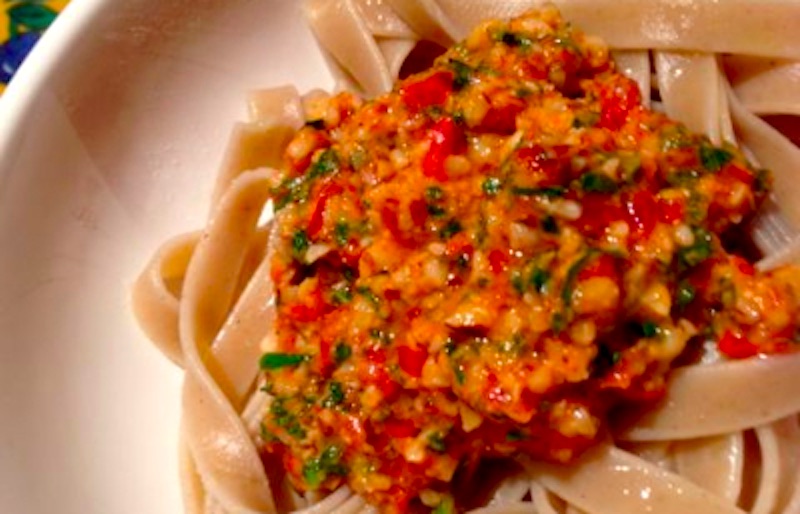
I cooked a batch of the fettuccine and ate it with pesto alla Trapanese, the almond and tomato sauce served across Sicily.

Pasta with Pesto alla Trapanese

Briefly toast a handful (about a cup) of almonds in a skillet until just beginning to brown. Combine the almonds in a food processor with two or three coarsely chopped tomatoes, a couple of garlic cloves, a handful of basil (I also added some mint), a pinch of salt and a good drizzle of olive oil. Pulse until well-blended but not completely pureed. Add a couple of big spoonfuls to bowl of cooked pasta*, sprinkle with Parmigiano Reggiano and eat.

* You can also substitute your favorite whole wheat or regular pasta for the Pollinaria.

Tuesday, April 30, 2013

Don't Toss Those Tops!


For years I've been ripping off the tops of bunches of carrots and tossing them in the compost. When a checker at the store would ask if I'd like the frilly greens removed, I'd say, "Why, yes, thanks!"

Then a couple of months ago I stumbled across a reference to carrot greens in cookbook author Diane Morgan's "Roots," an encyclopedic tour of those edibles that grow beneath the soil. In it she describes that she, too, was a carrot top tosser until she found out they were edible, and I've since had several conversations with other former carrot top naïfs who now use the frilly, slightly carrot-y tasting tips in salads, sauces and sautés.

So now not only am I not wasting a perfectly edible source of greens, I have yet another delicious, vitamin-rich addition to my repertoire. Who knew?

Roasted Carrots with Carrot Top Pesto

My friend Hank Shaw, a forager and hunter of some reknown, loves to serve the game animals he hunts with the food that they may forage in the wild. Serving the carrots with their tops, while not quite the same thing, gives me a similar thrill.

1 bunch carrots with greens
1-2 cloves garlic
2 Tbsp. pine nuts (toasted in a dry skillet, if desired)
1/4 tsp. salt
4 Tbsp. olive oil

Preheat oven to 400°.

Remove greens from carrots, leaving 1-2" of stems attached. (I try to get long, slender carrots for roasting, but if the carrots are thicker, halve them lengthwise or chop into 1/2" coins.) Brush with olive oil and arrange on parchment paper on a baking sheet. Roast in oven for 30-40 min. until fork-tender.

For the pesto, remove leaves from carrot stems as you would with parsley or cilantro. Put the leaves in a blender and add garlic, pine nuts and salt. Add 2 Tbsp. of olive oil and purée, drizzling in remainder of olive oil, plus more if needed, to make a finely textured sauce.

Place roasted carrots on platter and drizzle with pesto, or serve carrots plated with drizzle of pesto. I usually put the remainder in a bowl on the table for pesto addicts to serve themselves.

Monday, February 08, 2010

In Season NW: First Appearance


You gotta give credit to the first person to gather and then figure out how to eat stinging nettles. Granted, they must have looked appetizing, the bright green leaves and fleshy stems poking up out of the cold ground on those ancient early spring days. But one unprotected encounter with them, as with any vicious beast, would be enough to kill anyone's appetite for subsequent meetings.

Stinging nettles.

Last year was the first time I'd tried cooking with them, and the Spring Leek and Nettle Tart I made as an appetizer was a big hit. Then recently my friend Hank Shaw wrote about his quest to conquer this challenging herb, and inspired me to go at it again.

The unrolled, flattened roast.

It didn't hurt that Dave had indicated his desire to smoke some pork in the near future, and I'd bought a couple of bags of nettles from the Urban Farm Market the day before. So a quick trip to the store for my current favorite budget cut, a boneless pork leg roast, had us prepping a nettle pesto stuffing for it to go on the grill that very night. (See also my recipe for Stuffed Pork Leg Roast with Kale and Pine Nuts.)

Stuffed, rolled and tied (just like the rodeo).

A side dish of papardelle with wild mushrooms and this was one early spring dinner that was thankfully painless and, at the same time, very hard to beat.

Pork Leg Roast with Nettle Pesto Stuffing

For the pesto:
2 c. nettles (remember to wear heavy gloves when handling the fresh herb)
2 cloves garlic
2 Tbsp. pine nuts
1/4 c. fine bread crumbs
1/3 c. olive oil
1/4 c. parmesan, finely grated
Salt to taste

For the roast:
3-lb. pork leg roast
Butcher's twine

Bring a medium-sized pot of salted water to boil. Have a large bowl of ice water nearby. Wearing heavy gloves to prevent nettles from stinging, add them to the boiling water. Boil for 1 minute, then, using tongs or slotted spoon, remove them from the pot and plunge into the bowl of ice water to stop the cooking and fix the color.

Remove nettles from the ice water with tongs and drain in a colander. Remove any large stems (you should be able to handle them with bare hands at this point), keeping the tender stalks and leaves. Wrap them in a kitchen towel and twist it tightly to remove all the water.

Put nettles, garlic, pine nuts and bread crumbs in bowl of food processor. With processor running, drizzle in olive oil and process till smooth, adding more olive oil if needed. Put nettle mixture into medium mixing bowl and add parmesan, stirring to combine. Add salt to taste.

Clip strings tying pork roast and unroll. If it's not an even thickness, use a sharp knife to make shallow cuts so it unrolls completely and becomes one even slab (see photo above). Reserving 1/4 c. of pesto, spread the nettle pesto over the interior surface of meat. Reroll and tie tightly with butcher's twine. Rub reserved pesto on outside of roast.

Grill over indirect heat until internal temperature reaches 125-130° (approx. 1 hour), then remove to cutting board, tent with aluminum foil and let it rest for 20 minutes. (Other recipes call for an internal temperature of 155°, but we find that the meat tends to be overcooked and dry at that temperature.) You can also roast this in the oven at 350° for 1 1/2 hrs. or so until it reaches the same internal temperature.

Thursday, February 04, 2010

Don't Call It Vegan


There's something about the term "vegan" that really rubs people the wrong way. It has a certain holier-than-thou tone to it, as if all other foods, the ones most of us eat, have been declared unclean.

Even worse, the foods deemed worthy of consumption have a reputation for being dull and flavorless. Think tofu, brown rice or rutabagas. Then there are the foods that try to mimic cheese or bacon or turkey and fall pathetically short. Which makes the vegetarian diets of yore look positively lush by comparison.

But you don't have to take a lemons-into-lemonade, turn-that-frown-upside-down attitude to switch your thinking around to what you can have instead of what you can't. Think of the intense flavors we love: heat, spice, sweet. All perfectly fit a vegan diet. Then there are the fats: olive oil, sesame oil and nuts spring to mind. And the great flavors of legumes, fresh greens, squash, garlic, mushrooms. Makes you think, right?

So when I saw the following recipe in John Ash's book From the Earth to the Table,it looked like a tasty new pasta recipe using pesto, cauliflower, pasta and beans. Not some wacky vegan food-like substance. Try it sometime when you're craving a flavor-packed, hearty dinner. You'll be surprised when you don't feel like you've done without.

Pasta with Roasted Cauliflower and Parsley Pesto
Adapted from John Ash's From the Earth to the Table

For the pesto:
4 c. packed fresh parsley leaves
4-5 cloves garlic, fresh or roasted
2 Tbsp. pine nuts, fresh or toasted
Zest of 1 lemon, grated
1/2 c. olive oil
Salt to taste

For the pasta:
1 med. cauliflower
2 Tbsp. olive oil
1 lb. rigatoni, penne or other pasta
3/4 c. kalamata olives
1 c. cannellini, borlotti or other beans, cooked
Mint sprigs for garnish

Put parsley, garlic and pine nuts in bowl of food processor. While processing, drizzle in olive oil until smooth. Empty processor into medium-sized bowl and add rest of ingredients. Combine.

Preheat oven to 350°. Break cauliflower into 1" pieces and place in large mixing bowl. Drizzle with olive oil and stir to coat. Empty into 9" by 12" roasting pan and place in oven for 30-40 minutes until nicely browned.

While cauliflower is roasting, bring a large pot of salted water to boil. When cauliflower is almost done, put pasta on to cook until just al dente. Drain and put in large serving bowl, adding pesto, roasted cauliflower, olives and beans. Mix. Serve garnished with chopped mint leaves.

* You can also add 1/4 c. parmesan to the pesto, and served grated parmesan at the table for sprinkling.

Thursday, May 28, 2009

My Latest Love Affair


In any long marriage there are ups and downs, times of passion and times when Dave probably thinks, "What the heck am I doing with this person?" I've done the same thing with food, from what's known in our family as my Velveeta Period in grade school through my decades-long affair with pesto (I blame the garlic).

Several years ago the attraction waned and I moved on to other fascinations with poached eggs and stuffed pork, but recently a piece by Melissa Clark in the New York Times piqued my interest in looking up my old flame.

The reason? It had undergone some cosmetic surgery and I was finding its new look curiously fetching. The basil had been replaced with pea shoots, and after a brief dalliance with those curly greens last spring, I've been flirting with them a lot more this spring.

So when I saw some shoots waving their fronds at me from a table at the farmers' market, I brought them home and immediately looked up the recipe. A whirl in the processor, a little heat, and this new affair was off to a promising start.

Pasta with Pea Shoot Pesto
Adapted from The New York Times

For the pesto:
1/4 c. pine nuts
3 c. pea shoots
1/2 c. fresh cilantro leaves
2 cloves garlic, chopped
3/4 tsp. kosher salt
1/3 c. extra virgin olive oil
1/4 c. grated Parmesan

For the pasta:
1 lb. penne (or your favorite shape)
1 Tbsp. olive oil
2 cloves garlic, minced
2 c. pea shoots
1 6-oz. can albacore tuna
Zest of 1 lemon
Salt and pepper to taste
Parmesan for sprinkling

Put pine nuts, pea shoots, cilantro and garlic in processor. With processor running, drizzle in olive oil to make a paste. Pour pesto into mixing bowl and stir in parmesan.

Bring pot of water to boil and add pasta. Cook till al dente. While pasta cooks, heat olive oil in saute pan and add garlic. Saute briefly and add pea shoots, cooking till just wilted. Add tuna and stir to warm. Remove from heat and stir in lemon zest. Season to taste with salt and pepper.

Drain pasta and put in serving bowl. Add pesto and stir to coat (you may not need all of it). Top with pea shoot mixture and sprinkle with parmesan.