Showing posts with label katherine miller. Show all posts

Friday, April 05, 2013

The Prosciutto Project: Hurry Up and Wait


"Good things come to those who wait."

This old proverb extolling the virtues of patience has been appropriated by advertising agencies—Heinz ketchup and Guinness come to mind—and generations of moms with squirmy kids. (The moms, of course, potently implying that its opposite is also true.)

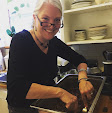
Katherine meeting her meat.

I'm embarking on a project with Katherine Miller, editor of the Oregonian's FoodDay section, which will test my patience to the limit. That is, we're making prosciutto, the Italian style of dry-curing a whole leg of pork.

The process of dry-curing, I've come to realize, is not like making bacon, which cures for a week in the fridge and is then smoked for a few hours, whereupon it is completely edible. Nor is it like pancetta, which requires a week of curing and is hung in a cool, dark place for a couple of weeks before you can indulge.

Kendra and Ivan of Goat Mountain Pastured Meats.

No, prosciutto is a much, much more protracted process, curing in salt for at least twelve days and hanging to dry-cure for up to a year. Yes, a year. Twelve months. Three hundred sixty five days—you catch my drift. No wonder wannabe charcutiers get wigged out just thinking about it. That's a long time to find out that you've just invested considerable time and money into what has become a big pile of moldy, not to mention potentially lethal, protein.

Eric of Mt. Angel Meat cradling our prosciutto-to-be.

But hey, I thought it would make a good story, not to mention a tasty experiment, so I convinced Katherine we should do it together. Plus I think it helped that she got to meet a couple of my favorite meat farmers, Kendra Kimbirauskas and her husband, Ivan Maluski, of Goat Mountain Pastured Meats in Colton, and canoodle with their placid porkers.

We picked up the 25-lb. leg this morning from Eric at Mt. Angel Meat Co., a USDA-certified meat processor, salted it down, wrapped it in plastic and set it under weights in Katherine's fridge. I'll be able to tell you how it went in a year or so!

Thursday, September 01, 2011

Conserving a Resource


We're pretty old school around here. Both Dave and I grew up on opposite sides of the country but both with our noses buried in books—solving mysteries, flying in rocket ships, sailing the seven seas and generally living a much more exciting life than we found in our middle class homes and public school classrooms.

Dave eventually became a newspaperman, working in a real old-fashioned newsroom, with typewriters clacking and telephones ringing and years of accumulated coffee stains and cigarette burns on the desks. And there was always a haze of smoke floating in the air from the cigarettes dangling from the reporters' lips.

We actually met at a newspaper when I was in college and had a summer job in the ad department doing paste-up. Instead of going on dates he'd take me on reporting trips out to surrounding communities. When Mt. St. Helens exploded, we and droves of reporters rushed up to cover the story.

Today we still get two newspapers every day, and a perfect Sunday morning requires nothing more than the Sunday papers and good strong coffee.

I love the special sections in the papers, especially FoodDay in Tuesday's Oregonian, which I've been fortunate to write for in my new-found career as a food writer. So I was surprised, shocked even, when I opened the Oregonian on Tuesday to find that FoodDay, instead of having it's own section, had been merged with that day's Living section. Instead of its usual six pages, it was down to fewer than four. And the usual Living features, the comics and the TV listings were simply tagged on to the end, a bizarre mash-up of both content and style.

FoodDay's editor Katherine Miller, in response to an e-mail I sent expressing my condolences and questions, said "this change has been in the works for several months. FOODday is now four pages (once a month the fourth page will be the back of the section), instead of six. The move was part of the reorganization of the paper's features staff outlined last Sunday in an editorial by Executive Editor Peter Bhatia. This is also a move that many other newspapers have already made. In October I'll be attending the Association of Food Journalists conference in [Charleston, SC], where I'm sure I'll hear many similar stories."

It's a sad development, especially at this moment when Portland's food culture and the bounty of the region is exploding on the national scene. So how can we stop the demise of such an important resource about local food? Subscribe to the paper, write the editor, and let them know that FoodDay is important.