Showing posts with label flint corn. Show all posts

Tuesday, January 02, 2018

A Corny Sidekick For Your Next Pot of Soup


One thing I love to do is mix up a batch of cornbread to accompany a big pot of soup or stew. As simple as it is to make, it doesn't always happen because it's even easier to slice off a few hunks of the fabulous sourdough bread that Dave cranks out like clockwork every couple of weeks. But there's nothing more satisfying than throwing some simple ingredients in a bowl, giving them a few gentle turns by hand and pouring it into a pie pan, then pulling it out of the oven just before ladling out the soup.

Made with Ayers Creek 8-Row Flint Corn.

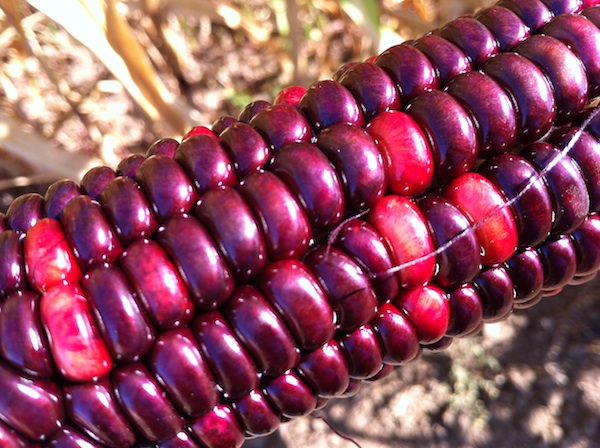
Of course, I'm a devotée of the coarse cornmeal ground from the organic flint corn grown by Anthony and Carol Boutard of Ayers Creek Farm, with its flecks of red, orange and yellow and its deeply corn-y flavor, but regular cornmeal works, too. I've also baked it using their Peace No War—PNW, as in Pacific Northwest, get it?—purple cornmeal (top photo), which gives it a mahogany tinge and is no less flavorful. But whatever cornmeal you choose, and whatever form you choose (it's wonderful as a loaf, in a round cake or pie tin, or even muffins), definitely give this a try with your next pot of soup.

Check out these fantastic, simple soup recipes.

Cheesy Cornbread

1 c. flour
1 c. cornmeal
3 tsp. baking powder
1 tsp. salt
1 c. milk or buttermilk
2 Tbsp. melted butter
2 eggs
1 c. sharp cheddar cheese
1 large green chile, chopped (optional)

Preheat oven to 400°.

In large mixing bowl, combine dry ingredients. Stir in milk and melted butter. Add eggs, cheese and chile (if using). Grease and flour baking pan or muffin tin. Pour in batter. Bake 18 to 20 minutes, until toothpick inserted in center comes out clean.

Note: You can also add cumin, a teaspoon of red pepper flakes, some chopped green onions or one-third cup drained corn. It's a very flexible recipe.

Saturday, December 05, 2015

Farm Bulletin: 3. Lento assai, cantate e tranquillo—Stately (very slow), singing and peaceful


In this first of of two essays, contributor Anthony Boutard of Ayers Creek Farm gives us an idea of what it takes to selectively breed a new type of corn. As you read it, note that when he says "sixth iteration," it's a farmer's shorthand for six years, since each crop takes a full year to reveal its characteristics. It starts with a "Hm, that's interesting" oddball variation on an ear of corn, kernels of which are planted out in the field the next year, more selections are made and planted the year after that, etc., etc. And that's not accounting for failures or other problems encountered on the way. Stately, slow (and at times frustrating) for sure.

We will approach this market* with a measured, restrained pace, tent assembled to provide shelter from the rain. Consistent with the notation in the title, the market's 10 a.m. opening will be ushered in with the Robert Gray Panache choir singing peaceful songs of the season.

We will bring our gift packs of preserves to this market and the next. This year, the $25 gift box includes raspberry, purple raspberry, loganberry and green gage. Always a good idea to hold a few boxes in reserve for those moments when a gracious reciprocation is needed.

Anthony evaluating an ear of corn.

This week we will have corn from the sixth iteration of the "Peace, No War" art project. Descended from a chance ear with purple kernels, we have been reselecting the corn for ever darker kernels, and some ears are so densely pigmented they approach a matt black. In the Spanish area of Meiro (Galicia), they grow a similar corn and it is called millo corvo. The key to a flavorful grain corn in Oregon is to move ripening time into September when we have the sun and heat to produce a quality kernel. The original ripened in late October, and did not have the quality we wanted. It is a matter of nudging the corn earlier, and now a substantial proportion is ripe just past mid September.

The beautiful purple-red stalks of Peace Not War.

The purple/black corn results from the layering of a deep blue aleurone under a red skin (pericarp). The dominant pigments are water soluble anthocyanins, and like the related pigments in red wine, they confer a slight astringency to the grain. Peace, No War is a flour corn, so it is much lower in protein than our other sorts, with a lighter texture as a result. Cornmeal cookies are a holiday favorite, and you can now have three different types. The purple flour corn produces the lightest version of the cookies. The anthocyanins in many plants, including our peaceful corn and the purple sweet potatoes, are pH indicators. With the acid in the lime juice and zest, as well as the use of baking powder, the color of these cookies is a lovely lavender-pink.

Ears are saved for further evaluation.

If the cornmeal is used with alkaline ingredients such as baking soda, the pigments turn a dark blue-black. You see it happen if you put a bit of purple cornmeal, moistened with water, in a bowl with some baking soda. Add some vinegar and the dark mix turns pink. A few years ago, our friend Vonda came to us quite perplexed. She made a sweet potato pancake recipe and they turned green. As it turned out, she used a mix of purple and yellow fleshed sweet potatoes, and the recipe used baking soda. At the proportions she used, the mix turned bright green. The yellow pigments are carotenoids and are unaffected by pH. With the right recipe, you could probably turn out a green cornmeal cookie or cornbread for St. Patrick's day using a mix of the Peace, No War and Roy's Calais Flint meal.

* Hillsdale Farmers' Market, Dec. 6, 2015

Saturday, December 20, 2014

Farm Bulletin: Purity That's Above Reproach


Seeds are the kernels from which farm families derive their livelihoods, a vital resource fostered and selected over many seasons for flavor, hardiness and quality. Contributor Anthony Boutard of Ayers Creek Farm was recently asked to submit some of his hard-won flint corn seed for testing, and reluctantly gave some up for that purpose, not out of fear of what might be found out, but because each one is a precious commodity, the end point of years of work.

We produce our own seed for many of the vegetables, legumes and grains we grow, reselecting each year for better traits and quality. This summer, Brian Campbell and Crystine Goldberg of Uprising Seeds asked if they could include some of our varieties in their 2015 seed catalogue. We agreed and the next thing you know, they need to check our corn seed for genetic contamination.

Is it good enough?

It was with a heavy heart that we posted seed to them knowing that those beautiful kernels would be completely destroyed and then probed for any violation of their purity. The reason we grow food is knowing the pleasure it gives the people who eat it, not to have it suspiciously handled by an uncaring and unloving lab technician.

We have recovered, but it took a psychic toll. For what it is worth, the purity of our Amish Butter and Roy's Calais Flint is unchallenged, free of any corrupting genes. We knew this intuitively from working with the corn so intimately, but the cold, clinical diagnosis provides additional validation of our effort. Ultimately, though, it is not the negative—non-GMO—that we are striving for, it is the lovely, rich flavor those two varieties of corn bring to the table. We are glad that we are of a mind with Brian and Crystine on this substantive point.

Saturday, April 26, 2014

Shelling Corn the Old-Fashioned Way


There's the easy way and then there's the slow way. In describing how Anthony and Carol Boutard process the Roy's Calais Flint corn they grow at Ayers Creek Farm, I said that Carol used a hand-cranked, cast iron corn sheller to take the dried kernels off the corncobs.

Roy's Calais Flint corn…beautiful!

Yesterday it was my turn to learn how that part of the process works by helping Anthony shell and clean 10 large bags of corn, ending up with 175 pounds of shelled corn kernels.

Why don't they just buy an automated machine that would do the same job faster and easier? Anthony said that at a cost of more than $20,000 and at their scale of production it doesn't make economic sense. That means the old hand-cranked sheller is assured of many more seasons of work.

Wednesday, April 16, 2014

A Pound of Cornmeal, A Whole Lot of Work


I'd gone to Ayers Creek Farm to help with some chores, but the first thing I did was to head out behind the house where I knew Anthony had his telescope set up. This time of year it's focused on the top of an old snag about a hundred yard from the house in a grove of firs. Looking through the eyepiece, I could see three fluffy grey humps. One hump shook itself and turned into the sunlight that was just coming up over the hills to the east. Piercing golden eyes lit up, and when I whooped the other two humps turned and I was the one who was being watched.

I tore myself away from the three great horned owlets when I heard Carol starting up the gator to head over to the shed—actually a large new processing barn for the corn, beans and berries that are grown on the farm—to help grind 120 pounds of flint corn needed for the week's deliveries to some of Portland's best restaurants. Carol escorted me to the back room of the shed and introduced me to my companion for the day, a small corn mill (top video and left) that, shaking and rattling, has ground their signature Roy's Calais Flint cornmeal for the past several years.

If you've ever heard the words "artisan" or "slow food" or gone to the farmers' market and wondered how a farmer could charge several dollars for a one-pound bag of organic corn meal, I have your answer. Let's not go into the several years it takes to develop the perfect corn for your climate that grows well, is resistant to local pests and yes, tastes good, too. The year before planting, thousands of that season's harvest are sorted to find just the right kernels to use for seed for the next season's crop. When the next spring arrives, it's time to prepare the fields, plant the kernels and make sure the plants survive to maturity. In late summer the corn is harvested, the stalks are stripped, the cobs are dried for several months and then sorted to find the very best ones to grind into cornmeal.

Those selected cobs are bagged and stored until it's time to grind the corn, which is where I entered the picture. Carol had put the cobs through a hand-cranked cast iron corn sheller that removed the dried kernels, then run them through a cleaner that removed the silks and other debris from the shelling process. The crates of shelled kernels were stacked next to my grinder friend, and it would be my job to turn the machine on, fill the hopper with kernels and watch as they dribbled down through the grinder, each hopper-full filling the bucket at the bottom with around 10 pounds of cornmeal.

After the bucket was filled and I'd set it up for the next batch—it took about 20 minutes or so to run the full hopper through the grinder—I turned on the machine and then headed into the main room with the bucket of cornmeal. Each batch of the ground meal had to be hand-sieved through a mesh-bottomed frame with handles at each end, which meant dumping about three pounds at a time into the sieve and shaking it into a tub until all the meal had filtered out, leaving a pile of larger corn bits and husks from the kernels.

The sieved cornmeal was still slightly warm from the grinding, and the smell of the freshly ground corn was like fresh tortillas or a warm pot of polenta—distilled comfort. After each bucket had been sieved, I scooped the meal into a tub to weigh it out into five-pound portions that I bagged and labeled. Then it was time to run back to the grinder for the next bucket, take it out of the grinder, put in a fresh bucket and refill the hopper. Did I mention that this had to be done for 120 pounds? Right.

By mid-afternoon, having paused for a lunch on the patio of lamby-licious shawarma wraps from Izgara in nearby Forest Grove, the crates were filled with bulging bags of cornmeal ready for delivery. Baptized from head to toe in cornmeal dust, I drove back to town with a new appreciation for what it took to produce those little one-pound bags of cornmeal waiting for me on my next trip to the market.

Thursday, November 08, 2012

Food Farmer Earth: A Farmer's Sensibility


In my interview for FoodFarmerEarth with Gaston farmer—and GoodStuffNW contributor—Anthony Boutard, he allows as how farming, for him, isn't just crop yields and calculations. There's also a place for whimsy, experimentation and even an aesthetic sensibility.

The son of a renowned Massachusetts botanist, Anthony Boutard was raised with the rich aromas of the earth and an appreciation for the changes in the natural world that come with the turning of the seasons. Educated as a forester, he came out West to work with a new organization, 1000 Friends of Oregon, dedicated to preserving a balance between urban and rural life.

After a few years of living and working in Portland, he and his wife, Carol, decided to move out of the city and engage their growing commitment to local, organic food. Looking for a farm that was close enough to the city to make deliveries, in 1998 they found a 140-acre working farm on the banks of little Ayers Creek in Gaston, Oregon.

“If you’ve got one and a half million people who are potential customers, it makes it a little more workable than if you were 350 miles away,” he said of their choice, adding that it wasn’t all cold calculation. “It just had a good feel to it.”

Read the rest of Anthony's story.

Watch part two of this interview, Meditation on Winter Fields. This week's recipe is for easy street-style enchiladas with adobo sauce. Get regular updates on this series about our local food scene by subscribing.

Saturday, November 12, 2011

Farm Bulletin: A Connecticut Yankee in Chef Barattini's Kitchen


This year's fall colors have been particularly magnificent due to high summer rainfall causing leaves to lose their chlorophyll more slowly in the fall, resulting in increased intensity of color in the foliage. These facts don't diminish our enjoyment, as contributor Anthony Boutard of Ayers Creek Farm demonstrates most ably in this treatise on flint corn.

Our 2003 order to High Mowing Seeds included five pounds of 'Roy's Calais Flint' corn. The catalogue offered a simple endorsement: "Makes good cornbread." It reminded us that we had not enjoyed flavorful cornbread for a long time, and that the yellow stuff in a box was little more than a gummy matrix for cheese or a substrate for savory toppings, itself bereft of any semblance of true corniness. Ours was a classic impulse purchase, with no clear idea of what making cornmeal entailed, or whether the catalogue entry was just another gross exaggeration aimed at rank sentimentalists.  As it happened, the flint corn yielded a good crop that September, we learned to grind corn with a stone mill and flavorful cornbread returned to our kitchen.

A flint corn kernel.

We are often asked what "flint" means. The bulk of the corn kernel is the starchy endosperm; the carefully stored source of energy and nutrition for the new plant when it germinates. The starchy endosperm ranges from soft to hard, depending upon how much protein is packaged up with the starch. Popcorn and flint corn have the hardest kernels because they have a lot of protein packed among the starch granules. The primary difference between the two is that popcorn kernels are smaller, about half the size of the flints. Popcorn and flint corn are the most flavorful and nutritious types of corn. Dent and flour corn form the other end of the spectrum. They are soft and much easier to mill, and definitely sweeter, yet we find they lack the satisfying flavor we seek.

Flint corn leaf.

"Roy's Calais Flint" belongs to a cluster of flint corn varieties that are collectively called the "Northern Flints," originally found on both sides of the Appalachian range, extending from the mid-Alantic states northwards to the Gaspé Peninsula in Canada. The Northern Flints first show up in the archeological record around 1000 AD, and were a staple in New England before the Pilgrims arrived. Because Northern Flint remained isolated from other corn races, the variation was derived from selection of mutations within the population, rather than a genetic exchange with other corn races from other places. Consequently, there are several characteristics which allow a person familiar with the race to identify it wherever it is growing. The plants are short, three to six feet high, sometimes beautifully pigmented and produce one or more side shoots, called tillers, that often terminate in an ear with a kernels. The cylindrical ears are long with eight rows of kernels typical, though sometimes there are ten or twelve rows. All of the kernels on the plant are the same color, and the yields are crappy.

Color variations in flints.

The meal produced by the Northern Flints is either pearly white or yellow-orange, with the white meal types often associated with the coastal regions where fish dominated the diet. The yellow meal is rich in beta-carotenes which accents its corny flavor. Kernels with a red skin (pericarp)  have better cold soil germination and ripen earlier, so they are favored in cooler areas and higher elevations where the season is short. Red kernels produce yellow meal with the red flecks you see in our cornmeal.

In 1924, the Connecticut Agricultural Station published a report on corn in the state. The report evaluated 42 named varieties of flint corn collected from 70 farms and seed stores across the state. Although unintended, Bulletin 124 provided the obituary for flint corn in New England. In fact, its primary author, geneticist D.F. Jones, was one of the architects of the F-1 Hybrid Corn Belt Dents that dominate modern corn production. In a decade or so, the Northern Flint corn would be functionally extinct in its original range, with a few examples preserved by the odd dogged traditionalist. For the most part, modern New Englanders have no idea about this legacy and have never tasted a good flint corn, with the possible exception of Rhode Islanders who have preserved their "White Cap" flint in statute as the legally correct corn for making Jonny Cake.

Various forms of Queen Ears.

Roy Fair of Calais, Vermont was one of those traditionalists, and following his death local farmers provided Tom Stearns of High Mowing Seeds with some his flint seed. In our experience from working with this corn for nine seasons, what makes Roy's remarkable is that fact it carries a genetic library of the Northern Flint genetic code, rather than a tightly drawn selection of traits, such as those found in other flints like King Phillip, Longfellow or "Rhode Island White Cap." In our seed production, we have tried to preserve as much of this genetic exuberance as possible while seeking out desirable commercial characteristics. To ward off the displeasure of the gods, ancient pottery makers created a deliberate flaw in their work so as to avoid the harsh penalties of perfection, likewise we include in Roy's genetic mix, or grex, the occasional "queen ear," one that bears several branches and odd kernels. Many years ago, our staff explained to us that queen ears provide good fortune to the milpa (the corn field), and we don't want Ceres angry either.

Italian mais otto file.

Although few people in its natal land are familiar with Northern Flint, various selections of this landrace are considered culinary treasures in northern Italy, Rhine Valley of Austria, Switzerland (especially in the cantons of Ticino, St. Gallen and Graubünden), on the Japanese island of Hokkaido where it is too far north for rice cultivation and in many other places. The white flint selection grown in the Rhine Valley of Switzerland is called Rheintaler Ribelmais and is protected with an AOC (Appellation d'Origine Contrôlée) designation. In the northern Italian valleys and southern Switzerland, Northern Flint corn is mais otto file, or eight row corn. At regional fairs, selected Northern Flint ears are proudly displayed along with the ground corn.

Bean, kale and cornmeal soup.

On this month's menu at Chef Aurelio Barattini's restaurant Antica Locanda di Sesto in Lucca, you will likely find Infarinata, a soup of cornmeal, beans and kale. As he notes in his blog, he uses an eight row flint corn grown in the valley around Garfagnana. Some historians credit Giovanni di Verranzzano for bringing the Northern Flint to Europe. He was a warrior seeking fortune and fame, not agricultural improvement. I suspect the Northern Flint was sent back to family in Europe repeatedly by farmers and gardeners who enjoyed the grain in their new home.

In western New England, northern Italian immigrants, experts with stone, settled to work the marble and granite quarries. I grew up and went to school with their grandchildren and great grandchildren, and I prefer to think of those quarry workers sending back a package of beautiful and flavorful corn to their family. In fact, Oregon is just about as distant from the Northern Flints' origins as Gafagnana, and it took a while to show up here. Regardless of the how it got to Europe, it is great to see this Yankee grain treasured by farmers and chefs far distant from its land of origin. When in Lucca, be sure to stop and have a meal at Chef Baratinni's restaurant.

Addendum: Someone could write a book about how to grow and enjoy real corn, America's original grain. Unfortunately, the experts in publishing do not believe there is a market for such a book at the moment, so you all will have to settle for the corn itself. Costs less per pound than a book and you can eat it, nourishing both the body and mind, a better deal by far.

Bean, Kale, and Polenta Soup
          
There are various versions of this classic northern Italian soup, Infarinata, that bring dry beans, cornmeal and kale together with a bit of pork. In a conversation over lunch, Linda Colwell reminded us that La Jota of Trieste is also a variation on this rustic soup, using sauerkraut instead of kale, and fragrant with cumin. Our friend and former neighbor, China Tresemer, helped us put together this recipe.

The recipe calls for unsmoked but cured pork: guanciale or pancetta, but in a pinch, a piece of salt pork will do. You can make this dish without the meat as well. Likewise, savoy cabbage, rocket or escarole can be used for the greens. For beans, we use Borlotto Lamon which has a deep nutty flavor and pleasant sweetness. The water the bean cooks in yields a delicious broth. There are several reasons why this variety is not more available commercially: Pole beans cost more to grow. The Lamon must be handpicked and has just three or four beans per pod compared to the usual five to seven. It also ripens late, splits in the rain and is prone to viruses. Mere details—other than that it is perfect, the most glorious of the cranberry beans.

Serves 4

3 c. (525g) Borlotto Lamon dry beans
Water
4 oz. (100g) unsmoked but cured pork, minced
2 Tbsp. extra virgin olive oil
1 carrot, minced
1 onion, minced
1 stalk celery, minced
2 cloves garlic, minced
3 sage leaves, fresh or dried, minced
1 c. canned crushed tomatoes, preferably your own
Salt and pepper
8 stalks of kale, collards or lacinato kale, rib removed, minced
1 1/2 cups (210 g) medium-coarse flint cornmeal
Good olive oil

Soak the dry beans in plenty of water overnight. Drain the beans, add fresh water to cover the beans by about 2 inches (5 cm), bring to a boil, then turn down the heat, and simmer until tender, 40 to 90 minutes.

In a soup pot, sauté the pork in the olive oil until it begins to turn golden. Add the minced carrot, onion, and celery, and sauté gently until the vegetables are soft. Add the garlic and the minced sage leaves. Add the tomatoes. Cook until the mixture thickens a bit, about 12 minutes. Add salt to taste. Chop the kale leaves and add to the pot. Add the beans and their liquor, topping the soup off with more water to create a good broth. Season with salt to taste.

Bring the soup to a gentle simmer. While the soup is simmering, trickle in the cornmeal and stir occasionally until the polenta is tender, about 40 minutes. Season to taste with salt.
          
Serve the thick soup in shallow bowls with a good ribbon of the olive oil on top.

Saturday, October 01, 2011

Farm Bulletin: Summer Into Fall


While city folk can live in denial of the change of seasons, refusing to bring in the patio furniture and insisting on dining outdoors until the first snow flies, farmers have to acknowledge summer's end and prepare for the onset of winter. This week contributor Anthony Boutard lets us in on the preparations at Ayers Creek Farm.

The harvest has shifted from blackberries to beans and corn. Last Sunday, as the furies vented in Hillsdale, it was a sunny and warm afternoon in Gaston, not a drop of rain and nothing but the merest zephyr was observed. Zenon and Abel shook their heads in disbelief when we described the rain and malicious gusts of wind that that bedeviled us. Any thought that they were teasing us was banished by buckets of freshly harvested and very dry Dutch Bullet beans. Bean season was officially open.

About half of the beans of each variety were dry and ready to pick this week. With rain forecast for next week, it is a good idea to harvest everything that is ready. Since last Sunday, it has been a steady and relentless march through the bean rows. After picking, the pods are threshed, and then the beans are run through a fanning mill to remove debris. The beans are laid out on screens where they will remain until they are absolutely dry. We run a dehumidifier to hasten the drying. Fully dry beans have a distinctive click when you run your fingers through them.

Virtually all beans in the United States are mechanically harvested with a combine. This works well for the standard commodity beans which have been carefully bred for tough skins that allow them to survive in the maw of the machine. Our beans are thin skinned and split far too easily to go through that ordeal. One year we tried using the larger thresher and we had an ugly mess on our hands. The beans we grow have to be hand harvested and gently threshed, there is no way around that fact. The culinary quality of beans with a thin skin make the effort worthwhile. Nonetheless, we are one of a tiny handful of farms willing to grow these beans.

Today, we shifted to harvesting the flint corn. Last winter, Giana Bernardini, baker emeritus at Nostrana, was entrusted with selecting the seed ears, so we are dubbing the 2011 harvest the "Bernardini Collection." They are beautiful ears, Giana. Like the beans, we finish drying the corn under cover, and the air is filled with the sweet fragrance of corn. The ears are laid out on the same screens we use to dry the frikeh and beans. They will need several weeks to dry enough to store. Because we planted more rows of corn, we will need to assemble more screens. The Amish Butter needs a couple of weeks more before we start harvesting it. That variety always provides ample grounds for nail biting, especially in a late year like this.

A couple of showery days will allow us to assemble more screens and dig the sweet potatoes. They will need to cure in a 90 degree room for ten days, and then six weeks at room temperature. Then our attention will turn to the squash, as well as planting garlic and wheat. It will be a busy month, but we will get the preserves done.

Saturday, September 10, 2011

Farm Bulletin: Wheat Fruits


If you're like me and have been confused about wheat, corn and whether to soak beans or just cook them and get it over with, contributor Anthony Boutard of Ayers Creek Farm has the answer for you. So stick with this one, read it all the way through, and all will be revealed.

Not too many years ago, the term "wheat berry" slipped into the culinary lexicon, probably from the purveyors of sugary breakfast material. We know it is a lost cause, but as berry and wheat growers, it still sticks in our craw. Not only is there nary a trace of resemblance between a kernel of wheat and a berry, but it has also displaced two very good words to describe the food: wheat kernels and wheat grains. They are part of our language. We talk about a "grain of truth" or a "kernel of truth," never a "berry of truth." Ah, but as so often happens, there is grain of truth in the term, even though it obviously seeped out of some sort of crude marketing scheme now lost to memory. Both berries and wheat kernels are types of fruit.

A flint corn kernel split the same way as the wheat at top, with the embryo at the bottom. The lighter band of cells just under the skin is the aleurone layer.

The wheat kernel (top, with the relatively small embryo at the left) is a fruit characteristic of the grasses. Kernels of corn, millet, barley and wheat, and the seed you sow to grow a lawn, are all a fruit called a caryopsis. But, you aver, fruits are seeds surrounded by pulpy flesh, often sweet and delectable, and wheat looks just like a seed. Actually, a fruit is the ovary tissue that remains with the seed after it detaches from the mother plant, whether it is fleshy, pulpy or dry. The outer part of the wheat kernel, called the bran, or the pericarp among botanists, is actually the remains of the plant's ovary tissue that has dried, forming a hard protective coat. Inside the thin pericarp lies the seed itself. If you look very closely, the fruit of wheat has a characteristic shock of white bristles at the top of kernel.

If you soak a kernel of any grain for a day or so and, when it is soft, slice it lengthwise with a razor, you can easily see the various parts of the caryopsis with a hand lens or a microscope. I have found the macro setting on a digital camera with good resolution is a very useful microscope. As noted, the pericarp forms the outer skin. Inside, there a single layer of relatively large cells that looks almost as if someone drew a thin line just inside the pericarp. Called the aleurone, it is the outermost layer of the endosperm tissue. The kernel has a vault of food contained within the endosperm, and the aleurone layer provides the enzymes, the keys, needed to unlock the food. Inside of the aleurone is the starchy part of the endosperm. It is mostly starch with some protein and oils in the mix. This part of the endosperm contains the food necessary to grow a root in order to provide water and minerals to the growing plant, and a leaf to start the process of making sugars from the sun. Just add water, and life hastens again. Even when it is dormant, a seed is living and respiring, and this why seeds gradually loose their viability. Some after a year, some after a decade or more.

At the base of kernel lies the embryo, or germ as it is known to millers. This fatty bit of tissue is a fully assembled plant ready to grow roots and leaves. The first leaf is fully grown. Called the scutellum, and this leaf remains pressed against the endosperm, never to see the light of day. The scutellum is unique to the grasses, and its primary role is to absorb the nutrients released from the endosperm as rapidly as possible, and transfer them to the growing roots and leaves. Most of the fats in the kernel are in the scutellum. All plants except orchids produce endosperm cells. In most plants, the endosperm is absorbed by the embryo and stored in the seed leaves cotyledons. The two halves of the chickpeas are the seed leaves that absorbed the endosperm.

When cooking mature grains and pulses, such as wheat or beans, we always recommend soaking them overnight. Yes, this requires a modicum of planning and foresight. Some people resist and just cook them, or haul out the heavy metal in the form of a pressure cooker. True, if the grains or beans are fresh, you can soften them and render an edible food. But this impatience and lack of finesse means a less flavorful bean or grain in our experience.

Why is that, you might ask? Allowing the plant's own enzymes to work on the starches and proteins for a day or so, and starting the process of breaking down the starches and proteins naturally, makes for a more tender and sweeter grain or bean. Moreover, in many of the seeds, complex compounds are released into the surrounding soil during germination that are not always good to eat. The compounds may be protective in function, or serve as attractants to root fungi. You can smell and taste these compounds in the soaking water, and decide whether they will enrich your life. The only beans we cook in the soaking water are black turtles. One silly notion often floated out there is that soaking leaches out the minerals. This idea that nutrients pour out of a germinating seed willy nilly makes no sense at all, but is repeated endlessly. As noted, some of the compounds actively released by the seed are best poured down the sink.