Showing posts with label chanterelles. Show all posts
Tuesday, November 14, 2017
Green Bean Casserole, Redux
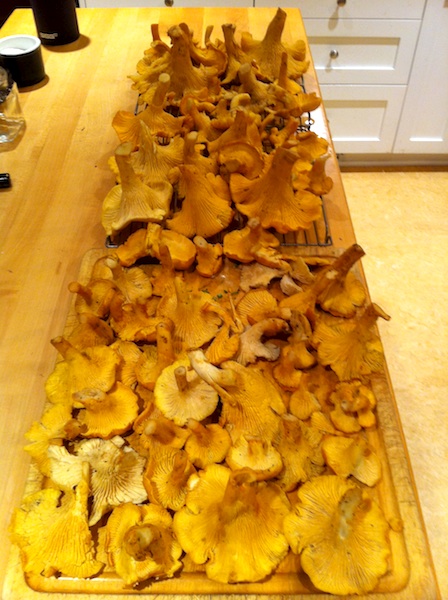
I just realized that Thanksgiving is next week, not two or three weeks in the future as I had somehow convinced myself. Luckily I contacted my turkey connection this last week, congratulating myself for being so ahead of the game. (Oops!) So now the long list of possible sides is being compiled, to be added to the "must haves" of turkey, mashed potatoes, gravy and pie, and the voting and deal-making is getting fierce. Real Good Food contributor Jim Dixon's recipe for reconstructed green bean casserole, using still-in-season foraged chanterelles, is high on the list.
Green Bean "Casserole"
I can't eat the old school version anymore, but I came up with this homage that provides the same flavors but tastes much better. If you can get chanterelles, use them, but any mushrooms will work.
Slice a pound of mushrooms and put them in a skillet with some salt but no added fat [or oil] over medium high heat. The mushrooms will start giving up water right away, and you want to cook them in their own juices until it's almost gone before adding a generous drizzle of extra virgin olive oil. (If we're having the usual November weather, chanterelles can be very wet, and this technique concentrates the flavor and improves the texture. It also works with most mushrooms.)
After you add the oil, add a finely chopped shallot and a good shot of dry sherry (a good fino is perfect). Let that bubble away for a few minutes, then add a pound of green beans that you've cooked in boiling, salted water for 3 minutes and drained. Pour in about a half cup of heavy cream, bring to a boil, and cook for a maybe 5 minutes or until the cream has thickened and the beans are tender. Adjust the salt, add some black pepper if you feel like it, and serve topped with crispy fried onions from a can (Lars is a Danish brans sold at New Seasons that's better then the ubiquitous French's). You could make your own or substitute bread crumbs or nuts, but I think some kind of crunchy topping is required. Have a great Thanksgiving.
Labels:
casserole,
chanterelles,
green beans,
Jim Dixon,
Real Good Food,
recipe,
Thanksgiving
Thursday, October 27, 2016
Wild Chanterelles Mean Great Meals This Winter
I'm sure it comes as no surprise that I follow a few foragers on social media, people like Hank Shaw, Langdon Cook and Monica Wilde. I also have friends who forage professionally, like Jack Czarnecki and his sons Chris and Stefan, of the mushroom-centric Joel Palmer House in Dayton, Oregon. Then there are the myriad chefs, cooks and other folks I know who pull on their wellies and get out in inclement weather to hunt—not pick—our wild edibles.
So when I start seeing photos of wild-foraged chanterelles circulating around the ether, it gets my heart pining to head out into the woods myself with a basket and high hopes. I actually did get to do some foraging this last weekend at Fort Stevens State Park near Astoria on the Oregon coast, but it's more well known for its porcini mushrooms, or boletus edulis, than chanterelles, due to the mix of trees planted on its former sand dunes.
Not that I was complaining about the three pounds of boletes we found there, not at all. (I wouldn't want to tick off the mushroom gods, after all.)
Luckily for Portland folk there are plenty of wild chanterelles available at local farmers' markets and stores—some even have special sale prices—so I've been able to stock up on those chanterelles in case I don't get out in the forest soon enough to catch them at their peak. An hour of roasting in the oven at 400°, draining off the juices a couple of times for the deliriously delicious mushroom stock that'll get used in risottos and chowders, and then popping the roasted mushrooms into zip-lock freezer bags. Then I'll have plenty of braises, soups and other delights to look forward to this winter.
So far we've had chanterelle quesadillas (thanks Kim Severson), a stunning mushroom chowder and last night a coq au vin with roasted yams that blew away any other chicken dish we've had lately. Fast, dead simple and so delicious, it was lucky that there were any leftovers for Dave to take to work for lunch today. Seriously, this is a company-worthy dinner, and would be more than adequate using regular mushrooms. But to send your guests into the stratosphere, invest in a pound of the wild things. You won't regret it.
Coq au Vin with Chanterelles and Roasted Garnet Yams
For the chicken:
3 Tbsp. olive oil
3 lbs. bone-in, skin-on chicken thighs (approx. 10)
1 onion, roughly chopped
4 cloves garlic, minced
1 lb. chanterelles or other mushrooms, roughly chopped or 1 cup pre-roasted mushrooms
1/2 tsp. dried thyme
2 tsp. dried basil
1 c. dry white wine
Salt to taste
For the yams:
4 medium-sized garnet yams
Preheat oven to 375°. Bring a medium pot of water to boil. Cut yams in quarters. When water boils put yams in boiling water, let it return to a boil and cook for 3 minutes. Remove and transfer to baking sheet, skin side down. Place in oven and roast for approx. 45 min. or until tender. Turn off oven until chicken is done and serve alongside.
While yams are baking, place a large skillet over medium-high heat and add oil. Heat until oil shimmers, then brown the thighs on both sides in batches, removing to a plate as they're browned. When thighs are browned, add onions to the fat in the pan and sauté until translucent. Add garlic and chanterelles and sauté until tender. Add herbs and stir in, then pour in wine. Put chicken thighs into the pan with the vegetables and wine. Bring to a boil, then reduce heat to a simmer. Cover and simmer 45 minutes. Add salt to taste. Serve.
Labels:
chanterelles,
chicken,
coq au vin,
foraging,
mushrooms,
recipe,
roasted mushrooms,
yams
Monday, September 28, 2015
Chanterelles: NW Forests, Golden Goodness
It's like an equation: Deep piles of Douglas fir needles plus cool Northwest rain equals…chanterelles! There's nothing like running across a patch of these unique and beautiful beauties while hiking in the woods, or even coming across piles of them in the produce section at your local market. Buttery, rich and tender, they're terrific plain or tossed with pasta. Contributor Jim Dixon of Real Good Food gets us started.
While the month's dry weather makes wandering through the forest looking for mushrooms very pleasant, some rain would make foraging more productive. But there are still plenty of chanterelles popping up, and if you don't find any in your favorite secret mushroom patch, head to the farmers market or a well-stocked produce department.
Funghi Trifolati
Trifolati means cooking in olive oil, garlic, and parsley, and mushrooms or funghi trifolati appear regularly on northern Italian antipasti tables. Mushrooms contain both fat and alcohol-soluble flavor compounds, so a splash of wine brings out even more mushroom-y goodness. And while it's not part of the Italian approach, starting off with a dry sauté concentrates the mushroom flavor and improves the texture dramatically.
I learned the method from an old mushroom-hunting guide called All That the Rain Promises, and More, and I always cook mushrooms like this:
Slice or tear the chanterelles into pieces and put them into a hot skillet, preferably cast iron, with nothing else. Keep the heat on medium-high, and within a few minutes the funghi will start releasing water (add a pinch of salt to help drive out the moisture). Cook, stirring frequently, until the water has almost disappeared; the time will depend on the moisture content. When the bottom of the pan starts to look dry, add a generous pour of extra virgin olive oil and a little chopped garlic.
Cook for a minute or two, then splash in a bit of white wine and let it cook down for another minute or two. Remove from the heat and add some chopped flat-leaf parsley and a few grinds of black pepper. If you're feeling Italian, eat these by themselves as an antipasto. Or spoon onto a slice of grilled bread, toss with a little pasta, or stir into scrambled eggs.
Read about one of my first mushroom hunts with Oregon mushroom guru Jack Czarnecki, and get links to more recipes at the bottom of the post.
Labels:
chanterelles,
Jim Dixon,
mushrooms,
Real Good Food,
recipe
Wednesday, October 02, 2013
Into the Woods with Jack
I heard my e-mail inbox ping with an incoming message.
The subject line: "Sharoooooms!!!" It was from one of my favorite people, Jack Czarnecki, Oregon's master of fungi and maker of truffle oil. He was inviting me along to forage mushrooms with two of his most eagle-eyed compatriots, Dick, whom I'd met on a previous expedition, and Chris, who, like Dick, is a retired teacher. I've been on a few expeditions with Jack gathering these denizens of the forest deep, and it is always an educational, entertaining and thoroughly exhausting experience, since he moves like a bear up and down hills, tirelessly seeking his quarry.
First stop, Joe's Donuts.
Our quest this time was for matsutake mushrooms, highly sought-after for their distinctly spicy, sweet aroma. Jack said he loves them for the persistence of their flavor when cooked, unlike many mushrooms that tend to lose the intensity of their flavor when combined with other ingredients. We'd also be picking up white chanterelles, which flush in the same locations as the matsutakes. Both would be featured on upcoming menus at the Joel Palmer House, where Jack's son Chris has taken the helm, allowing his father to 'shroom at will.
Find the five matsutakes.
Since we were heading up on the flanks of Mt. Hood to various hunting grounds that he and his pals had explored before, we met up at Joe's Donut Shop in Sandy, a requisite stop to ask Wy'east's blessing for the hunt and to plot the day's traverse of the mountain. After consuming coffee and several of Joe's namesake pastries (I particularly liked the applesauce, though they've now got pumpkin on the list), we headed out, turning off onto a series of Forest Service roads to the first in a series of stops.
Out in the open.
Though there were jokes about blindfolds, Jack knows I'm completely befuddled once we get off the main highway. Plus the fact that he knows the narrow, rutted roads like the back of his hand and drives them accordingly. In the car he described the matsutake and its habits like it was a member of the family, complete with tales of chance meetings and great hunts past.
But once we stopped the car and got out, he was all business. He handed me a long-bladed knife, scoffing at the Swiss Army knife I'd brought as insufficient to dig out the deeply rooted matsutake. Since I'd never foraged for this particular mushroom, and the fact that it can at first look like a number of deadly amanita mushrooms, he took pains to show me how to properly identify it.
The telltale dusty root.
The matsutake, like many fungi that grow in the forests of the Pacific Northwest, are found in areas where there is deep, moist duff from the fir trees. Sometimes they're sticking up from the surface, but most often you'll spot one barely emerging from under a hat of fir needles, or even still beneath the surface, only given away by an oddly placed hump on the forest floor. The good news is, they tend to erupt in clumps, so once you see one breaking the surface it's good to scan the area for any cracks or clumps that indicate other matsus nearby.
Jack spotted some almost instantly, and said it was important to get the whole mushroom out, root and all. That's because the most important indicator of the matsutake is at the root end, where it will have an ashy, grey dust clinging to it. The second indicator is the sharply defined gills under the cap, which emit the distinctly spicy, sweet aroma this mushroom is known for.
A happy man.
After this lesson, Jack let me go off on my own, though I always kept in sight of one of the veteran foragers, not only because they had walkie-talkies, but because they always knew how to get back to the car, a crucial skill when you're wandering around in the wilderness. Fortified by Heidi's forager's lunch (huge cold-cut, cheese and onion on rye sandwiches and her signature giant chocolate chip cookies), and after making several stops that filled up the back of the Truffle-Mobile, Jack's trusty Subaru wagon, we headed back to town.
As big as my head!
The guys were particularly impressed by my find of not just one, but three huge cauliflower mushrooms (ahem), in addition to a not-too-shabby-for-a-beginner matsutake and chanterelle take. Summing up over the required dinner at SE Powell's Om Seafood—mushroomers are apparently big on talismans in the form of restaurants—Jack said that in all his years in Oregon, going on two decades now, this may be the best year he's seen for mushrooms of all sorts. It was theorized to be some combination of warm-but-not-too-hot days followed by rain but not-too-much rain (it's like talking to vineyard people) that caused the crazy flush of all kinds of hot mycorrhizal action.
Whatever the reason, it was a thrilling day, not only because of the amount of mushrooms taken, but because I got to be one of Jack's select crew, a compliment of the highest order. Thanks, Jack!
Thursday, November 18, 2010
Wet and Wild
My friend Donald Kotler loves to grow vegetables for his café, Toast, in southeast Portland. What he can't grow himself, he'll sometimes contract with local farmers to grow for him or buy from farmers directly.
He's also a forager extraordinaire, and when he mentioned going out to hunt down some wily late-season chanterelles, it was all I could do not to drop to my knees and plead to go along. And, a couple of weeks later, head out we did on what turned out to be a drenchingly wet November day, with temperatures plummeting into the mid-40s.
One of the rosy-pink mystery mushrooms.
Since most of his favorite spots are three to four hours away and we both had to get back to town by mid-afternoon, Donald decided to head up the Gorge on the Washington side and see if we could find some likely locations. Turning off the highway past Camas, we drove up a forest road, pulling off to investigate a couple of spots that Donald said "didn't feel right" and then eventually parking at a gated side road that looked like it hadn't had much traffic of late.
Mushroom hunting is akin to other types of hunting in that you basically charge off into the underbrush, over fallen trees and through thickets. The best places don't feature groomed trails or signage ("Mushroom picking 100 yards ahead" signs are rare), and you have to be prepared to climb steep hillsides, slide down muddy embankments or bushwhack your way through the underbrush that grows up out of the Doug fir duff where you'll find your prey.
The other key, particularly if you're like me and your sense of direction goes out the proverbial window when you're in the woods, is to go with someone who possesses an unerring sense of direction, i.e. who knows where they left the car. The only other gear required is a bag for your booty, should you find any, and a pocket knife for cutting the mushrooms, rather than yanking them up and potentially damaging the root that will sprout new mushrooms. An experienced guide with a well-thumbed guidebook is also valuable.
The haul, cleaned and drying out a bit.
We began on one side of the road and found several kinds of mushrooms, some small and brown (Donald calls them LBMs for Little Brown Mushrooms), others amber-colored and some with a rosey pink glow on top and white gills underneath. Like the other trips I've made to hunt fungi, at first I find myself overwhelmed by the sheer complexity of what I'm looking at, with fallen leaves, moss, fir needles and shrubbery competing for my attention. But then I'll see one mushroom, then a few more, and eventually I'm able to pick out the ones I want from the visual noise of the forest floor.
After crossing the road, we came on several patches of chanterelles that were, like us by this point, a bit soggy from the rain. But the thrill of finding first one, then another, then a few together was thrilling enough to keep us looking until we had four or so pounds between us, at which point we reluctantly agreed it was time to head back. I'm just hoping I'll remember where it was when the season rolls around next year, but even if I can't I'll know better where to look if I stumble across a place that, in Donald's words, feels right.
Find directions on how to roast mushrooms for freezing or use in other recipes like Wild Mushrooms with Pasta and White Wine Sauce, Mushroom Risotto with Truffle Shavings, Springwater Farm Cream of Mushroom Soup and Mushroom Quiche.
Labels:
chanterelles,
donald Kotler,
mushrooms,
toast
Wednesday, September 22, 2010
My Dream Café
If contributor Jim Dixon of RealGoodFood opened a café, I'd eat there on a regular basis. The atmosphere would be convivial, with lots of conversation and laughter. The staff would be friendly yet professional, long-time servers who know (and enjoy) their customers and love food. And the ingredients would be first-rate, with Italian olive oils, grains and beans instinctively combined with the freshest seasonal produce to make simple, satisfying fare.
While I’m not really thrilled with the rain (September is usually Oregon’s best month, sunny warm days and cool evenings), it does mean more mushrooms. Some old friends have a cabin near Trout Lake, and they recently brought us a big bag of white chanterelles from the slopes of Mt. Adams.
Chanterelles and Corn
I cook mushrooms using the dry saute method from Dave Arora's "All That the Rain Promises and More,"
The mushrooms will quickly begin to give up their moisture. Watch them closely, and when most of the liquid has cooked off, drizzle with extra virgin olive oil and cook for a few more minutes. A sprinkle of flor de sal and they’re ready to eat.
With these white chanterelles, I splashed a bit of white wine into the skillet and added a chopped shallot along with the olive oil.
I’d also picked up a few ears of fresh corn at the farmers market, and while I hadn’t meant to combine them with the mushrooms, serendipity brought them together.
I cut the kernels from the cobs, tossed them in a skillet with olive oil and salt, and roasted the corn until nicely browned. Both the roasted corn and chanterelles were served as side dishes, but I couldn’t stop mixing them on my plate. The sweet corn and umami-rich mushrooms seem made for each other. While we should have chanterelles around for at least a few more weeks, fresh corn will be over soon, so pick up a few ears and celebrate the last gasp of our crappy summer.
Top photo from Langdon Cook's Fat of the Land, a terrific blog about foraging in the Northwest.
Thursday, November 05, 2009
Touching Up My Roots: Tuna Casserole

What to do with all those mushrooms I collected on my trip to the mountain, especially since they really don't last long in the refrigerator and needed to be dealt with quickly? After sautéing a few for snacking on while I cleaned the rest, I took Michael Ruhlman's advice and loaded them in a roasting pan, drizzled them with a tiny bit of olive oil and a sprinkle of salt and put them in the oven to roast.
What came out was a pan full of deep golden mushrooms swimming in a broth of the liquid that had seeped out of them (top photo). Realizing that chanterelle broth was probably not readily available on the shelf at the store, I drained off the liquid, chopped up the mushrooms and bagged them for storing in the freezer.
I had a cup or so of mushrooms left over and pondered the best and highest use of this treasure, this wonder from the wilds. And that's when it hit me. A dish from my childhood, something comforting and full of personal meaning.
The solution."Tuna noodle casserole!" I crowed. I've mentioned my love of that 50s-era "convenience" food before, the one my mother made practically every Friday night of my childhood, right?
But mine wasn't going to be a casserole made from a processed cream-like substance with little brown bits floating around in it and with shreds of big brand, mercury-laced chunk light tuna, no sir. I'd make the cream sauce from the roasted mushroom broth and those golden mushrooms and with a tin of low-mercury, line-caught and Monterey Bay Aquarium-approved Oregon albacore. And, since I know you'll ask, no, there were no Kettle salt'n'pepper potato chips crumbled on top—I wasn't brought up that lucky!
Chanterelle and Oregon Albacore Casserole
2 Tbsp. butter
2 Tbsp. flour
2 c. milk or cream or a combination of both
1 c. mushroom stock, preferably from the roasted chanterelles, below
1 c. (approx.) roasted chanterelle mushrooms, roughly chopped
1 6-oz. can Oregon albacore tuna (drain and reserve juice)
1 lb. dried pasta
Heat oven to 350°.
Put pot of water for pasta on to boil. Meanwhile, melt butter in medium-sized saucepan over medium heat. Remove from heat and stir in flour until thoroughly combined. Replace on medium heat and cook, stirring constantly, until raw taste of flour is gone. Add milk and continue stirring until sauce thickens. Add mushroom stock, mushrooms and reserved juice from tuna and heat. (Because most Oregon albacore is packed fresh then cooked, the juice in the tin is from the tuna itself. If using albacore packed in water or oil, do not add to sauce.) Add salt and pepper to taste. Remove sauce from heat, stir in chunked albacore.
When pot of water boils, add pasta and cook till al dente. Drain. Mix pasta and sauce and pour into casserole (add crumbled potato chips if you must). Bake 30 min. until top is browned.
Note: After adding the mushrooms and mushroom broth to the sauce (but before adding tuna juice or tuna), you basically have a mushroom soup. Add salt and pepper to taste and call it dinner.
Tuesday, November 03, 2009
Travels with Chili: A Mountain of Mushrooms

Let's just say it was within an hour of Portland. On a mountain. At an undisclosed location. And yes, if I told you where it was I'd have to kill you. Or it would be my neck in a noose.
"Pick me! Pick me!"But that's the way the mushroom-foraging world works. Secrecy. Blindfolds. Sworn statements.
So when my friend Kate told me she was going up to one of her favorite spots to pick chanterelles, I knew the rules. No loose lips, no sinking ships. Blogging, and even photos were allowed as long as there were, ahem, no distinguishing marks that would give away our location. Like spy craft from a John le Carré novel, only in heavy coats and wellies. And if I ever go back to that location at a later date? I would need to share the harvest (I think she even referred to it as "tribute") with her.
But for chanterelles at the height of the season in a prime picking location I would have signed away rights to my first born and given up in-house I.T. help forever. Fortunately such draconian measures weren't mentioned, and we drove up to (hmhmhmhmhmhm) just outside of (lalalalalala) under a high cloud cover and no rain in sight. The temperature was even moderate, which was a blessing considering we'd be thrashing through the dense undergrowth and over fallen logs, looking for little golden highlights poking up through the duff.
It took awhile for my eyes to adjust to the terrain, since the leaves from the deciduous trees that make up the understory are exactly the same color as the mushrooms, and it's rare that the whole chanterelle will be sticking up, waving its arms and shouting, "Over here!" And once you do make the adjustment, you see all kinds of mushrooms…big black ones, little buttons dotting a log, speckled mahogany ones gleaming and no doubt deadly.
The haul: Chanterelles and a cauliflower mushroom.So you walk and climb and look in likely spots, generally very near the base of the big doug firs, at first hopeful, then resigned, then irked that other people are finding them and you're not. But eventually you'll stumble upon (or step on, in my case) a beautiful specimen and just when a howl of frustration starts to issue from your throat, you see another one nearby, and several more right around that.
With a break for sandwiches, coffee and maybe a wee dram from a flask, we admired our sizable harvest and then spent another hour or so hunting just a few more. And with a solemn reminder to keep mum, we packed up our suddenly heavy baskets and drove down the mountain.
Labels:
chanterelles,
foraging,
Kate Vincent,
mushrooms,
Travels with Chili
Subscribe to:
Posts (Atom)