Showing posts with label Preserves. Show all posts

Wednesday, November 28, 2018

Farm Bulletin: Inner Workings, Part One: Preserves


Farms are not made solely of soil and crops; many also produce what are known as "value-added" products like salsas, sauces, flours or packaged goods that give the farmer additional revenue streams in addition to fresh produce. Ayers Creek Farm dries its corn for popcorn as well as grinding it for polenta, extending the season (and income) beyond the harvest. Here, contributor Anthony Boutard describes how they produce their (insanely) delicious preserves, as well as announcing the end of their blackcap preserves, which Carol Boutard and I came very close to producing as part of a line of food-oriented sexual aids. (Yes, it's that good.) Also, at the end of this post note Anthony's announcement of farm store days coming up this weekend, December 1st and 2nd.

About ten years ago, we were approached by a specialty food company that wanted to carry our preserves. After a lot of flattery, they asked us what about our wholesale price, then they asked what our price would be if we upped our production. We carefully explained that with a small run of preserves, there is no point at which they are cheaper to produce. All of our costs are per the jar; there are no variable costs at this scale. We explained that we are farmers who happen to make a few preserves, and are content to keep it at a scale where we don’t have to cut corners. For example, we could make cheaper preserves by adding pectin which would double the number of jars per pound of fruit, using frozen lemon juice instead of hand squeezing the lemons on the day of production, or buying machine-harvested fruit. We will leave that sort of production to professional preserve-makers, happy to defend our amateur status.

A wide selection (see complete list below).

This year will mark the last of the blackcap preserves. The raspberries as a group are tough to grow on a commercial basis as they are prone to a bevy of root diseases. Blackcaps and purple raspberries generally fall apart after four or five years, other varieties hang on a bit longer. By comparison, our oldest Chesters were planted in 1993 and are still going strong. This autumn we plowed the blackcap plants under and prepared the land for other crops. It was our third planting and, with a measure of sadness, we have decided against planting more. With increasingly uncertain weather and high establishment costs, it is no longer a wise investment. We will have a few jars of crabapple jelly this week. It is a lovely, subtle jelly that was once the domain of patient, elderly sorts, and one of Anthony’s odd fixations.

Paul Fuller and Carol Boutard in production at Sweet Creek Foods.

In 2017, early stone fruit was shy due to rain and frost during bloom. Too few to even bother harvesting for preserves. A relatively dry and mild spring this year allowed us to bring back green gage, golden gage and tart cherry preserves. The lack of any temperature spikes in June and July along with cool nights assured high quality currants and berries. Winemakers will rattle off their favorite years when everything seems to fall into place. It is no different with other sorts of fruit, though without the attending cachet. Good thing, too. We would hate the thought of people asking if we had any of the ’15 raspberry with its refined floral notes and delicate tannic finish.

The Hungarian-type cherries (Balaton, Jubileum and Danube) are morello types, meaning they have a dark red juice rather than the clear juice of the Montmorency-type. Staff froze 210 pounds of the cherries in July. In the past, we have made preserves from a mixture of the Hungarian and Montmorency cherries, but this year we decided to try the single sort.

Anthony with his prized Montmorency cherries.

In early November, the two of us pitted them, netting 164 pounds for processing. We have a fine cherry pitter collection, including an expensive stainless machine designed to pit 10 at a time. At the moment, we favor a cheap plastic sort that sits well in the hand. We take a few pounds out the freezer at a time, let them soften for 20 minutes or so, and then remove the pits. The pitter lasts for about 70 pounds and then something breaks. Even with hand-pitting, a few pits manage to find their way into the processed fruit.

When we started cooking the cherries last week, we discovered the fruit wanted to float in the filler, so some jars had no fruit, just syrup, and others all fruit. Not good. Fortunately, Paul was quick on his feet and set up a hand-filling station. Linda Colwell, who had dropped by Sweet Creek simply to observe the process, was quickly handed a hairnet, gloves and apron, and pressed into service.

Jostaberries.

Cherries are low in pectin relative to other fruits, so the set is quite loose. We have never added commercial pectin because it dulls the fruit’s character, as does longer cooking to concentrate the fruit. As with our other fruits, in cooking we only go to 222°F (105°C). Better bright and active than dull and sedentary is our operating principle. We are very happy with the resulting flavor. An excellent sauce on ice cream.

The Hungarians were planted at the suggestion of Trillium Blackmer, who bought our Montmorency cherries at the Hillsdale Farmers’ Market.* One day Trillium wistfully noted that she really enjoyed Balaton cherries and she wished someone would grow them in Oregon. Her plea was compelling. At the time, nursery stock for the Hungarian-types was almost impossible to find. Balaton had been released only a few years earlier in 1998 and the cherries were unknown outside of Michigan. We tracked down a couple dozen at Cummins Nursery, a very small operation in Ithaca, New York. We ordered every tree available over the next couple of years. The Hungarian cherries are registered varieties and the royalties we paid on our trees went to fund fruit research in Hungary.

Read Part Two, Inner Workings: Horseradish.

*Ayers Creek Farm no longer attends the Hillsdale market.

* * *

From Anthony: We are planning open days for the coming weekend, the 1st and 2nd of December. Our hours will be from 1 pm to 4 pm. As a reminder, we are strictly cash or check; we do not have the ability to process electronic payments. For those who find the journey out to the farm difficult or prefer the ease of electronic payments, World Foods' Barbur location and Rubinette Produce carry robust selections of our beans and grains. Pastaworks, which has carried our preserves since our first run in 2005, has a complete selection of our preserves at its City Market and Providore locations.

We will have a full selection of preserves, beans, and grains, as well as chickpeas, mustard and other odds and ends. We will have family-sized beets, horseradish, melons, tomatillos, spuds, big white onions and other stuff. Our selection now includes: Loganberry, Boysenberry, raspberry, golden gage, green gage, Italian prune, Veepie grape, blackcap, red currant, black currant, jostaberry, damson, tart cherry, quince jelly, crabapple jelly (available only at the farm).

Ayers Creek Farm can be found at 15219 SW Spring Hill Rd., Gaston, Oregon, 97119.

Saturday, February 04, 2017

Farm Bulletin: Particular About Preserves


The first time I tasted the preserves from Ayers Creek Farm, it was their black cap jam, and I was bowled over by the intensity of the fruit that burst from it. Subsequent jars of plum, blackberry, raspberry and quince jelly each carried the same concentrated flavor intrinsic to its particular fruit, and I've found very few other preserves that can match it. Here contributor Anthony Boutard reveals the secret to their preserve-making prowess, and why other brands may never measure up.

Our preserves are made from the farm's fruit only. If the fruit is shy in the field, it is shy in the kettle and then in the jar, but we hope never shy on toast. The fruit is predominantly the first run from the field, the very best for processing because it has high acidity, along with high aromatic and pectin content. Lots of character and an outgoing disposition. Acidity, not sweetness, defines a fruit. Paradoxically, on most berry farms this highest quality fruit is left to over-ripen or rot because there is not enough to justify mustering a crew to harvest it, let alone the time and fuel needed to deliver such a small quantity. The economics of berry production are tight. Fortunately, we are diverse enough that staff can harvest for a hour or so in the cool of the day, and then set up irrigation and perform other essential tasks. And we only have to deliver the fruit to one of our freezers.

Because of the fruit's quality, we achieve a good set without adding commercial pectin. We freeze the berries whole in the harvest crates without crushing them. This preserves the aromatics and avoids any enzymatic degradation while the fruit is freezing. For the plum preserves, staff harvests a blend of firm, acidic fruit and riper, more aromatic fruit. The mix lends more character to those preserves.

Most are processed using 750 grams of sugar per kilogram of fruit, and freshly squeezed lemon juice. The currants and jostaberry are prepared using 950 grams of sugar per kilogram of fruit. All are cooked in two gallon lots using a set of four small steam kettles. We use sensitive digital thermometers to track the temperature of the fruit. We generally shoot for 220-221°. However, each of the 15 fruits cooks differently, and they vary from year to year. This year, the purple raspberry set at 216°, the lowest we have ever seen in our fruit. Still scratching our heads over that. The behavior in the pot indicated a set had been achieved, but the reading on the thermometers didn't match, so we decided with our eyes rather than the instrument. An overcooked preserve is a terrible disappointment. As a general matter, we err on the side of a runnier set rather than risk a gummy texture and dull flavor.

When finished, we have concentrated about a half pound of fruit in each 10-ounce jar. When we started making preserves, we found there were all of these baffling rules of identity defining jams, conserves, jellies, sauces, spreads and preserves. We artfully dodge the identity question by avoiding any description on the label. All we do is name the fruit and ingredients.

Our ability to make preserves of this quality rests on a very special relationship we have developed with the owners of Sweet Creek Foods, Paul and Judy Fuller. Since 2005, we have produced more than 35,000 jars of preserves at their factory in Elmira, about 35 miles west of Eugene. They are set up to process large quantities of fruit in several 200 gallon kettles, thousands of jars a day. The physics of cooking in large kettles require the addition of commercial pectin, something we have avoided because those pectins bind with the fruit's acids and dull the flavor. We pay extra to use the little kettles that otherwise are reserved for testing purposes, and eke out about 1,000 jars each day. As Paul notes, he could do that in an hour if we weren't so damned picky. We sweeten the deal by bringing down a huge pot of soup for Paul, Judy and their staff.  

The difference in price between the different types is not an indicator of quality differences. The difference reflects extra labor costs and shrinkage associated with deseeding, and removing the stems from the currants. In the case of damsons, it's the labor associated with pitting such a small plum. Jellies are their own challenge because the juice and pectins must be extracted by slowly stewing the fruit, and then drawing off and decanting the clear liquid. They are our art project, the test of our mettle as preservers with their fragile, jewel-like essence. With jellies, there is no gracious exit from a mistake.

We don't have a favorite preserve as such; they all find their way onto our table. However, the one that is the true measure of our efforts is the red raspberry. Commercially prepared raspberry preserves, jams, conserves, spreads, however they are identified, are found in every grocery store in the land, and many of us had parents or grandparents who put up some raspberry jam. If we felt our red raspberry tasted the same as Smuckers or some tonier brand, we wouldn't devote the time and effort. On the other hand, we are not foolish enough to compete with memories and are very happy if the quality simply reminds you of the raspberry jam you enjoyed at your parents' or grandparents' table.

Tuesday, December 15, 2015

Great Gifting: The Gift of Deliciousness


Oregon is a place full of growers, artisans and makers, especially when it comes to food. For those who aren’t lucky enough to live here, nothing can top a care package of Northwest-made goodies.

To follow on this year's theme of giving self-liquidating gifts, i.e. those that don't need displaying or dusting, this list of some of my favorite producers is just a start—and don’t forget locally roasted coffees, cheeses, cookies and more.

If you prefer to head out to the shops and hunt down your own gifts instead of shopping online, you can't do better than to make a beeline to a farmers' market near you and buy any of the myriads of delicious, homemade treats direct from the folks who made them.
  • Ayers Creek Farm Organic Preserves The best preserves I've ever had, period. Get some for yourself while you're at it. Also available at Vino Wine Shop, Pastaworks, City Market, Food Front Co-op and People's Co-op.
  • Meat Tubes from Old Salt Marketplace If you have someone on your list who loves meat products, or if you need a handy gift to take to a holiday party, call or e-mail these guys and order one of their gift "tubes" (above right) of responsibly sourced, handmade meats and accompaniments. I'm thinking of a couple of people I know who'd love one!
  • Willamette Valley Confectionery Old-fashioned peppermint bark and pate de fruit (made from fruit from local farms).
  • Quin Candy Handmade, small-batch candies with a modern twist.
  • Alma Chocolate Sarah Hart's chocolates, caramels and bon bons are unique, beautiful, delicious and handmade with care. 'Nuff said.
  • Cardamom Hills Trading Co. chutneys Sourcing from local farmers' markets make Sophie Rahman's chutneys so vividly flavorful that any of the commercial brands you may have tried pale by comparison.
  • Jacobsen Salt Co. Salt Harvested from Netarts Bay, I can't think of a cook on your list who wouldn't love some of this salt in their pantry.
  • Bee Local Honey Local bees making hyperlocal honeys.
  • Urban Cheesecraft DIY cheesemaking kits These little kits are perfect for any cheese lover on your list, and simple enough for the youngest!
Read part two of this post about getting some exclusive, small-batch fresh-pressed olive oils from Italy! And read the other posts in this year's Great Gifting series: The Gift of Class(es) and A Gift that Keeps on Giving.

Tuesday, August 04, 2015

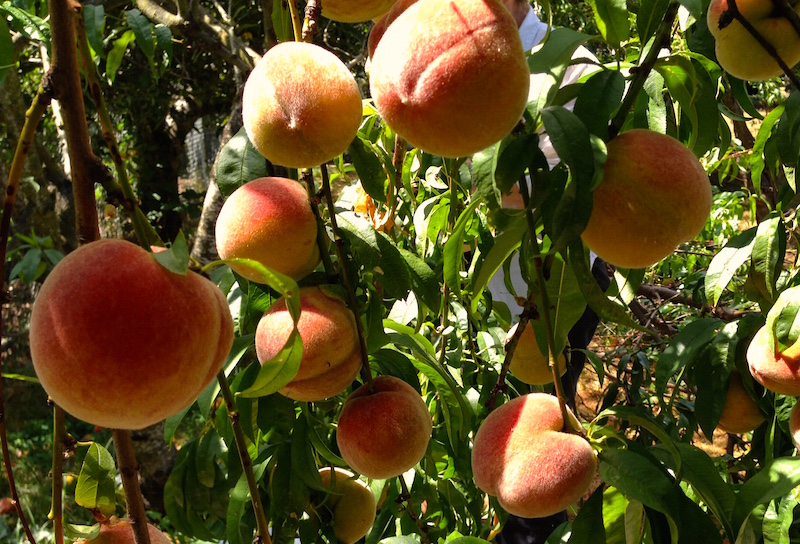
A Peach of an Offer


A text message from my friend Ann was all it took:

"Need peaches? A friend invited me to come pick peaches from her three overloaded trees. I thought I'd go this afternoon. Want to come?"

How could I refuse to help unburden those three trees? It verged on turning away from a lost puppy or refusing to help a poor lost soul.

In other words, I was so in!

With our boxes stacked in the back of Chili, we arrived at the aforementioned friend's home in the Cully neighborhood to find that, indeed, the trees were so loaded with fruit that several large branches had torn off under their weight. A few ripe peaches had fallen of their own accord and were lying in the grass gently decomposing in the warm shade, but few bees were buzzing around, making our job ever so much more pleasant.

A slight press with a finger into the flesh near the stem gave a good indication of ripeness—a bit of "give" is all you're looking for—and, since there was so much that was ready, it took us only about a half hour to get twenty pounds apiece. Even better, since it was obligatory that we taste test a couple, they turned out to be not only richly sweet and juicy, but a freestone variety that peeled with a simple tug at the skin near the stem. What a treasure trove!

When I got home it was incumbent upon me to make a dessert with them, and with peach cobbler near the top of my nigh-perfect dessert list, I whipped one up and stuck it in the oven. While it baked, I sliced up and froze a gallon-and-a-half or so on parchment-lined cookie sheets to be dumped into zip-lock bags for a surprise dessert in the dead of winter. The rest were made into peach jam in two batches over the next couple of days as the not-so-ripe peaches matured, more goodness to open up in the coming fall and winter, reminding me of that hot, sunny day under the peach trees with my friend.

Peach Jam

The first fruit of the season, whether berries, stone fruits, zucchinis or cucumbers, have naturally high levels of pectin, so you can make preserves without resorting to adding pectin, which some people feel changes the flavor of the fresh fruit.

15-16 ripe, medium-sized peaches
3 1/2 c. sugar
1 Tbsp. fresh-squeezed lemon juice
1/2 tsp. salt

Pit, peel and cut the peaches into 1/2" or so chunks. Put in large saucepan or Dutch oven and add the rest of the ingredients. Bring to a gentle boil over medium heat and simmer until the jam is thickened and sticks to back of a spoon. (You can also do the frozen plate test.)

I like my jam a little runny and it took about 2 hrs. or so to get to that point. I also don't like excessively sweet preserves, so judge the amount of sugar based on the sweetness of the fruit and your own tastes. If the jam is too chunky for you after it cooks, take a potato masher and squish it until it's the right consistency.

As far as canning, I simply take washed jars and fill them within a quarter inch of the top, put on the canning lids and rings and cool them to room temperature, then freeze them. If you have a hot water-bath canner, follow the directions for shelf-stable storage.

Saturday, November 16, 2013

Farm Bulletin: Preserving the Best of Summer


Ayers Creek Farm returns to the Hillsdale Farmers' Market on Sunday (11/17) from 10 am to 2 pm for its winter run, and they are bringing along the first batch of their stunning preserves, including a couple of new contestants for the title of "Most Addictive Jams & Jellies."

Preserve production is when we reprise our summer, the good moments and the disappointments. All of the fruit we use, with the exception of lemons, comes from the farm. Many farmers contemplate preserve production as a way to capitalize on surpluses and low grade fruit, throw some sugar and pectin into a big pot and you have something to sell. Extension people call it "value-added." As we warn other farmers, the notion that making preserves as "value-added" is simply poppycock. We must purchase the jars, organic sugar, organic lemons and pay for the use of Sweet Creek Foods' kitchen and staff. We have added an investment and value is added only if and when you sell the preserves for a profit, so there is no sense poking some low grade fruit in glass.

Carol and Paul starting a batch.

We started making preserves from the opposite end of the harvest. The very first berries to ripen in the field are the highest quality fruit. They set up well without any added pectin and the flavor is brightest due to their higher acidity. For us, taking the better part of the day to deliver ten flats of berries is a waste of time and fuel. So early in the morning, we bring in a few flats each day and freeze the berries. We never crush them; they are packed into buckets whole when frozen. This gentle treatment preserves the aromatics and acidity of the fruit, as many of you know because you handle our berries the same way.

Small-batch cooking at its finest.

Our preserves are very farmer-ish, just one type of fruit and no secret ingredients or surprising combinations. The preserves are cooked in 2 1/2 gallon steam jacket pots, so the cooking surface is a gentle 270°F (132°C). We cook about a gallon at a time. Paul Fuller has three 275-gallon pots, but at that volume, you have to add pectin in order for the fruit to gel. Several years ago, Carol's brother, Bill, visited the farm and walked us through a series of very carefully documented variations. Tasting the various versions, it was clear to us that adding pectin robbed a vital part of the fruit's spirit, inconvenient and indisputable. Sweet Creek has just two of these small pots, but Paul has added two more so we can increase production next year. There is no other co-packer in Oregon that would put up with our fussy demands, so as long as Paul and Judy own Sweet Creek and welcome us back, we will make preserves.

The most important tool for us is Paul's Omega HH1501AJK digital thermometer. In cooking, the fruit goes through a series of temperature steps. The critical range is 220 to 222°F (104.4 to 105.5°C). The fruit sets up in that range—if you allow it to bounce up to 224°F (106.6°C), the fruit has an overcooked flavor and texture. One year, the cord to the thermometer frayed and we had to use a different one for the last run of the day. The calibration was off and the fruit overcooked slightly. We now have our own Omega, so if one goes we have a backup. It also allows us to conduct test runs at home.

My favorite, the blackcap.

As we noted earlier, we see the season reflected in the fruit. The heatwave that came through during our ramble in June destroyed much of the black currant, boysenberry and blackcap crop. We have some, though not enough for the stores. The early raspberry and loganberry crops preceded the heat wave, so they are in good supply. We have done an even better job with the tart cherry preserves, though they are inherently lower in pectin than other fruit and are on the runny side. We have yet to perfect pit removal, so there will be an occasional pit in the jars. This preserve is an even greater labor of love than the others and we should drop it but we like it too much. This year, we have added a small run of grape preserves from the Veepie grape. The goal is a grown-up grape flavor with skins in the mix. The golden gage and mirabelle are back as well.

Aphrodite holds a quince.

Speaking of labors of love, Aphrodite is often portrayed holding a quince. Our two small quince trees had such a heavy crop that the trees largely collapsed. We have a small run of quince jelly in memoriam for the efforts of those two unfortunate trees. They will recover eventually and we are planting more because we cannot imagine life without a bit of quince jelly. Eventually, we will add more jellies to the mix. We have several crab apples which should bear good crops in a year or two. The jellies will test Paul's patience even more, which should him some level of beatification among fruit lovers. Though we promise him that we will stop at 19 different preserves, a good prime number, so there are just two more types to go.

Photo of statue of Aphrodite from Wikipedia.

Saturday, September 21, 2013

Jammin' with Peaches


My mother grew up in a tiny ranching town at the foot of the Blue Mountains in Eastern Oregon where winters were long and stores were few. Which meant that any fruits or vegetables that grew in their garden or that they could buy from local farmers were canned or preserved for the cold months. During my childhood she'd haul out the old blue and white-speckled canner and "put up" jars of cherries, peaches and jams that would line the shelves of the pantry, releasing the sweet flavor of summer on frigid winter mornings.

I never caught the canning bug from her, but every once in awhile even I'm tempted to preserve a little summery goodness in glowing glass jars. Though instead of lining my pantry they go in the freezer until a piece of bread or bowl of ice cream calls for some adornment. This year's stunning peach crop deserved to be enshrined in jars and celebrated on special occasions, so I did a little research and made the following freezer jam. I think my mother would be pleased.

Peach Freezer Jam

4 lbs. peaches
2 c. sugar (add more if you like sweeter jams)
1/4 c. lemon juice

Place three salad plates in the freezer—these will be used to test the jam to make sure it's jelled.

Peel and dice the peaches. Place in large pot or Dutch oven. Pour sugar and lemon juice over the top, stir briefly and let it sit on the counter for 1-2 hrs. This will allow the peaches to macerate, releasing some of their juices. Then mash the peaches until they're the consistency you like. (I prefer mine a little chunky.) Over medium-high heat, bring the fruit to a boil then reduce to a simmer, stirring often to prevent sticking. Cook for 30 minutes. Pull the first plate out of the freezer and spoon a small amount onto the plate. Let it sit for a minute, then test it with your finger. If it has formed a skin and doesn't seem too runny, it's done. If not, cook for another ten minutes and test again. Repeat until it suits your taste. (I like mine a little runny, the better to soak into a warm piece of toast or melt into a bowl of ice cream.)

Bring a shallow pot of water to boil on the stove and put the caps and screw-on lids in it. Boil for 1 minute to sterilize them. Spoon the cooked jam into clean, dry glass jars, leaving about 1/4 inch at the top. Cap and screw on lids. Allow to cool and then put them in the freezer.

Get more peachy recipes: Bourbon Peach Sorbet, Peach Cobbler.

Wednesday, April 27, 2011

Jam On It


This article appeared in the March/April issue of NW Palate magazine.

Forget Captain Crunch. Even Tony the Tiger couldn’t entice me, no matter how loud he roared. Snap, Crackle, and Pop made too much noise first thing in the morning. Pancakes? Too much fuss. Fried eggs and bacon? Meh.

What I loved for breakfast as a child was toast slathered with butter and smeared with my mother’s homemade jam. She was a whiz, cooking up pots of strawberries, raspberries, peaches, and pears and pouring them into jars large and small that were saved from the ones we’d emptied the previous year. Opening a jar of her strawberry freezer jam was like an explosion of distilled summer, with its bright red color and deep, rich strawberry flavor.

Wherever I travel, I try to bring back a few jars of local jams and preserves, made from fruit grown in the area, to extend my trip just a little bit longer, if only for as long as it takes to have breakfast.

Oregon

King Estate
The organic fruit in their Blueberry and Raspberry Pinot Noir jams is grown on the winery’s estate near Eugene and infused with their outstanding wines. 9 oz., $8. Available online or at the winery.

Republic of Jam
Master “jammelier” Lynnette Shaw makes low-sugar, artisan jams from Willamette Valley fruit. Most interesting is her Mostarda di Carlton Apple, a traditional Italian condiment that’s more like chutney—a tasty accompaniment to sausage or roasted turkey. 9 oz., $8. Available online and at the tasting room in Carlton.

Marché
Chef Stephanie Pearl Kimmel, founder of Eugene’s revered Excelsior Café, now owns Marché Provisions in the 5th Street Public Market. Her berry jams and pear butter are made from all-organic local fruit. 9 oz., $6.50. Available online and at the store.

Sassafras Southern Kitchen
A budding project of four Portland women, the collaboration has cooked up Southern-inspired preserves, from fig to brandied plum, plus a few enticing relishes—Sunchoke, Pear and Meyer Lemon, and Heirloom Beet and Fennel. 8 oz., $8–$9. Available online and at some Portland retailers.

Ayers Creek
If it’s heirloom, orphan, or rare, farmers Anthony and Carol Boutard will try to grow it on their farm near Gaston. Look for Damson plum, Loganberry, and Italian Prune. Oh, and their blackcap jam also qualifies as a marital aid. 8 oz., $6. Available at the Hillsdale Farmers’ Market and online at Portland-based specialty food store, Foster & Dobbs.

Oregon Growers
A collaborative effort of several growers around Mt. Hood, these jams use less sugar than traditional recipes, allowing the full flavor of orchard fresh fruit to shine through. 12 oz., $6.50. Available online and at specialty food stores around the Northwest. 

Pennington Farms
The Penningtons started as flower growers in Colorado before moving to Oregon’s Applegate Valley to start a 90-acre berry farm and bakery. Their Strawberry/Rhubarb is pie in a jar. 16 oz., $6.50. Available online and at area specialty food stores.

Sunset Valley Organics
Seven years ago, farmer Bob Wilt’s diabetes led him to shift his farm to organic growing methods. His blueberry jams, spreads, and preserves are made with as little sweetener (evaporated cane juice) as possible for health and flavor benefits. 10 oz., $5.95. Available online and at specialty stores in Oregon and Washington.

Washington

Blue Cottage Jams
The Martin family started making jams for themselves and their friends. Fifteen years later, their low-sugar preserves and butters, all made with Washington fruit, are in demand all over the state. Try the Montmorency Cherry Jam, made with a unique variety of tart pie cherries. 7 oz., $5.25. Available online and at select stores.

Aldrich Farms
These jellies and preserves are a celebration of Whatcom county fruit. Check out the Cranberry Pepper and Blackberries & Brandy. 5.5-12.5 oz., $4.95-$7.95. Available online and at various area farmers markets.

Wild Harvest
It’s best to leave the berry picking to the professionals, as bears and cougars love them too. These jams are made from hand-gathered mountain huckleberries, blueberries, blackberries, gooseberries, lingonberries, and black currants. 8 oz., $8.95. Available online and at stores statewide.

Woodring Northwest Specialties
Dale Nelson, a chocolatier by trade, also makes some fine fruit jams and preserves. Rare finds: Golden Raspberry, Gooseberry, and Mimosa Marmalade. 9 oz., $7.75–$9.75. Available online and at his store at Seattle’s Pike Place Market.

Sakuma Brothers
This fourth-generation farming family in the heart of Skagit Valley grows their own berries and processes them into jams. Try the Tayberry, a cross between a loganberry and black raspberry. 12 oz., $4.95. Available online and at their market stand in Burlington.

Canter-Berry Farms
On their historic five-acre farm in Auburn, Clarissa and Doug Cross have made a living growing and making jam from some of the tastiest blueberries in the state. Available online and at their Pike Place Market store. 11.5 oz., $7.

British Columbia

Taste of the Okanagan
It’s refreshing in this day and age when a company says, “We don’t put ‘JUNK’ in our jars,” meaning unequivocally no preservatives, additives, or food coloring. Their product line includes intriguing flavor profiles such as Apple Rosé Wine and Beer-Blasted Pepper. 8.7 oz. (260 ml), $9.50 CDN. Available online year round and from June through October at the Kelowna, B.C. Farmers & Crafters Market.

Mix Bakery
To accompany their award-winning baked goods, this Vancouver-area bakery makes a selection of cool jams in flavorful combinations like Plumbleberry (plums with mixed berries) and Pear with Balinese Vanilla. 8.4 oz. (250 ml), $7.95 CDN. Available at the bakery and online at Edible BC.

Joy Road Organics
A 100%-organic line of preserves created by two BC chefs from the Okanagan, Dana Ewart and Cameron Smith. Try their Blood Orange Marmalade, Red Haven Peach, and Coronation Grape. 8.4 oz. (250 ml), $7.95 CDN. Available online and at the retail location of Edible BC, at Vancouver’s Granville Island Public Market.

Vista D'oro
Great with pork or as an accompaniment to blue cheese, the Turkish Fig confiture is made with the excellent walnut wine also produced on the farm. 7.75 oz. (770 g) $8.95; 14.1 oz. (400 g) $14.95. Available online, at their farm store in Langley, B.C., and at Edible BC.

Fore & Aft
Caterers Patrick Brownrigg and Beverly Child make a pair of sweet-meets-savory flavors: balsamic jelly [8.4 oz. (250 ml), $6.95 CDN] and red pepper [2 oz. (55ml), $2.95 CDN]. Available at Edible BC.

Okanagan Lavender
Andrea McFadden started growing lavender when she inherited her father’s declining apple orchard. Now she captures the flavor of summer in lavender jelly—the best thing ever with lamb. 4.2 oz. (125 ml), $5.95 CDN; 6.4 oz. (190 ml), $8.95 CDN. Available online and at Edible BC.

Saturday, September 05, 2009

Farm Bulletin: How It's Done


This latest essay from contributor Anthony Boutard of Ayers Creek Farm describes the relationships, informal and collegial, that exist between farmers, suppliers and, yes, even bureaucracies.

We buttoned up the Hot Lips harvest [Ayers Creek supplies berries for their sodas. - KAB] on Monday, and shifted our attention to packing blackberries for Sweet Creek Foods. Run by Paul and Judy Fuller, Sweet Creek is a small processing facility located in Elmira, west of Eugene. They source everything they can locally, and also allow farms such as ours to use the facility. Without Paul and Judy, we would not be able to produce our preserves. They also work work with a host of other farms in the valley. On Wednesday, when we went down to collect empty buckets and move some fruit into their freezer, Paul had just returned from the coast with a load of tuna.

The trip to Elmira takes us down 99W, and is a spectacular trip. On Wednesday, the last burning of the south valley grass seed field was taking place, for better or worse. From now on, only a small area of fescue production in the Santiam Hills will continue the annual rite.

Seed production is a vital part of the valley's agriculture, and many seed houses have offices in Brownsville. The list of seeds grown in the valley is more extensive than simply grasses. You may pass a quarter section planted to coriander, cabbage, beets or turnips. The passerby may wonder why a whole field of squash has been wastefully left unharvested when, in fact, it is being grown as a seed crop. In a seed production area, it is vitally important for producers, even as competitors, to know where everything is planted in order to avoid cross pollination. Similar crops, for example turnips, need to be isolated from one another by as much as two miles to keep the seed crop pure. For wind pollinated plants such as corn and beets, the isolation distance is greater.

To administer the seed production area, the extension office maintains a "pinning map" (right). The seed companies literally take a pin which has a small card with the seed type and variety being produced attached to it, and pokes it into the property where they will pant the crop. It is an honor system based on years of custom and collegiality.

Yesterday, we filled the van with the buckets of freshly harvested blackberries and called Paul to tell him the van was on the road. He leaves Elmira at the same time, and we transfer the fruit when we meet, usually around Monmouth if traffic is light. If all goes well, we will complete Sweet Creek's order next Friday. We will next see Paul and Judy when we process our preserves in late October. The fields will have greened up from the autumn rains and big leaf maples will glow among the dark firs.

Photo, top, by Jen McCabe for The Oregonian. Pinning map by Lindsey du Toit, Washington State University.