Showing posts with label NW Palate. Show all posts

Saturday, October 08, 2011

Paddling in the Gene Pool


When I was a kid my summer activity of choice was spending hours submerged in the blue quietness at the deep end of the pool, seeing how long I could swim underwater without coming up for air. Sailing was a revelation that had to wait until I was an adult, when friends invited Dave and I to go out on their sailboat. My favorite sailing moment always came when the engine shut off, the sails unfurled and the only sound was the prow cutting through the water and the wind whipping the rigging.

Tiny Cowichan Bay.

As I mentioned in an earlier post, when Eric Pateman of  Edible Canada asked if I'd be interested in going on one of their gourmet kayaking trips, it was all I could do not to scream "Woo hoo!" into the phone, no doubt scaring the bejesus out of my would-be host. But I managed to maintain my composure, which meant that a few weeks later I was driving a rented car up to the small town of Ladysmith on the inland coast of Vancouver Island, an area known as the Cowichan Valley.

Hilary's Cheese.

Like our own corner of the Northwest, the valley is known for its bounty of local produce and wines, as well as cheeses, beer and bread…sound familiar? So on my way up to Ladysmith I stopped in the tiny town of Cowichan Bay to sample some of that local goodness at Hilary’s Cheese shop. Hilary is Hilary Abbott, the man who, with his wife Patty, makes the cheese from island goat and cow milk. The day I was there they had a slightly aged goat cheese with a grape must-washed rind, a mild goat cheddar and a goat blue with a greyish, bloomy rind. All were fairly fresh so hadn’t developed many secondary characteristics, but all three were uniformly delicious. The cheese plate came with slices of bread from the shop next door, True Grain, which features BC, and even some island-grown, grains and flours.

Morning from my window at Island Estuary.

After filling up on the cheese, bread and fruit at Hilary's, I headed for the Island Estuary Bed and Breakfast, owned by chef Lynda Diamond and her husband, photographer Ted McCrea. The B&B, which was to be our base camp for the weekend, was situated on a wooded hillside just south of Ladysmith overlooking Holland Creek Estuary and Ladysmith Harbour.

Lynda's amazing albacore with seaweed salad.

The large, comfortable house is beautifully designed and filled with artwork that Ted and Lynda have collected from local artisans, and each room features a stunning view out over the estuary. Lynda strives to serve locally sourced food, including coffee from a local roaster, wines from the island and produce from area farms.

One happy paddler.

With a terrific lunch of fish tacos with a couple of kick-ass salads alongside, the assembled group of ten intrepid paddlers was off to our first lesson a few minutes' walk up the beach at Sealegs Kayaking. As a complete newb, I was a teensy bit nervous that I'd totally embarrass myself and tip over, lose my paddle or not be able to keep up with the rest of the group. By the end of the weekend I was very proud to say that none of that happened, and since the group was made up of a wide range of skills and physical abilities, I fit right in.

The Island Estuary Cosmo (recipe below).

In the three days we had drop-dead gorgeous weather, fantastic food, calm waters (those inland channels, remember?) and saw lots of seals and jellyfish. I'll save the specific details for the article I'm writing for NW Palate magazine (the Mar./Apr. 2012 issue), but suffice it to say that this area just north of Victoria is well worth visiting all on its own or for a few days out of a longer trip.

Here's a recipe for a killer Cosmo that Lynda served the first night:

Island Estuary Cosmo
From Lynda Diamond

1.5 oz. vodka*
1/2 oz. Cointreau or any other orange-flavoured liquor
2 tsp. of Rose's Lime Juice or fresh lime
1.5 oz. cranberry juice

Mix all together in a cocktail shaker with lots of ice, then strain into glasses. Enjoy!

* Lynda said she uses Schramm vodka from Pemberton Distillery and always keeps it in the freezer.

Saturday, October 01, 2011

Singular Expression


If there's a nautical gene in the pool, I've definitely got it. As a kid, Flipper was my favorite show, not because I envied the adventures of the two boys who befriended the marine mammal, but because I wanted to be the dolphin swimming free in the ocean. (I was much too young to know the facts of captive, trained dolphins back then.)

So when I got a chance to go up to Vancouver Island to do a story for NW Palate magazine about Edible Canada's gourmet kayaking weekend, I couldn't clear my calendar fast enough. The trip was a tour of the waterways near Ladysmith, BC, wide stretches of flat water that are home to seals, fish and jellyfish. But first I had to get there.

My first stop was a night at the Stone Soup Inn just north of Duncan in Lake Cowichan, BC, a bed and breakfast as well as a restaurant. I pulled into the driveway just as owner Brock Windsor and his wife, Ayako, were unloading their van stuffed with produce from area farms. The perfume from several tiny cantaloupes poured out the open van door, and cases of heirloom tomatoes glowed in its dark interior, along with beets, lettuces and herbs still dripping with morning dew.

Stone Soup is also a working farm, with chickens, turkeys, pigs and a large vegetable garden that supplies the restaurant with eggs and produce. And Brock loves to head out with his backpack to forage for mushrooms and other wild edibles, and has relationships with local farmers for specialty crops that he can't grow himself. But ask to see a menu and he'll tell you there is no such thing here. He serves is whatever is fresh and available in five course "surprise" tasting menu for $65 with a wine pairing of BC wines for an additional $35.

The night I was there I was the only guest, but Brock insisted on giving me the whole enchilada, even saying it was fun to cook for just one person. So despite my protests I was seated at a corner table, and Rachel, his able kitchen and dining room assistant, started me off with a 2010 Averill Creek Pinot Gris and a salad of iceberg lettuce, a new variety from France that Brock had found, tossed with nasturtiums, shiso, Vidalia onions, slivers of poached Qualicum oysters and lemon cucumbers from Rachel’s garden.

It could have been awkward sitting there by myself, but Rachel was fun to talk to and Brock would come out of the kitchen to tell me about each course. The second wine was a 2010 Rocky Creek Ortega from Cowichan Bay, white-gold with a pink cast, with a big flowery nose and a sweetness that worked well with the acidity of the next course, a single slice of a very large yellow-red Pineapple tomato with a few roasted hazelnuts, black cherry tomatoes and a sheep sorrel-chive mayonnaise. It was served in a very warm pasta bowl, which heated up the tomato, a nice touch.

The next wine was a 2009 Blue Grouse Pinot Gris from Duncan, a white with a nose like blue cheese. It came with a super-fresh chunk of seared skin-on salmon from nearby Port Alberni that was served on a combination of green runner beans and roasted apricot, fig and Nodding onion with a little fresh tarragon (top photo). Can you say crazy delicious?

The entrée, God help me, started with a red, a rich, juicy ’08 Garry Oaks Zeta from Salt Spring Island. It complimented a loin of pork from one of the pigs Brock had just slaughtered, very lucky pigs that are fed the same food he serves in the restaurant (i.e. kitchen scraps). It came with a transparent applesauce (“The way my mother made it.”), roasted cauliflower, his garden carrots, a luscious ham broth from the roasting of the loin, beets, potatoes and a side of chanterelles that he and his son had picked.

If you can believe it, I was still upright for the dessert, which commenced with an ’09 Averill Creek Cowichan Black made from blackberries, a perfect accompaniment to a molded chocolate mousse that stood in the middle of a rosemary-infused caramel sauce, berry coulis and a pingpong ball-sized globe of blueberry sorbet. Fan-freaking-tastic.

It's amazing I didn't need to be rolled up to my room, but I have to say I slept soundly till morning, eventually making my way downstairs to find my corner table set with toast and coffee. I poured a cup and wandered into the kitchen to find Brock busy prepping for the night's dinner. After declining anything other than a very basic breakfast, I did agree to try a poached pullet egg and some of his house-smoked bacon. Do I need to say it was terrific?

We talked as he cooked, and I was even more impressed with his dedication to serving absolutely fresh food sourced as locally as possible, preparing it very simply to let its flavor shine. The people of the Cowichan are lucky to have him cooking there, and I only wish his inn was closer so we could become regulars at his table.

Details: Stone Soup Inn, 6755 Cowichan Lake Rd., Lake Cowichan, BC. 250-749-3848.

Tuesday, September 20, 2011

My Awesome Summer: Gourmet Kayaking


Just so you don't think I've given up blogging for tweeting, I'm posting some shots of the reasons I haven't posted much lately.

First, September has turned into out-of-town month, starting with a gourmet kayaking trip to Vancouver Island courtesy of Edible Canada and NW Palate magazine. Major fun even though it's for "work." I mean, being out on the water and staying at a lovely B&B with terrific food and fun folks? How does it get better than that?

Trust me, you'll be hearing the blow-by-blow (or stroke-by-stroke) soon enough. Though you can follow me on Twitter and get more regular pictorial updates.)

Monday, August 22, 2011

Oregon Albacore A to Z


With albacore season in full swing, it seemed like a good time to run this article, which I wrote last season for NW Palate magazine.

Wind off the ocean whipped through the rigging on his boat, and sea lions barked in the background as albacore tuna fisherman Rick Goché recalled growing up on Tillamook Bay on Oregon’s north coast.


“I’ve been fish crazy since I can remember,” he said. “When I was old enough to make my way down to the creek, I was fishing with a safety pin and a string. I can still remember when I got my first factory-made hook.”

Rick Goché's boat, the Peso II.

Goché grew up to be a fisherman; today, he fishes the Pacific Northwest’s deep, abundant waters, casting off from Coos Bay for two to six weeks at a time. It’s hard work, and definitely not child’s play. “When you’re a hundred, 200, 300 miles offshore, it’s not like you can duck into a port when the weather gets bad,” he says.

His brother, Larry (below right), fishes with him, and his son, his daughter, and his grandson have taken turns on the boat as well. He has hopes that his daughter Lauren, who will be working on tuna boat this summer, may eventually take up fishing as a career.

“Even though she won’t be on the boat,” he said, “it’ll be cool to be on the water with her.”

Larry Goché on board the Peso II.

The average age of a fishboat owner is 62 (Goché is 57—“I’m one of the young guys,” he says), and the industry has had trouble attracting younger people into a career that not only is dangerous but also requires hard physical labor and long periods away from home.

Another issue facing the industry is consumer awareness, a concern voiced by chef Eric Jenkins while he was handing out samples of hot-off-the-grill wild West Coast albacore outside a Portland-area Whole Foods market. “I’ve had a couple of people say they won’t eat fish because of the mercury,” he said.

It’s a sentiment echoed by Wayne Heikkila, a second-generation albacore fishboat owner and now executive director of the Western Fishboat Owners Association (WFOA). “[People] don’t know tuna from albacore, or skipjack from yellowtail.”

Unloading the albacore from the hold.

The tuna most of us grew up eating in casseroles and sandwiches was probably skipjack, which is caught on giant factory ships that operate in the deep, tropical oceans of the world and is sold under brand names like StarKist, Bumblebee, and Chicken of the Sea. Nearly all of those ships are longline fisheries, which tow a fishing line several miles long with thousands of hooks baited at regular intervals along its length. The problem with this method is that it produces significant bycatch—meaning that it also hooks endangered and threatened sea turtles, seabirds, marine mammals, sharks, and other fish besides skipjack.

The tuna caught in these deep waters are several years old and can weigh 40 to 60 pounds. They have absorbed mercury and other toxins, enough to cause the Food and Drug Administration and the Environmental Protection Agency to advise pregnant women, nursing mothers, and young children to limit their intake of the fish.

Those warnings have caused big headaches for the West Coast albacore industry.

That’s because the advisories don’t distinguish between the albacore caught in the deeper oceans and those younger and smaller tuna caught off the West Coast of the United States and Canada. Ranging in age from three to five years old and weighing 12 to 25 pounds, these younger albacore simply have not spent enough time in the ocean environment to contain the levels of mercury found in the larger, older fish.

Heikkila is frustrated that so much of the albacore caught off our own coast is exported to Japan for sushi, and that Northwest foodies would rather buy a can of albacore tuna from Spain (produced, ironically, from West Coast albacore that is exported to that country) than albacore caught and canned on their own coastline.

Fresh Oregon albacore just before it's sealed.

“We’re trying to get consumers to eat more of the local product,” Heikkila said. Approximately 16,000 to 23,000 tons of albacore are caught per year. “It’s crazy—we send 80% to 90% of it to other countries and then the U.S. consumer has to buy it from overseas. That money could go into local fishermen’s pockets.”

What’s more, Northwest consumers are generally unaware that these local fish are caught one at a time using what’s called a pole-and-line or troll-and-jig method. This approach employs 10 to 15 lines of nylon cord measuring six to 100 feet long that are towed behind a boat. Each line has a barbless “jig” or lure at the end that is attached to a double barbless hook. When a fish bites the jig, the fisherman hauls it by hand into the boat, allowing the fishermen to keep only “right-size” fish and eliminating bycatch.

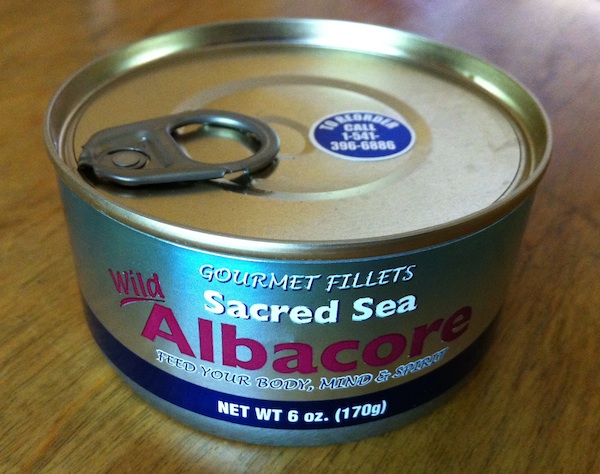
The Goché's Sacred Sea brand albacore.

The U.S. and Canadian albacore fisheries in the North Pacific, made up of mostly small, family-owned boats like Rick Goché’s, received a boost last year when Seafood Watch, a program of the Monterey Bay Aquarium that evaluates the ecological sustainability of wild-caught and farmed seafood, listed U.S. and Canadian troll- and pole-caught albacore from the North Pacific as a “Best Choice” due to negligible bycatch and the healthy stock of albacore in the region.

But the biggest shift in public awareness may come from the recent announcement by the Marine Stewardship Council (MSC), which has certified the Canadian Highly Migratory Species Foundation (CHMSF), an albacore fishery of Canadian-based boats, and the U.S.-based WFOA as sustainable and well-managed.

“It’s a very rigorous, on-site process that looks at a fishery as opposed to a sweeping view of a species,” said Kerry Coughlin, the Regional Director for the Americas of the MSC. “It’s our view that’s how you get a very rigorous assessment process that’s accurate, and it’s how, in some cases where fisheries aren’t sustainable, you’re going to bring about change on the water.”

And when they see the blue MSC label (right) in their grocer’s seafood case or on a can of albacore, “consumers can have the assurance that it is an environmentally responsible choice,” Coughlin said. And, because they come from younger fish, the fresh loins of albacore available from July through October at most retailers contain more have more “puppy fat,” as an industry spokesperson called it.

“I think it’s moister,” Jenkins said. “It seems to have higher fat levels, particularly concentrated in the belly.” His suggestion to consumers buying a whole loin is to ask their butcher to keep the belly meat on, adding that many butchers either keep it for themselves even cut it out, which he considers a travesty.

Locally canned albacore would be almost as much of a shock to most shoppers. The major-brand tuna on their grocery shelves was caught and frozen at sea, then thawed at a cannery and cooked in big steamers, where it loses much of its natural juices and fats. It is then packed in cans and cooked again, requiring the addition of water or oil to keep it moist.

That contrasts with most local tuna, which is packed in cans when it’s fresh and cooked only once, sealing in the natural juices and not requiring the addition of oil or water to keep it moist.
Between MSC certification and a growing concern among consumers about where their food comes from, families that depend on the North Pacific albacore are seeing a brighter future for their children, and a way of life that they prize.

“On a boat, you have to have all your senses attuned to your boat and the fish and your gear, but what it comes down to is stay alive and fill up the boat,” said Rick Goché. “When I pull away from the dock and I cross the bar and I feel the ocean lifting the boat, I leave everything behind as much as possible. Sure, I miss my family, but I don’t miss all the complexities of being on land.”

Monday, December 20, 2010

Keeping It Simple: Kevin Gibson of Evoe


An edited version of this story first appeared in the November/December 2010 issue of NW Palate magazine.

* * *

“The whole idea was to show how simple it is. No smoke and mirrors.”
—Kevin Gibson

One of the big fictions in this current food-obsessed age is that you can't prepare great food if you have anything less than a gourmet kitchen filled with gleaming stainless steel appliances, preferably restaurant-grade.

The truth is that fine cooks can make do without all the fancy high-end equipment. Just drop in to Evoe, a plain-looking café from the street in Portland, Oregon, as I did one early afternoon, and take a seat at chef Kevin Gibson's prep table-cum-chef's bar. With little more than a sharp knife, a mandoline, a household-grade electric stove, and the same non-stick plug-in griddle my mom made pancakes on for most of my childhood, he turns out some of the best food in the city.

Not to be missed are Gibson’s deviled eggs, a mustard-infused version dipped in breadcrumbs and fried on the griddle till warm and vaporous. The best thing to do is to order another item as each one arrives: blistered padron peppers (from Oregon’s Viridian Farms), for instance, followed by thin slices of artisan-cured meats with an assortment of house-made pickles. Ordering this way allows you to sit at the butcher block counter and watch Gibson peel an artichoke to order, or shave a delicata squash into ribbons. It’s like having a personal chef prepare your lunch while you take a master-level cooking class.

While he prepares plate after perfectly composed plate, Gibson tells the story of how he came to his current post.

The oldest of four children, Gibson grew up in a solidly middle-class family in Iowa City, Iowa. His father was in charge of facilities for the University of Iowa and has a square named for him on the campus. His mother pursued her master’s degree in social work when the kids started school, and he recalls that may have piqued his nascent interest in the culinary arts.

“I think what started it was that while Mom was going to school, she would let each one of us kids cook a dinner each night of the week,” he said. “It was casseroles and gravy and tater tots.”

He also remembers visiting his father’s parents on their farm, and the cellar where his grandmother put up row upon colorful row of preserved fruit and vegetables to pull out during the long Midwestern winters.

During summer his family would head west to visit his mother’s parents in Portland, Oregon. He remembers going with his grandparents to buy produce from the farms and farm stands that used to be out near the airport. It may have been that exposure to the Pacific Northwest that drew him back after college.

With experience managing a café and bakery in his hometown, he found work in the food service industry almost immediately upon his arrival in Portland. Following a tip from a co-worker, he eventually came to work at the now-legendary restaurant Zefiro. It was to be a watershed experience for Gibson for several reasons, not the least of which was that his first interview was with Monique Siu, the woman who would later become his wife and partner in opening Castagna.

“I came in with all this managerial stuff from Iowa and she asked, ‘How are your knife skills?’” he said.

Gibson attended culinary school while working at Zefiro. After graduating, he left for a six-month stint at a resort in Costa Rica, which turned out to be another instructional experience.

“There was a staff of women who lived in a little village down the beach, and they would bring all this great super-simple food that was so delicious,” he said. “Chicken soup with masa dumplings that had cilantro and onions inside of them, and gallo pinto, black beans with peppers and rice with a piece of fish on top or steak.”

He also recalls the fruits. “This produce guy would show up and have everything from watermelon to strawberries to berries and papaya. It would all be super-fresh.”

When he returned to Portland, he returned to Zefiro, but this stint was short-lived due to his blossoming relationship with Siu. “We jibe really well on food, on what we like to eat, aesthetics, how people should be treated,” he said.

They married, and eventually Gibson and Siu opened their own restaurant, Castagna, in what was then a moribund stretch of industrial buildings along southeast Portland’s Hawthorne Boulevard. Here, Gibson honed his approach to food, focusing on the freshest ingredients available locally and prepared simply to bring out their essence.

In 2007 he left the kitchen at Castagna, working for several months at Cameron Winery. “It’s really hard work,” he said. “It was fun, but it’s not glamorous. Pruning in the cold, you start listening to the birds and your mind starts to wander. You appreciate a warm place for lunch.”

Three months into his sabbatical he got a call from Peter de Garmo, the godfather of Portland’s Slow Food movement and owner of Pastaworks, the city’s premier Italian food market. He lured Gibson back with his idea for opening a café that would showcase the store’s existing products and act as a testing ground for new items.

“The whole idea was to show how simple it is. No smoke and mirrors,” Gibson said. The café, which came to be named Evoe, is a place where people hang out and talk, with wine and small plates that Gibson loves to make, along with reasonably priced entrées that sing with freshness and simplicity.

Gibson is still getting accustomed to cooking in front of his customers. It’s been hard for this essentially shy chef to go from the shelter of a restaurant kitchen to being within arm’s reach of his customers, but he says it’s also been eye-opening.

“Putting a plate down in front of people, that immediacy, I like that,” he said, smiling at the thought. “You know that old adage, “You eat with your eyes first”? I always kind of suspected that, but I’d never really experienced it.”

Sunday, December 19, 2010

Great Gifting: Not Dead Yet!


Obsolete. Finished. Doomed. All descriptors used when the subject of the future of print comes up. Not to mention much wringing of hands, rending of robes and tearing of hair. But if you're stuck for a last-minute present, not to mention one that will remind the recipient of you several times a year when they open their mailboxes, you can't beat a subscription to a magazine.

True confession? I've been on the way to a birthday party, stopped at the store, picked up a copy of a magazine, stuffed it into a gift bag with a card (remembering to tear out a subscription form) and given it to the birthday guy or gal. If I'm lucky I remember to send in the aforementioned form or go online to subscribe.

More embarrassing? I admit to actually giving a subscription to a magazine that I know the recipient would never subscribe to in a million years. Like buying a conservative relative (no names, please) a subscription to a lefty publication like Mother Jones or The Nation on the off-chance they actually look at it and find out there's more to an issue than Glenn Beck has been telling them. Or giving a non-cook a magazine that features healthy, easy recipes…I mean, if they only read a few articles or look at the pictures, that's OK, right?

So, to get to the point, I'm asking you to consider supporting a couple of excellent local publications that are trying hard to survive in the current new media maelstrom and who happen to occasionally carry stories that I write.

One, NW Palate Magazine, was originally a wine-centric magazine that has recently embraced a wider calling, one that truly reflects its name and celebrates the bounty that we find here in the Northwest: our farms, food, chefs and fisheries. The other is MIX, the sole survivor of the Oregonian's fleet of publications, a glossy, beautifully designed paean to Oregon's burgeoning food culture. Each gives you more than strung-together blurbs masquerading as articles, with longer "think pieces" from some terrific Northwest writers.

So whether you're desperate, seeking passive-aggressive satisfaction or just want the perfect gift for the food-centric on your list, these might be just the ticket. One more benefit? You can always ask for their back-issues!

Details: NW Palate Magazine, six issues per year, $18; two years (12 issues), $33. Subscriptions available online. MIX magazine, 10 issues per year; two years (20 issues), $28. Subscriptions available online.

Check out the other gift suggestions in this series: Book by Book, Classic Design, Class Acts and Giving From the Heart.

Thursday, August 19, 2010

Getting a Head


When someone drops an opportunity in my lap, I grab it. Especially if it involves pork products.

So when my friend (and editor) Peter Szymczak of NW Palate magazine said he was testing a recipe for a pork terrine that was going to run in the next issue, and that it would involve cooking and stripping a pig's head, I not-so-subtly volunteered to help. He graciously accepted, saying the split-down-the-middle head would be brined for a day, then go into the oven to braise for 12 hours in a broth of wine, vegetables and water.

On the pretext of checking the galleys of the article on Big Table Farm that I wrote for the same issue, and to check out the redesign of the magazine (a big, and welcome, change), I dropped in about halfway through the braise. The head itself, which I named Max (after Max Headroom), was still intact (top photo and left) but on its way to melting into a tender, falling-off-the- bone mass of porky goodness.


And sure enough, when I returned that evening, it had all decomposed into a somewhat recognizable but now barely held together form (right). Which made it relatively easy to pull out the bones, cartilage and anything resembling glands and leaving the meat, skin and fat to cool in a pan till we could shred it by hand.

Traditionally, scrapple is pork combined with cornmeal, then fried before serving, and this recipe from Chef Robert Belcham, owner of Refuel and Campagnolo restaurants in Vancouver, B.C., called for making a small batch of polenta and mixing it into the pork with herbs. We then packed it into terrines, and set it in the fridge under weights to compress. Can't wait to slice into it!

Look for the recipe along with an interview with Chef Belcham in the Sept./Oct. issue of NW Palate magazine, as well as my article on Clare Carver and Brian Marcy of Big Table Farm. And get a load of the redesign of the magazine to boot! Subscribe online: 1 year/6 issues for $15; 2 years/12 issues for $27. Cheap!

To see the reincarnation of Max in terrine form, see Getting a Head: The Eating.

Friday, November 27, 2009

Season's Greenings: Good for the Environment


Today is Black Friday, and I can't think of a better way to turn this mad season of consumption on its head than to think about ways we can start spending money in a sustainable fashion. This is the third in a five-part series adapted from an article I wrote for the Nov.-Dec. '09 issue of NW Palate magazine.
Lindsay Coulter is the Queen of Green at the David Suzuki Foundation, which works with government, businesses, and individuals to conserve the environment by providing science-based education, advocacy, and policy work.

Coulter suggests giving paper new life. Recyclable papers made from newspapers, magazines, and envelopes can be made into cards, bookmarks, gift tags, and small gift boxes, and can be embedded with seeds that grow herbs and flowers indoors in pots or outdoors in the spring. Plus, crafting is a great family, kid-friendly activity. Check out her recipes here.

Coulter also recommends buying used goods, whether recycled, vintage, pre-owned, or antique, which minimizes the carbon footprint attached to the gift. One more idea: “Consider giving experiences instead of stuff,” she says. Gift certificates to restaurants, for instance, make great gift card stuffers. “Throw in bus tickets or passes for an extra shot of green,” she adds. For more of Lindsay's ideas, go to her website, and take a look at other green gifts in the Suzuki Foundation holiday catalog.

* * *

Eco-Guides puts homeowners on the path to sustainability with in-home consulting on home energy conservation, waste reduction, toxics reduction, water conservation, and green gardening. The Portland, Oregon-based service offers a three-session package that has estimated per home savings at $466 per year, much less than the cost of the service.Taste of the Oregon Coast gives you a delicious way to support the protection of Oregon’s wetlands habitat. Along with a $100 donation, you’ll receive a can of Local Oceans Seafood Smoked King Salmon and a bottle of Rogue Beer, plus a personalized thank you letter. Call 503-691-1394 for information.

A recycled bike chain bottle opener from Resource Revival in Mosier, Oregon, says love to your dearest beer aficionado.—$14

Fat of the Land by Seattleite Langdon Cook. This book explores the Pacific Northwest via adventures in foraging and discovers a regional stew of food, natural history, and unusual characters.—$27

Read Part One: Gifts That Grow, Part Two: Farm to Table, Part Four: Helping Others and Part Five: DIY Food & Drink.

Monday, October 13, 2008

Boise: Beautifully Basque


Normally I wouldn't recommend driving seven hours just to have dinner. But the city of Boise, with its richly complex Basque community, makes it well worth the drive. And you might just consider staying a couple of extra days to give the place its due.

I was there last week researching a story for NW Palate magazine (thus the dearth of posts recently) and, far from being yet another deadly recounting of historic highlights, I found a thriving culture that is a celebrated part of the city as a whole. So much so that the city dedicated a whole block just steps from the capitol building downtown that is a magnet for tourists as well as a gathering place for the city's Basque community.

In the process of conceiving this cultural area, the design committee used Portland as an inspiration and created sidewalk panels (photos, top and left) incised with Basque surnames and traditional Basque songs (with music!). Even the street surface was decorated with the red and green colors of the Basque flag and the four-pronged lauburu, the national symbol of the Basque region.

With restaurants, a museum, a Basque market and more, there's lots to talk about!

Read the rest of the series: Basque Home Cooking, Basking in Basque-ness and Wait…There's More!