

One chef at the Ayers Creek Farm tour held for its retail and restaurant customers summed it up nicely. "I wouldn't miss this for the world," he said, noting that not only is it one of the region's premier organic farms with a completely original, single-minded vision behind everything grown there, but "there's nowhere else can I talk with 150 other local chefs and restaurant people with the same approach to food."

It was a chance for Carol and Anthony Boutard to thank their customers, yes, but there was a not-so-hidden agenda behind the festivities. The farmers behind this unique place—Anthony is the author of the Farm Bulletins, a staple of Good Stuff NW for more than ten years—have been working to promote the idea of using fermented grain, a happy accident they discovered while researching Anthony's book, Beautiful Corn. (Read his essay on fermented grain, or borş.)
Romanian in origin, it takes just a couple of cups of ground grain—corn or barley are ideal—and a bit of salt to get it started. Mixed with warm water and left out at room temperature for four or five days, it results in a perfect stock for savory dishes. It adds the same body as a meat-based stocked with the added benefit of being much cheaper to make, plus it has the probiotic qualities common to fermented foods.

While a few folks had picked up the idea, Anthony felt another reminder might be required to put it on their front burners, so to speak, so he and the farm's chef, Linda Colwell, collaborated to come up with a menu based around this elixir. They chose an astonishing posole of pork shoulder rubbed with aci sivri chile oil and paste that was roasted and shredded; then added fermented grain stock from Peace, No War corn; hominy made from nixtamalized Amish Butter flint corn; and steamed borage and poppy leaves.
A second soup was made from cardoons, slow-braised in butter along with potatoes and run through a food mill, then the pulp and fibers were combined with fermented barley stock. Its soft green color was tantalizing, and its flavor reminded me of the dill pickle soups that were popular a few ago. A third dish and, as a devotée of risotto, one I'm dying to try, is a risotto using fermented wheat stock. Linda brilliantly paired it with caramelized onions and the farm's Arch Cape chicory, which were stirred in just before serving.
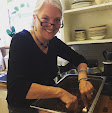
 Sarah Minnick with Arch Cape chicory pizza.
All this was put over the top by special guest chef Sarah Minnick of Lovely's Fifty-Fifty, who skillfully handled the farm's massive wood oven, pulling out pizza after pizza of her addictive sourdough crust topped with spears of Arch Cape chicory, green garlic and raw, organic cheeses from Cascadia Creamery in Trout Lake, Washington. Icing on the proverbial cake was a jostaberry kuchen made by farmer Myrtha Zierock—of which I managed to score a couple of pieces before it was demolished by the crowd.
Thus fortified, Anthony and Carol trooped everyone out to the fields to survey the Arch Cape chicories marked for seed, plus mustard, wheat, favas and new breeding projects, some of which have already been years in development. Is it any wonder that their farm is one of my favorite places (and they are two of my favorite people) on the planet?
Fermented Grain, aka Borş
200 grams coarsely ground grain (corn, barley, wheat, etc.)
28 grams sea salt or kosher salt
Water
Put the grain and salt in a two-quart mason jar. Add very warm water to fill past the shoulders of the jar. Secure with a lid (the plastic lids work great for this). Shake vigorously to combine. Loosen the lid to allow any developing gases to escape and leave on your kitchen counter for four or five days. Tighten the lid and shake two or three times a day, loosening the lid again after each shaking.
Use like stock in soups, risottos, or any dish that requires a savory stock (see post, above).

Posole with fermented corn stock.
While a few folks had picked up the idea, Anthony felt another reminder might be required to put it on their front burners, so to speak, so he and the farm's chef, Linda Colwell, collaborated to come up with a menu based around this elixir. They chose an astonishing posole of pork shoulder rubbed with aci sivri chile oil and paste that was roasted and shredded; then added fermented grain stock from Peace, No War corn; hominy made from nixtamalized Amish Butter flint corn; and steamed borage and poppy leaves.
A second soup was made from cardoons, slow-braised in butter along with potatoes and run through a food mill, then the pulp and fibers were combined with fermented barley stock. Its soft green color was tantalizing, and its flavor reminded me of the dill pickle soups that were popular a few ago. A third dish and, as a devotée of risotto, one I'm dying to try, is a risotto using fermented wheat stock. Linda brilliantly paired it with caramelized onions and the farm's Arch Cape chicory, which were stirred in just before serving.

All this was put over the top by special guest chef Sarah Minnick of Lovely's Fifty-Fifty, who skillfully handled the farm's massive wood oven, pulling out pizza after pizza of her addictive sourdough crust topped with spears of Arch Cape chicory, green garlic and raw, organic cheeses from Cascadia Creamery in Trout Lake, Washington. Icing on the proverbial cake was a jostaberry kuchen made by farmer Myrtha Zierock—of which I managed to score a couple of pieces before it was demolished by the crowd.
Thus fortified, Anthony and Carol trooped everyone out to the fields to survey the Arch Cape chicories marked for seed, plus mustard, wheat, favas and new breeding projects, some of which have already been years in development. Is it any wonder that their farm is one of my favorite places (and they are two of my favorite people) on the planet?
Fermented Grain, aka Borş
200 grams coarsely ground grain (corn, barley, wheat, etc.)
28 grams sea salt or kosher salt
Water
Put the grain and salt in a two-quart mason jar. Add very warm water to fill past the shoulders of the jar. Secure with a lid (the plastic lids work great for this). Shake vigorously to combine. Loosen the lid to allow any developing gases to escape and leave on your kitchen counter for four or five days. Tighten the lid and shake two or three times a day, loosening the lid again after each shaking.
Use like stock in soups, risottos, or any dish that requires a savory stock (see post, above).


 Posts

