
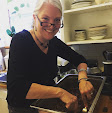

My friend Jeffrey Hannan has had many past lives. An author, playwright and digital user experience manager, he lived on a farm as a child and gravitated to goats as his familiars. Which is why, whenever he visits Portland, it's a requirement that we stop by at least one spot where they gather, even if only through a pasture fence. His most recent appearance in Oregon entailed a road trip to the wilds of Gales Creek for a chat with Lise Bueschen-Monahan and her 100-or-so goats at Fraga Farmstead Creamery.
Goats rule.
At least in my private hierarchy of the animal kingdom. How, then, to resist an invitation to visit Steve Monahan and Lise Bueschen-Monahan’s Fraga Farmstead Creamery? Not possible.

Kathleen Bauer and I bundled up and donned our farm boots one chilly afternoon in January. We climbed into her truck and headed 30 minutes west, to where the fringe of suburbanization meets wide open farmland. A bit further, to the south, before the road wants to rise into the Tillamook forest, lies a farm with a pond, a red barn and dense stand of pines trees.
Here a herd of 100-plus female goats roams a shady evergreen forest, rubbing themselves and their horns against the trunks of trees. They come running as a pack when Lise strides into the large open field and calls out to them: “Goaties!”

Some of Fraga Farm's goats.
Goats are curious looking things. Like most quadrupeds (and some humans), they have a big midsection supported by four slender appendages. Their heads are triangular. Their eyes are equal parts mischief and interrogation. They’re also set a bit too far apart, leaving us mere humanoids struggling to match their gaze.
They think nothing of strolling up and swarming around you, rubbing their thick bodies against your legs or chewing on your shoelaces as you stand in place to learn the story of the farm.
Goats like—they will often insist upon—your affection. They love to be scratched. However, they can be fickle creatures. They’re all too quick to divest you of their attention when they discern that fresh hay has been laid in the barn.

Lise is the goatherd of the family. She is aided by Franklin, a tall, amiable intern who, upon completion of his master’s degree, aims to establish a goat dairy when he returns to his native Ghana.
Lise’s husband Steve is the cheese maker. Together they create a small collection of superb goat milk cheeses—traditional chevre, camembert, feta, and an aged raw milk cheese akin to cheddar—as well as some insanely delicious goat milk caramels.
The quality of the product is not by accident. That’s why Kathleen and I were there: to uncover the method behind the magic.

Lise walking with her "goaties."
It was quiet time on the farm when we visited: a period of relatively little activity when milk production has waned and the busy-ness of kidding season has not yet begun. Kidding season lasts roughly from January through May. About 20 kids are born each year. Some of the does are kept as milkers; the rest of the kids are put up for adoption as pets.
In some industrial goat dairies, the moment kids are born they are taken from their mother and killed so that every drop of mother’s milk is reserved for commercial use. Not a drop, so to speak, is wasted. In contrast, when a kid is born at Fraga, both kid and mother are put in their own enclosure after birth to give them a chance to rest. The kids then nurse for about two months, at which point they are weaned and the mother’s remaining milk is used to make cheese.
This nurturing, natural method of raising goats leads to better cheese. Not to mention a healthy quality of life for the animal. It is fairly well documented that the commercial raising and slaughter of animals for meat and dairy is highly unnatural and traumatic. This trauma ultimately finds its way into the end product—be it meat, cheese, milk or butter.

“Everything is hormonal,” explains Lise. Birthing, feeding, weaning and milking all are driven by hormones, just as hormones drive interactions between human mothers and their children. When animals are dragged into slaughter or robbed of interaction with their parent or offspring from the moment they’re born, the animal’s normal hormonal processes are disrupted. Moreover, the cramped, unhealthy conditions in which many industrial food animals are raised adds a deeper degree of damage.
The natural, normal processes of grazing, birthing and weaning that take place at Fraga are antithetical to industrial methods. Fraga’s methods are emblematic of a larger food movement which strives to farm with the earth and its inhabitants instead of against it or in perceived domination of it.

The farm's camembert-style cheese.
The methods that small farmers like Lise and Stephen apply result in superior products with a higher cost of production. Unfortunately, the demand to keep retail prices as low as possible while maximizing profit means ethical trade-offs that holistic farmers are not willing to make. As a result, small farmers face relentless competition from industrial farms and large retailers whose sole objective is to increase their own share of the consumer’s wallet.
When it comes to producing food or dairy, there is an uncomfortable symbiosis between man and animal: we are far more dependent upon them than they are on us. That said, a herd of animals—dairy goats, for instance—requires conscientious care if we’re going to right the current imbalance. These workers require and deserve our diligence and decency.
The same can be said of a bed of vegetables: by nurturing their growth through natural methods such as soil regeneration, which ensures a healthy mix of microbial magic, instead of creating land that’s been fertilized literally to death, the negative trends in industrial farming can be countered.

Whether those trends can be reversed is an entirely different argument. Even at a friendly sit-down at a wooden table in a farmhouse. After a tour of the farm and a lengthy visit with the herd in the barn, the three of us retreated to the farmhouse. Warmed by fresh coffee, farm-made cheese and bread, our degrees of optimism varied. What was agreed upon, though, is that many of us, when we buy food, have a choice: we can choose the cheaper industrial product or we can seek out humane and healthier alternatives.
This is the hard mission of Lise and countless other farmers in the bountiful Northwest: to create those options and stave off the inevitable demise wrought by big ag. It is also the work of Kathleen to provide exposure to these alternatives, to get people to understand where food comes from: to remember that we exist in a web of natural inter-relationships. If we are to eat well, and live well, we have to re-engage with the realities of our food supply.

With Lise and her goats, it's all about the love.
Food labeling, though, is an issue. (And a lengthy, head-spinning side topic.) What, after all, I wonder, is truly organic? What is “free-range”? These neat government labels, written by and for the benefit of commercial producers, do little to truly inform the public. They are guideposts that reveal nothing of the real methods of production behind them, but instead point us in directions we feel obliged to follow.
Are we being misled? This intentional ambiguity is a not just a crisis of conscience but a crisis of health: If the food we put in our mouths is grown in soil denuded of nutrients and nature’s complex, life-giving secrets, and if the animals we eat are abused in their service to us, what are we really putting into our bodies?
* * *

Author's note: Sam and Marilyn hung out in the chicken enclosure, where they had a homemade house of wood where they slept at night, and a wooden picnic bench and table that they could hop around on. When I’d get home from work or school I’d let them out to run around the yard and climb the giant boulders on the property. Marilyn loved corn chips and a sip of white zinfandel, which perhaps, alas, contributed to her early demise.


 was written by a friend. Fortunately he's a terrific writer, which I knew already from reading his blog,


 Posts
Posts

