Showing posts with label Eastern Oregon. Show all posts

Friday, September 09, 2016

Travels with Chili: Mountains of Fun, Part 3


On a trip to Eastern Oregon for a food conference in May (read my report here), I decided to take a couple of days to explore this incredibly beautiful part of the state. You can read part one about the trip to La Grande and Union; part two traveled to Baker City and Halfway, where I uncovered murder and mayhem on a bison ranch. The portion below follows up with adventures in the Wallowas, with stops in Joseph, Enterprise and tiny Lostine.

It was tough to leave beautiful Halfway and the stories of bison rancher Dave Dur, but my husband Dave and I were due in Enterprise for our farm stay at Barking Mad Farm, where owners Emily and Rob Klavins had arranged a meet-and-greet with local food folk. The trip was going to take three hours if we took the standard route back to Baker City to catch I-84 to La Grande, basically making a long circle around the western side of the Wallowas.

Barking Mad Farm.

But we'd heard about a short cut through the mountains on a National Forest highway that would slash our travel time by a third. Trouble was, no one could tell us for sure if the road—which is closed in the winter due to snow—had been cleared of debris and fallen trees. We were pretty sure the snow was gone, but I wanted reassurance that it was passable all the way through to Joseph. The forest service office in Baker hadn't heard, so Dave Dur called his buddies at the Halfway ranger station, and, while they couldn't officially announce it was open, they assured him that it was clear to Imnaha, just a few miles from Joseph. (Read about a previous camping trip to the Imnaha.)

So we took off in Chili, crossing our fingers that its low clearance wouldn't be a problem, and found our way to NF 39, a winding—and paved—two-lane highway that snaked its way through the mountains. At times it followed beautiful creeks that cut their way between steep forested gorges, at others it climbed zigzagging switchbacks to dizzying alpine heights above the trees. Eventually it dropped down to the Imnaha River and into Joseph, where we decided that our daredevil exploits deserved to be celebrated with a pint of local brew.

Well-deserved beers at Embers Brewing.

Unfortunately when we got to Joseph we found that Mutiny Brewing, our favorite area brewpub—and at the time the only woman-owned brewery in the state (now there's Covalent Brewing in Portland, owned by Meagan Hatfield)—had closed. Luckily we discovered Embers Brew House just down the street featuring 17 beers on tap and settled at the bar for our celebratory pints.

We pulled up to Barking Mad Farm with a half hour to spare, which gave us time to unpack and chat with Emily and Rob and meet their cattle dog, Roo. Their comfortable craftsman farmhouse is situated just outside Enterprise on the rolling plain at the foot of the mountains, which affords a spectacular view of the range (top photo) and an occasional peek at the its highest point, snow-covered Sacagawea Peak. The lawn and garden are studded with Adirondack chairs, with additional seating on the expansive deck, but I was drawn to the double hammock slung to take advantage of the view.

Michael and Jody Berry of Dandelion Wines.

Our room on the second floor of the house, called the Treetops Suite, was a large, airy room with sliding doors opening onto a private deck looking out at the mountains. I was ready to settle in with a book, but people were starting to arrive for the meet-and-greet. Emily had laid out a generous spread of breads and cheeses, along with dips and wine, and introduced me to the crew, including my friend Lynne Curry, a local author, food activist and blogger. Lynne had given the keynote at the food systems conference I'd attended—which led us into a discussion of local farms, CSAs and issues of food access in rural communities. (See my report here.)

After that we adjourned to spend a little more time catching up with Lynne, and she suggested a new wine shop in Enterprise that was having a rosé tasting that evening. We walked into Dandelion Wines, owned by Michael and Jody Berry, and saw not the expected lineup of four or five wines, but a counterlength formation of more than a dozen rosés from all over the globe ranging from the palest of blushes to a bright lipstick red. The just-over-ten-feet-wide by a hundred-feet-long space was also packed with locals exchanging hugs and catching up on gossip while juggling wine glasses and plates of noshes from a sideboard of delicacies that would be impressive at any catered event in the big city.

"This is Eastern Oregon?" I found myself thinking. "My, how you've changed!"

Wallowa Lake Lodge.

The evening continued at Terminal Gravity Brewing's pub, where you'd swear you'd walked into that Boston bar called Cheers where everybody knew everybody's name and the beer and food flowed freely in a spirit of community and conviviality. After that, retiring to our quiet aerie at the farm, we fell asleep as fast as our heads hit the pillows.

The next morning the coffee was strong, the pastries piping hot from the oven and the eggs were fresh from Emily's chickens, their bright yolks making up for the lack of sun in the sky. We drove off in Chili right after that, knowing we wanted to make a couple of stops on the way back, first an obligatory pause to admire Wallowa Lake and its historic lodge.

Original log chair at Wallowa Lake Lodge.

The lake was originally home to the Wallowa tribe of the Nez Perce band before settlers arrived, and the lake and the area surrounded it were guaranteed to the tribe in the Treaty of 1855. It was, that is, until gold was discovered in the area, and the tribe was displaced and banished. The Wallowa Lake Lodge was built in 1925 and is a gem among small lodges that still retain their rustic roots. The lodge's 22 rooms sit above the main floor with its stone fireplace and wood panelled dining room, and historic photos document the building of the lodge and grounds. This is definitely a place we want to come back to.

Our second stop was in the tiny town of Lostine. I'd read in none other than the New York Times Sunday Magazine about a fellow named Tyler Hays, who'd recently opened a shop in SoHo called M. Crow and Company carrying "a marshmallow roasting stick made of oil-rubbed walnut, copper and leather ($60). A child’s leather tool belt with a toy hammer made of cherry and Osage wood ($250). A pickle jar handcrafted from local clay and glazed with wood-stove ashes ($260). A pot of hair product made with homemade beeswax and hand-expelled oils ($120)."

M. Crow in Lostine.

What does this have to do with Lostine? Well, it turns out that the tony New York store is Tyler's second. The first is in Lostine, just miles from his hometown of Joseph. According the store's website, Tyler's family "were among the first few dozen families to settle the valley in the late 1800's" and the store in Lostine was run by the Crow family for 107 years. In 2012 he purchased the store "to prevent its closure and the loss of an iconic memory of my childhood" and to provide an outlet for his fascination with making everything he needs.

Interior of M. Crow in Lostine.

Much more rustic than the photos of the ultra-spare, white-walled SoHo store, the original in Lostine still has the creaking floorboards and dusty, old-building smell that I remember vividly from my childhood when I'd explore abandoned buildings and old cabins. It's got some of those expensive over-$300 jackets and fancy cutting boards, but it also features house-brewed beer and local honey (more of Tyler's hobbies). The article in the Times said "he plans to build a workshop in Lostine that will take over much of M. Crow’s production while creating jobs for area residents," providing an economic boost to the communities around the store.
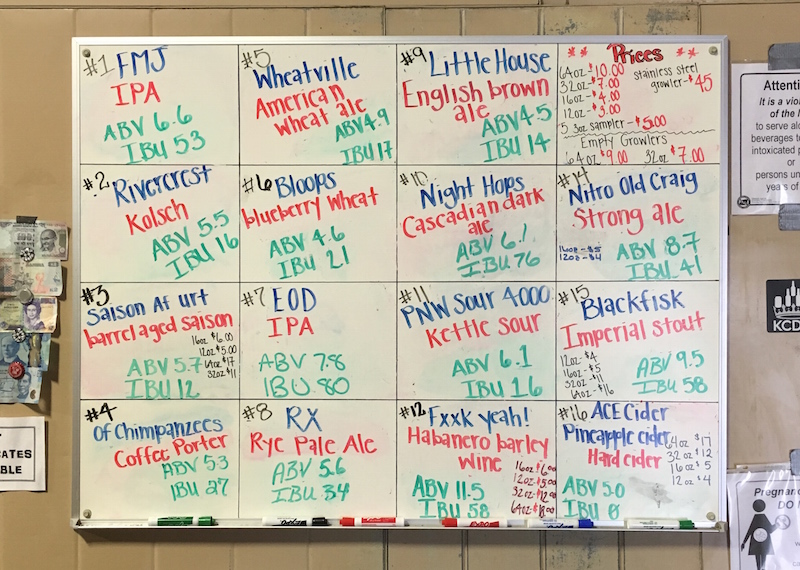
Tap list at Ordnance Brewing.

It certainly gave us something to talk about as we drove home, making our final stop in Boardman at Ordnance Brewing to check out just what was going on in the big metal storage building by the train tracks. (In the first installment of this series we'd arrived too early to sample its wares.) While it isn't a glossy brewery with repurposed timbers and copper-topped tables, they make an impressive array of 30 beers from the expected IPA to a fruit beer called Bloops to a sour beer, a CDA, a saison and a host (literally) of others, eleven of which were listed on the whiteboard graph tacked up behind the bar. It's easy to enjoy one or more sitting on folding chairs at the cable-spool tables.

Read the rest of the Mountains of Fun series: Part One about La Grande and Union and Part Two about Baker City and Halfway.

Top photo from Barking Mad Farm; photo of Dandelion Wines by Lynne Curry.

Wednesday, July 27, 2016

Travels with Chili: Mountains of Fun, Part 2


On a trip to Eastern Oregon for a food conference in May (read my report here), I decided to take a couple of days to explore this incredibly beautiful part of the state. You can read part one about the trip to La Grande and Union. The portion below follows up with our adventures in Baker City and a tour of a buffalo ranch in Halfway.

After a day spent sitting in a conference room, fascinating as the topic was, I was ready for a beer. Fortunately we were scheduled to spend the night in Baker City, home of the award-winning Barley Brown's brewery. In addition, we must have been due some karma points, since, on our arrival at the Geiser Grand Hotel, we were escorted to a corner room on the second floor with a stunning panorama of the aptly named Blue Mountains.

A sitting room with a view.

The historic landmark hotel, built in the Italianate style popular during the Victorian age, first opened in 1889 and remained in continuous operation until 1968. Threatened with demolition in the  early 1980s, it was bought by preservationist and developer Barbara Sidway and her husband, who spent several million dollars restoring the grande dame which now dominates the quaint downtown. From the gleaming woodwork to the filigreed railings and period chandeliers under the huge stained glass ceiling on the second floor mezzanine, it's clear this restoration was a labor of love.

Fermented libations at Barley Brown's.

After settling into our room, we strolled a block down the main street and took a seat at Barley Brown's bar, trying to decide on the type of beer we were in the mood for—mild, wheat, flavor, hoppy and bold are the categories listed. It's a small place by Portland brewpub standards, but features a wide-ranging menu from standard pub grub to a 10-ounce flat iron or 12-ounce ribeye. And from what we saw coming out of the kitchen, it all looked mighty tasty.

Our travel bar.

There was plenty of time before our dinner reservation at the hotel's restaurant that evening, so a snooze seemed like just the ticket to follow our pints. After waking up an hour later—and wondering why we don't do this at home more often—Dave reminded me that we'd brought our travel bar with all the fixings for martinis. A civilized cocktail in our elegantly appointed room before sashaying downstairs for dinner? Done!

Overlooking the Brownlee Reservoir and Richland, Oregon.

In conversations before we arrived, Sidway told me that once restoration of the hotel was completed in 1993, she felt the natural next step was to focus on featuring local food on the restaurant's menu. As I had found out at the conference earlier that day, being surrounded by cattle ranches, farms and fields of grain does not a local food system make. Most of the beef and grain was shipped out of the region to supply the commodity market, and the food available in local grocery stores was arriving from destinations hundreds, if not thousands, of miles away.

Buffalo mothers and calves near Halfway.

Since that time a few local ranches have started supplying the area with pasture-raised beef, pork and lamb, and Sidway has found small-scale farmers to supply vegetables for the kitchen during the summer months. As a result of meeting local producers for her restaurant, she also became active in promoting agritourism in the area. An outgrowth of those efforts is that hotel guests wanting to learn more about the economic and cultural importance of ranching to the region can now choose from a curated selection of Ranch Experiences.

Dave Dur, rancher, Halfway, Oregon.

One of Sidway's ranchers is Dave Dur, who supplies the hotel's restaurant with buffalo meat from the herd of 250 animals he raises on pasture in Halfway, Oregon, a little more than 50 miles from Baker City. Tucked in the foothills of the Wallowa Mountains, he (and his buffalo) also have a view of the Seven Devils Mountains on the other side of the Snake River in Idaho. On the day we visited in late May, the alfalfa on Dur's ranch was nearly ready to harvest and the foothills were so green it looked more like Ireland than the dry brown landscape I expected to see in that part of the state.

Originally from Pennsylvania, Dur owned an electrical business in Corvallis until he decided to buy the ranch in Halfway, though the buffalo only came along after he'd failed to make a go of sheep, grain, hay and cattle. A neighbor told Dur that he wanted to go back to Alaska, offering to sell him 12 buffalo for a good price. The animals turned out to be perfectly suited to grazing in his pastures. "These animals took care of themselves for millions of years," he said. "They don't need me to take care of them."

Buffalo on pasture in Halfway.

Tall, with a shock of white hair, crystalline blue eyes and a booming laugh, Dur has the courtly manners of a bygone era but isn't above making blunt observations. On a tour of the ranch, he also likes to shake up his city slicker guests by chasing some of bulls across the rutted pasture in his old Chrysler sedan.

"Murdered by his pretended friends."

After the merry chase, Dur took us to a spot in one pasture where there an iron cage surrounding a white marble monument (the better to protect it from buffalo that felt it was ideal for rubbing their horns on). It marks the spot where, as it states in flowing script, "Willard I. Moody was murdered by his pretended friends on this spot. Sep. 15, 1906." Dur said the story goes that Moody was killed in a disagreement over a woman, and that the memorial was placed there by Moody's father, with a similar marker on Willard's grave in the Halfway cemetery.

Now that's what I call a memorable farm tour. (Note to others: Murder? Buffalo chase? The bar has been raised!)

Read part one of this series about La Grande and Union. You can also read my report on the rural food system conference I attended.

Wednesday, June 01, 2016

Getting Good Food to Oregon's Far-Flung Corners


A couple of great new cookbooks arrived on my front porch awhile ago, and I wanted to try out a few recipes so I could share them with you. So, without thinking about it, I pulled out my phone and started a list of ingredients I'd need: basmati rice, fresh peas, tahini, mint, fennel, lemons, poblano peppers, smoked paprika, kimchi, fava beans, maybe some seasonal greens like garlic scapes, mizuna or raab.

Between a Whole Foods within walking distance and two New Seasons stores less than a mile away, plus Providore on Sandy that's not much further, most of the list was covered. Not to mention the four farmers' markets nearby for seasonal produce like local peas, favas, carrots, fruit and whatnot. Meats or fish? There are butchers and fish markets aplenty. And even if a recipe calls for exotic ingredients like Vietnamese culantro or key limes or black cardamom pods, between the Asian, Thai and international specialty markets in the area, there are very few things I don't have access to.

Okay, maybe not fresh durian. You've got me there.

M. Crow general store in Lostine, Oregon.

So my trip last week to the northeastern reaches of Oregon was a bit of a wake-up call. I was there to attend the Eastern Oregon Community Food Systems Gathering in La Grande, sponsored by the Oregon Food Bank. Added benefit: the keynote for the day-long conference was delivered by my friend Lynne Curry, an author, food activist and journalist from Joseph, Oregon.

The 53 people who gathered that morning over local pastries and coffee were a mix of food bank folks, Oregon State University Extension people, representatives from other community food agencies and a handful of area farmers and food retailers.

Curry's keynote contrasted the food system she found in 2001 when she moved to Joseph with the one that exists in 2016. When she first arrived, the only stores that carried groceries had a few staples, but depended mostly on sales of cigarettes, beer and junk food. Most of her actual food came from what she termed the "hidden food system" of rural living: food access meant getting eggs from the woman at the bookstore who raised chickens, foraging for mushrooms and other greens, and growing vegetables herself or trading with neighbors for the things she didn't grow. In the winter she fed her family from meat in her freezer and the jams, pickles, vegetables and sauces she'd preserved during the summer, much like our grandparents did in earlier times.

General store, Haines, Oregon.

It was amazing to me to realize that almost none of the food produced—mostly wheat and cattle—on the region's rich agricultural land is consumed locally. Rather, it's shipped hundreds, if not thousands, of miles across the country to go into the commodity market. Though, as Curry noted, that is starting to change, with livestock producers like Carman Ranch in Wallowa and 6 Ranch in Enterprise beginning to produce a marketable number of grass-fed cattle, as well as working with other area farmers to offer pigs, lamb, goats, chickens, eggs, honey and vegetables to their neighbors. These ranchers are also bringing their products to a growing number of families in Western Oregon who are interested in humanely and sustainably raised local meat.

Curry is seeing the interest in locally produced food—like the meat and vegetables above, along with beer and other products—becoming much more widespread, losing the "elitist" or "gourmet" label it had in 2001. Today, even in the far-flung regions of our state, she said that people are talking about where their food comes from, along with how it is produced, in a much more meaningful, inclusive way. And in this region where conventional agriculture—i.e. an industrial model that uses pesticides, herbicides and antibiotics—was the norm, people are beginning to demand more organic, sustainable food products for their tables.

Produce at the La Grande Farmers Market.

Farmers' markets in the area, which were few and far between in 2001, became a big outlet for local farmers and producers, and experienced growth that has slowed somewhat today. But, like here in Portland, they still act as incubators for new products, plus being what Curry referred to as a "third place" where communities can gather. She believes that this social aspect may be as important as the food that is sold, with the added benefit that they have an intrinsic educational component, showing people a different model of a food system, one based on community and relationships.

Despite this good news, though, there is still a great deal of work to be done on the issues of access to good food, not to mention the problem of food insecurity—that is, not having reliable access to a sufficient quantity of affordable, nutritious food. As outlined by Lauren Gwin and Sara Miller of the Oregon Community Food System Network, 18 of Oregon's least populous counties have lost stores where the community can access food. For instance, Morrow County went from five stores to one; Lake County went from three to one; Umatilla County went from 16 to 12. The town of Union has one store, which carries everything from hardware to t-shirts and features a small but adequate selection of staples on its shelves.

Pigs from Community Merchants in Union, Oregon.

Not surprisingly, these small, isolated communities also have the highest average cost of a meal, which makes sense considering the cost of getting the food to rural locations and the distances people have to travel to buy food. Compared to a national average of $2.77 per meal, people in Crook County average $5.01 per meal. In Curry County it's $3.18 and in Wasco County it's $3.10 per meal. Which, of course, means that the people who have the least amount of money to spend on food end up paying some of the highest prices for it.

Laying out the issues and challenges was the precursor to start coming up with solutions. Lynne Curry spoke about the opportunity to connect technology to the food system, proposing, like food hubs in urban centers, establishment of a collaborative network for transporting and distributing food to far-flung communites. This echoed another suggestion that rural groceries—which rarely meet the minimum orders required by large distributors—should have a system of joint purchasing agreements, which could potentially lead to purchasing and distributing produce and meat from area farmers and ranchers, which would also benefit local economies. There was a discussion of connecting the local health community to the food system in the Veggie RX "screen and intervene" program, where health care providers give low-income clients vouchers for free fruits and vegetables to stretch their SNAP (food stamp) benefits.

One group of farmers and retailers met to discuss how to bring more locally produced value-added products to market—jams, jellies, baked goods, pickles, etc.—with a focus on establishing certified community kitchens where producers could access commercial equipment. There was also discussion of the recently passed home bakery exemption (SB320) and the domestic kitchen license, with many questions asked about how it could be applied to bring more local products to market.

The energy of this group, even after a day of presentations, discussions and summations, and their desire to work together to better the everyday lives of the people in their communities, was inspiring. I'll be following up on these issues in future reports, and if you have comments or questions, please post them in the comments section below and I'll try to get them addressed.

Photo of Joseph, Oregon (top photo) from its website; photo of La Grande farmers market from its website; photo of Community Merchants pigs from its website.