Showing posts with label Chad Robertson. Show all posts

Monday, December 05, 2016

Great Gifting: Booking It for the Holidays


Several years ago, so long ago, in fact, that the internet was in its infancy—if the browser names Mosaic and Netscape Navigator ring any bells, you're in the right era—where carrying a powerful computer around in your hip pocket, one that could answer virtually any question within seconds, was a concept left to science fiction fantasists, and people at dinner parties had to scour actual books to settle arguments about the name of the guy who was in that movie or else argue for hours over the name of the dog that was sent into orbit by the Russians (Laika, for those who care).

A well-loved (and well-marked) book.

Our house was pretty handy for situations requiring reference material, so much so that one visitor dubbed it "the house of books" for the piles that were—and still are—a major part of our living room decor. So when the holidays roll around it's no surprise that books will fill many slots on our gift lists, both for receiving and giving. In no particular order, here are a few of my favorite food-centric tomes ideal for the bookish on your list. And feel free to add your own pick by clicking on the comments link below!

Buck Buck Moose by Hank Shaw. The third book by this self-described "hunter, angler, gardener, cook"—who is a superb writer on those topics as well as a good friend of mine—is a thorough compendium of hunting, cooking and eating "antlered things." Perfect for hunters, it's also a thoughtful treatise on how these animals are deeply intertwined with our history as a species. Carnivorous cooks will appreciate it, too, since his meticulously tested recipes are great even if you can't easily obtain venison—simply substitute beef, lamb or pork.

Life Without a Recipe by Diana Abu Jaber. Memoirs are slippery beasts, the good ones treading the fine lines between tell-all and tight-lipped, between my-life-is-so-fabulous and Blanche Dubois, cringe-inducing drama. Abu Jaber, a professor of writing and literature who splits her time between Portland and Florida, writes with skill about growing up the daughter of an American mother, a Jordanian father and a powerhouse of a German grandmother. In this, her second, memoir, she continues the journey she began in The Language Of Baklava, weaving "a book of love, death and cake."

Better from Scratch and Crackers & Dips by Ivy Manning. Prolific writer and author of cookbooks on subjects ranging from how to cook for a mixed-diet family to fixing easy weeknight vegetarian meals to one of the best farmers' market cookbooks around, these two slim volumes are packed with recipes so good they're already as well-thumbed as my grandmother's Joy of Cooking. Better from Scratch will stun you with how easy it is to make things you usually buy from the store—often for a premium price—like granola, beef jerky, graham crackers and kimchi. Ditto for Crackers and Dips, where you'll have fun, spend less and enjoy crunchy, sweet and savory treats made from whole grains, real butter, cheese, fresh spices and no preservatives.

Oysters and Crab by Cynthia Nims. Seattle writer and cookbook author Nims is passionate about the bounty of the Pacific Northwest, especially the creatures pulled from the depths of the waters off our own West Coast. In Oysters she describes in detail the biology of these amazing shellfish and how they help purify the waters they live in. She then moves on to suggest the best methods of buying, cooking (or not!) and eating them, with more than 30 recipes. Our West Coast Dungeness is the star of Crab, but she also covers its Atlantic and Gulf Coast cousins, delving into the history and importance of the commercial fishing industry, then quickly moving on to how to buy, clean and—with more than 50 recipes—how to cook these beauties.

My Beer Year by Lucy Burningham. This book by Portland beer writer Burningham has a long but delightful descriptor: "Adventures with hop farmers, craft brewers, chefs, beer sommeliers, and fanatical drinkers as a Beer Master in training." With wit (as well as Wit), it describes how this young writer and mom fell in love with beer to the point where she decided to become a Certified Ciccerone, going through the rigorous and arcane training and testing regimen to become a beer expert. (And you just thought knowing an IPA from a Porter made you that, right?) Full of character and plenty of characters, its a great book for the beer fanatic in your life.

Pure Beef by Lynne Curry. The current dietary advice, as Michael Pollan famously said, is to "eat food, not too much, mostly plants." But if we are going to eat protein, its important to eat animals raised humanely, with their feet on the earth and the sun on their backs. In other words, pasture-raised animals rather than those raised in crowded, confined conditions requiring daily doses of antibiotics to survive. To that end, I heartily recommend Joseph, Oregon, writer Lynne Curry's book on buying, cooking and eating grass-fed beef, an incredibly well-researched and thoroughly recipe-tested primer on how to get the most delicious results possible from these tasty beasts.

Virgin Territory by Nancy Harmon Jenkins. Dividing her time between a home on the coast of Maine and an olive farm in Tuscany, Jenkins shares her contagious passion for the flavors of the Mediterranean, a diet she is convinced is one of the most healthful and flavorful on the planet. I've tried several recipes from this book, and I can't argue with that premise.

Tartine Bread by Chad Robertson. If you have a bread baker in your life, or someone who's interested in learning to make bread, I can't recommend this book highly enough. My husband worked for two years to make what he considered the perfect artisan loaf, and was frustrated with what he felt were mediocre results until friends got him this book. It was a game-changer, and it apparently has some pretty good recipes for other good things to eat, though those pages remain remarkably unthumbed around here.

James Beard: A Biography by Robert Clark. As a fifth-generation Oregonian, I thought I knew plenty about native son James Beard. That is, until I read this biography of this world-famous cook, eater and bon vivant. A truly fascinating character in his own right, it follows Beard's upbringing in Portland in the late 1800s, his escape from his controlling-yet-supportive mother to New York and Europe and his lifelong love affair with the flavors and ingredients of the Northwest. In addition, it follows the evolution of the American palate with discussions that add depth and nuance to Beard's at times tragic yet joyful journey.

Wednesday, April 24, 2013

The Bread of Life


I was raised in the Episcopal Church in the "mission diocese" of Eastern Oregon. Oddly, contrary to that region of the state's right-leaning politics, the diocese was quite liberal theologically, which meant it didn't have the "smells and bells" of incense and ringing of chimes to signal the progress of the service. Instead, in 1979 it was among the first dioceses in the nation to get (paperback) copies of the brand new Revised Book of Common Prayer, which translated the ancient cadences (and at times indecipherable language) of King James into American English.

That new version of the old book changed everything, from the iconic Lord's Prayer to the words said during Holy Communion when, instead of receiving wafers of pressed cardboard…I mean, um…flour and water, we got actual pieces of bread torn from loaves made by the women of the church.

Though I've left those religious beliefs behind, I still embrace the idea that whole foods, whether made at home or store-bought, nourish both body and soul. Which is why I was so thrilled when Dave started making bread here at home.

At first it was hit-or-miss as he tried one recipe after another, nothing really measuring up to the rustic, hard-crusted, flavorful loaves he wanted to produce. He tried the no-knead style, which was pretty good, and the technique of misting the oven during baking, which improved the crust but still wasn't hitting the mark. He even made his own sourdough starter from the yeast left at the bottom of a bottle of Hair of the Dog's Doggie Claws.

He went through a dozen kinds of flour, from bulk unbleached to whole wheat to packaged brands, and shapes from boules to baguettes. He cruised blogs and artisan bread web sites like The Fresh Loaf, searching for hints from other folks who were on the same quest. After more than a year of less-than-stellar results, he was getting a little frustrated.

Cast iron pans did the trick.

Then, one Christmas, our friends Kathryn and Jeff got him a book, Tartine Bread, by Chad Robertson of San Francisco's legendary Tartine Bakery. Like the revised prayer book from my youth, it became a game-changer. Following Robertson's suggestion, Dave invested in a cast iron "combo cooker," the bottom a deep pan and the top a shallow frying pan. By inverting it, he could plop the risen dough into the shallow section, score the loaf and cover it with the deeper pan, containing the moisture released by the bread during baking. Halfway through baking the top pan was removed and the loaf returned to the oven to finish baking.

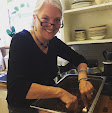
His biggest fan.

The results that first time were so startling that Dave ordered another cast iron pan and hasn't looked back since. He continues to tinker with the dough, and every two weeks he spends a day making several loaves that are stored in the freezer until we need them. It's called "Uncle Dave's bread" by our 3-year-old nephew, who asks for it every time he comes over and who invariably goes home with a loaf. Talk about nourishing body and soul…for us that's what it's all about.

Saturday, December 29, 2012

The Bread Man Cometh


The bread pictured above just came out of our home oven after two years in the making. (Talk about long fermentation…)

It started innocently enough one day when Dave stumbled across a blog called The Fresh Loaf, a news and information website for "amateur bakers and artisan bread enthusiasts." And enthusiastic they are, to the point of obsessiveness, with a focus that edges right up to crazy. Interestingly, if not surprisingly, it's based right here in Portland, so perhaps that single-mindedness is understandable, considering how this town feels about other foodstuffs like bacon, waffles and fried chicken.

In any case, Dave made a few stabs at baking his own bread using recipes he garnered from various websites and books, even going so far as to start his own sourdough from the yeast left at the bottom of a bottle of Doggie Claws from Hair of the Dog. Results of these experiments were mixed, from lumpen to acceptable, but none had the crisp crust and bubbled interior of the artisan-style loaves he was dreaming of.

Then on Christmas a year ago some friends, aware of his growing interest (read: budding obsession), gave us a book called Tartine Bread by Chad Robertson. Robertson's use of a wet dough fermented over many hours along with his method of baking each loaf in a cast iron Dutch oven became the catalyst Dave needed to start turning out the gorgeous loaves he'd imagined.

This is not to say he's completely satisfied—after all, what obsessive…er…I mean…"enthusiast" is—but he's happy with the results he's getting. And, needless to say, so are those of us who've been lucky enough to have a thick slice warm from the oven or sopped with soup or braises.