Showing posts with label Bill Hoyt. Show all posts

Monday, December 28, 2015

When Everyone Else Goes Right…


No, this isn't about Hill vs. Don or Bernie. It's about perspective, and, from what I've seen so far, mine is pretty different from the pack. As background, Mattie John Bamman, the new editor for the Portland outpost of the restaurant-industry website Eater, sent the following request: "Would you be interested in sharing your dining opinions as part of Eater Portland's end-of-year coverage?"

Now, I met Mattie—yes, it is his real name and isn't short for Matthew (the reason he gives is that he had "hippie parents")—at a media lunch given by the wonderful Bette Sinclair. For whatever reason he decided to include me in this year's survey. Here are the questions and my answers. I'll include links so you can read what others felt was noteworthy.

What were your top restaurant standbys of 2015?
My husband and I don’t go out much because, frankly, dining out is way too expensive for us to do on any kind of regular basis, so I’m hopelessly out of date on the “hot list.” As a matter of fact, several of them will close before we ever get a chance to go to them. (Cases in point: June, Levant, Noisette.)


Nostrana's Cathy Whims (r) and one of her—and my—favorite farmers.

So our standbys are places that make the kind of food we love and source ingredients from local farms and farmers: Bar Avignon, Lovely’s Fifty-Fifty, Old Salt Marketplace, Nostrana, Lucca and Davenport. Tastebud has to be included even though it’s just opened (we’ve been twice) because Mark Doxtader and Sarah (of Lovely’s) are the god and goddess of woodfired pizza made with local ingredients. Burrasca has become a favorite on our hit parade, as well.  Read more.

What were the top restaurant newcomers of 2015?
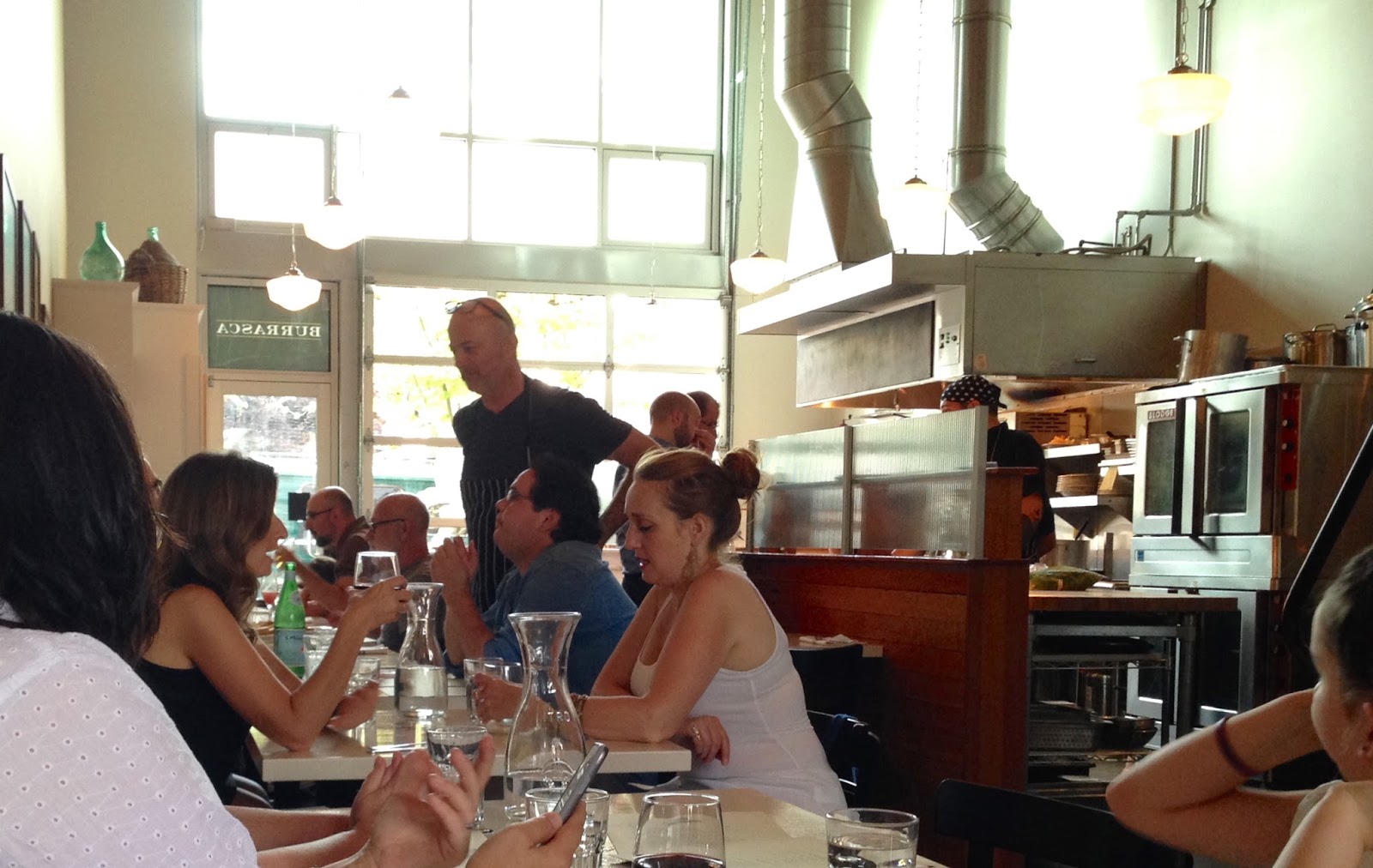
Tastebud because of the reasons listed above (Mark Doxtader, right). Burrasca (top photo). Love their take on Florentine classics like ribollita, peasant food that uses the simplest ingredients like old bread, leftover beans and greens to make a bowl of comfort; pappa al pomodoro; the deeply intriguing combination of squid and kale that is inzimino.

I’m hoping they’ll find a source for the fourth stomach of a cow, the abomasum, so I can have the famous street food favorite of Florence called lampredotto. Read more.

Describe the 2015 Portland restaurant scene in one word.
Free-for-all. Read more.

What was the best dining neighborhood in 2015?
No place like NE: We live within walking distance of Alberta, Killingsworth, Cully, Williams and Mississippi. (Sarah Minnick of Lovely's Fifty-Fifty, left)

Cully has to be the up-and-comer. Read more.

What was the biggest dining surprise of 2015?
No idea.

What was your single best meal in 2015?
Overall, very few meals can match what we have at home on a regular basis, from roast chicken to braised beef neck to pig trotters in a pot of Ayers Creek Farm beans to steaks on the fire when we’re camping.

Ben Meyer (l) and Bill Hoyt.

Meals out, wonderful as they can be from any of the places listed above, become more special because I don’t have to cook them. Current crave is the beef tartare at Old Salt using beef from Bill Hoyt of Hawley Ranch in Cottage Grove. Read more.

What was the biggest restaurant grievance of 2015?
The focus on chefs and technique versus good food made simply using the best ingredients (preferably local). Read more.

What are your headline predictions for 2016?
No idea.

Tuesday, September 08, 2015

Smoking the Perfect Brisket


Ask my husband what he'd like to grill for any given event and, barring Thanksgiving and Christmas when he smokes a whole turkey, there is only one answer.

His birthday? Brisket. Friends gathering for barbecue? Brisket. Anniversary dinner? Brisket. Our son's birthday (assuming we can get him to agree…)? Brisket.

Six hours in the smoker, many more to go.

There's something about that giant piece of meat that calls his name, that sings a siren song of smoke and meat and juicy perfection like no other. He's grilled and smoked dozens of them over the years, and they've all been deliciously satisfying. Smoke rings, that little red line just inside the surface of the slices that signals smoke-infused perfection? He's had them.

At 170°, ready to wrap.

But recently he read a recipe by Julia Moskin in the New York Times that piqued his brisket-loving soul. It called for a very simple crusting with peppercorns and salt, smoking the brisket for several hours—and here's the part that got him salivating—then it said to wrap the meat in unwaxed butcher paper and return it to the grill for another several hours.

Further research revealed that this method, called the "Texas crutch" by purists, allows the meat to cook in its own juices and better break down the collagen so that it melts into the meat. The brisket is then wrapped in foil and deposited in a closed ice chest to rest.

Wrapped, tied and going back in the smoker.

We happened to have friends coming for a Labor Day barbecue, so I called our new favorite meat source (and advertiser on this blog), Ben Meyer of Old Salt Marketplace, requesting a full brisket from Bill Hoyt's Hawley Ranch grass-fed cattle. A full brisket includes the flat, the meatier end of the cut, and the point or deckle, which has more fat. It also includes a thick cap of fat, which adds moisture when smoking or grilling for long periods.

The result? Smoky perfection, a big hunk of heaven that was meltingly tender yet still intact enough to slice and serve. And one that was crowned "Best Ever" by a very discerning group of carnivores.

Here's Dave's adaptation with his own step-by-step instructions.

Dave's Perfect Brisket
Loosely adapted from Julia Moskin's recipe in the New York Times.

I used an 18-inch Weber Smokey Mountain Cooker, for which these instructions apply. The Times article tells how to do it on a kettle grill.

1 whole beef brisket, 10-12 pounds
1/2 c. black peppercorns
1/3 c. coarse kosher salt
Hardwood briquets
Several chunks of oak wood

The night before smoking:

  • Grind the peppercorns very coarsely. Sift through a fine sieve to remove the fine pepper dust. Use only the coarse peppers. Mix the salt and pepper. Trim the brisket fat to 1/4 inch if necessary. Rub the salt and pepper mix on the brisket. Wrap in plastic and place in a baking sheet in refrigerator overnight.
  • Put a half dozen small chunks of oak in a pan of water to soak overnight.
  • Cover outside of smoker’s water pan with aluminum foil to make cleanup easier.
  • Clean cooking grates.
  • Fill the charcoal ring to an inch or so from the top with charcoal.

On smoking day, flip the charcoal chimney upside down. Put 20-15 briquets in the upended chimney. Place paper in the chimney below the charcoal and light it. When the coals are flaming and are covered with ash, spread the lit charcoal over the charcoal in the ring. Open the bottom vents all the way.

Assemble the rest of the smoker. Fill the water pan 2/3 full with hot tap water. Oil the top cooking grate. Remove the brisket from the refrigerator and place on the top cooking grate. I had to place it very carefully so that it would fit.

Place top dome on smoker. Open the top vent all the way. Close bottom vents to about 25 percent open. Put three chunks of the wet oak on the charcoal.

In a half hour check the temperature and adjust the bottom vents as necessary to keep the smoker temperature to 225-240. Add the remaining wet oak to the charcoal.

I checked the temperature about every hour or more frequently if necessary. The charcoal should smolder for hours without needing a refill.

I put the brisket on the smoker at 6 am.

At about 11 am the internal temperature was 175-180. I then wrapped the brisket in butcher paper, tying it with string, and put it back on the smoker.

After an hour I began poking it with my finger, testing to see if it was becoming more soft and jiggly as the fat, meat and collagen softened. At 3:30, 3 1/2 hours after wrapping the brisket and 9 1/2 hours after putting the brisket in the smoker, I pulled it from the smoker and wrapped it, paper and all, in aluminum foil. I then placed it into a cooler to await dinnertime. At 6 pm it was still hot.

Thursday, June 05, 2014

Ben Meyer: Making Sustainable Meat Accessible


Ever since the first time I met Ben Meyer, I've wanted to write a story about his passion for local food systems. Today you can read my story about him in The Oregonian.

The first thing to note about Ben Meyer is not his polite Midwestern manners, his oh-so-Portland uniform of stocking cap, flannel shirt and scruffy beard or that he's opened two restaurants in what were then—and still are, to some extent—underserved areas of the city. It's not even that he's been interviewed by the likes of Forbes and the Wall Street Journal wanting to hear about the local pasture-raised beef and pork he features on his menus and in the butcher case.

The key to Meyer is that this evangelist for whole animal butchery, whose walk-in is chock-full of large cuts of dry-aged beef, some as old as 80 days, spent 10 years as a vegan. Growing up in northern Indiana, he said all he knew was industrial agriculture.

"I grew up surrounded by hogs and soy and corn in the Midwest—northeastern Indiana—and basically saw nothing but factory farms, never thought there was anything different," he said.

Already politically active, he became a vegan because he didn't want to support a food system he saw as intrinsically unhealthy for himself, the environment or society. A move to an organic farm on the lush agricultural land of Washington's Vashon Island was eye-opening, and his preconceived notion of what a healthy food system looked like was blown out of the water.

Read the rest of the article, titled "At Old Salt Marketplace, chef Ben Meyer makes whole animal butchery his primary mission," to find out what turned Meyer from a full-time vegan to an evangelist for sustainable, accessible local food systems.