Showing posts with label artichokes. Show all posts

Thursday, July 18, 2019

Summer Discoveries: Cicely Straws, New Greens and…Fries with Eyes?


Though I love to travel to faraway locations as much as anyone, I don't have to go far from home to make some (potentially life-changing) discoveries. We're only a little over a month into the summer—in the Pacific Northwest the good weather can extend well into September or October—and it's been a banner season so far for eye-opening experiences.

Along with making my own infused vinegar and oil from the spiky pink pompoms in my chive patch, I've had three other new-to-me revelations.

At the Hoodland Farmers Market.

While I was planning a week-long sojourn in a cabin on Mt. Hood, I heard that the Hoodland Farmers Market in Welches had launched its first season and would be open during our stay. Being the farmers' market obsessive that I am, it was immediately put on our schedule. The day after we arrived, I had picked up a few greens to tide us over for the week when a small pile of green stick-like bundles caught my eye.

A hand-lettered sign said "Sweet Cicely Straws 10¢," so I asked the tall bearded fellow standing behind the table what they were like. He said they had a mild, slightly sweet flavor and that they'd be good with light sodas, but when he mentioned he preferred them with gin and tonics, I was sold. A little research revealed that cicely is related to anise, fennel and caraway—it's sometimes used to flavor akvavit—and that the leaves, seeds and roots are all edible.

In the interest of science, on our return to the cabin we immediately tested them with gin and tonics, served al fresco by the river, and while the flavor was subtle, indeed, they were a perfect (and perfectly local), functional garnish.

* * *


Confession time: My name is Kathleen and I have a greens problem.

There. I said it. I can't pass by a pile of leafy vegetation at a market without stopping and admiring the fluorescent light green, dark green or medium green hue, caressing a leaf to find out whether it's thick and substantial or soft and ephemeral. I imagine what it would be like to cook with (or not), whether to steam, chop, chiffonade or leave it whole, what preparation would bring out its best flavor.

Like I said, a problem.

So, of course, when Josh Alsberg of Rubinette Produce mentioned in passing that he'd just received some sweet potato greens from Groundwork Organics north of Eugene, it was all I could do not to grab him by the lapels—Josh with lapels is an odd image, but an apt metaphor for my mania—and insist he give me some right away.

But I held myself in check, picked up a bunch (well, two) and brought them home. Fairly substantial, the deep forest green leaves seemed like they would hold up to a quick stir-fry, so I threw them into a hot pan already heaped with sautéed spring onions and green garlic, spritzed them with tiny bit of chive vinegar and served them alongside rotisserie chicken.

So, you might ask, am I going to try to free myself of this greens obsession? Um…no…not anytime soon, as a matter of fact.

* * *


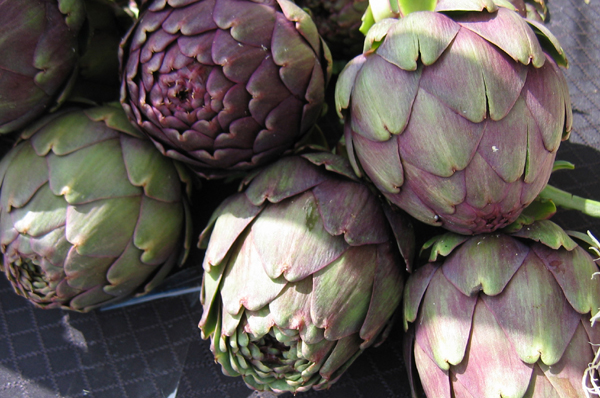
It started with a dinner on the garden-like patio at Burrasca with owners Elizabeth Petrosian and Chef Paolo Calamai. Elizabeth had posted photos of their Tuscan artichoke dishes made with organic purple Italian artichokes, grown by Tom and Patreece DeNoble of DeNoble Farms, which included a salad of raw shaved baby artichokes, tiny and tender fried baby artichokes and a creamy, delicate artichoke sformato.

Over the fire.

Another dish on the menu was frittura con gli occhi, amusingly translated as "fries with eyes," which was, to me, an irresistible must-have, not only because of the name but it also being fresh West Coast anchovies simply breaded and fried whole. (Yes, whole, as in heads on.) Tiny, crispy and tasting of the sea, I was entranced.

Tiny, tender and delicious.

So it was fortuitous when, the very next day, I stopped by Flying Fish, Lyf Gildersleeve's outpost for sustainably sourced fish, and what should be in the fresh case but some of those very same fresh anchovies. I bought a pound and brought them home, breading half of them in a flour, salt, pepper and pimenton mixture and the other half in a panko, salt and pepper mix.

Frying them in olive oil on a cast iron skillet on the grill, the flour breading coated them more completely and gave the little fish some extra crunch, while the panko was a bit scanty and not as crispy. But oh so fun and so delicious! (Plus I got to say frittura con gli occhi several times that evening.)

Tuesday, December 12, 2017

Party Favor: Crab and Artichoke Dip


I want to slide in a quick suggestion for your next holiday party, whether it's at your place or you need to take a little something to contribute to a gathering. It's a throwback to the days of yore and Madmen-style, cocktail-fueled evenings, where a table might be laden with tiny canapés made with Ritz Crackers, processed cheese and pimento olives.

Cheese balls were in fashion, sitting like an errant meteor on a china plate. My own mother was enamored of them—I think she really loved the nuts studding the exterior— and standbys like clam and onion dips orbiting big bowls heaped with salty potato chips. Chafing dishes, with little tins of Canned Heat burning beneath them, kept all manner of hors d'oeuvres like meatballs piping hot (sometimes erring on the side of molten), with rainbow-colored toothpicks nearby, the better to spear the choicest bits.

The warm crab and artichoke dip below would have fit right in on that table, even more so because it relies on canned food products and the stalwart presence of mayonnaise to bind it all together. You could substitute local Dungeness crab meat, farmers' market artichokes and homemade mayonnaise to make it, too, but I like the simplicity of the original in its all-American salute to convenience paired with deliciousness. And I know my mother would approve.

Hot Artichoke and Crab Dip
Adapted from New Seasons Market

1 14-oz. can artichoke hearts
1/4 c. capers
6 oz. crab meat (fresh is better and cheaper if you buy a whole crab and crack it yourself, but canned works, too)
1 c. parmesan, finely grated
1 c. mayonnaise
6 whole wheat crackers (like Triscuits), optional

Drain and chop artichokes. If using canned crab, drain well. Crush crackers to fine crumbs with a rolling pin.

Combine crab with artichokes, capers, cheese and mayonnaise. Sprinkle with crushed crackers. Put in baking dish and bake for at least 20 minutes at 350°. When slightly browned and bubbly, serve with your favorite crackers, baguette slices or tortilla chips. (Also makes a great stuffing for salmon fillet or chicken breast.)

Sunday, November 22, 2015

Farm Bulletin: 2. Vivace—Lively


If you shop at the farmers' market, you may notice a difference in the taste of the same crop grown on different farms. In winemaking this difference is known as "terroir," defined as "the taste of the place." For instance, carrots from DeNoble Farms on the Oregon coast might taste different from those grown at Gathering Together Farm in the Willamette Valley. Contributor Anthony Boutard of Ayers Creek Farm gives us an insight into some of the factors that might affect this difference in flavor from farm to farm.

Liveliness in vegetables is often elusive, a flatness in flavor that you can't quite put your finger on. It is easy to blame shipping distance, time on the shelf or variety. True, all of these can have a deleterious effect. Equally important is a good array of nutrients made available to the growing plant.

Castroville sign.

Many of us were introduced to artichokes grown in the coastal area around Castroville, California. In 1980, we visited Carol's sister Sylvia, then living in San Francisco, and she brought us down to Castroville where we saw the artichokes and enjoyed a perfect artichoke soup at a restaurant in the town. We'd fallen in love with artichokes as children, at that time  an expensive and seasonal treat, so we were eager to see them growing.

About two decades ago, in the mid-90s, the flavor of California artichokes struck us as flat as a cardboard carton, and we stopped eating them. We shrugged off our disappointment, thinking it was a decline due to the newer types which are treated as annuals. A symptom of the yield-over-flavor mentality.

Horseradish benefits from sodium added as a soil amendment.

Both of our fathers told us stories about the quality of food grown near the sea and the importance of salt in their flavor. Cecil Boutard told us that certain crops benefitted from salt applications, especially those that originated in coastal environments like asparagus and seakale. Peter Black, Carol's father, told us about the lamb he ate at Mont St. Michele where they graze on land inundated by the tide. From then onwards, every other meal of lamb was, as he recounted, a mere shadow of that perfection. We took their observations to heart, and over the past decade we have applied over 20 tons of sea salt to our soil or as foliar spray.

Early authors recommended the use of sea salt as a manure for certain crops, underscoring the observations of our late fathers. John Wilson in Our Farm Crops (1859), recommended its use if crops of maritime origin are grown more than 20 miles from the sea. His advice was based on carefully quantified yield trials. Still, most farmers we know recoil at our use of salt, grimace and usually mutter something about the salting of Carthage. That story never made sense to us given the fact that salt was too valuable to waste, even as a matter of revenge. Anyway, the proof is in the pudding: tons of salt later and we are still growing crops with no Carthaginian devastation. Even the crop that receives the most heavy applications of salt, horseradish, still needs weeding and the soil is still full of worms and other organisms.

Lycopene content is increased in tomatoes.

Last January, the journal Science (243:472-473) published an article titled "Ecosystems say 'pass the salt!'" The gist of the article, which opened with the standard reference about the destruction of Carthage, is that sodium is a limiting nutrient in non-coastal ecosystems, and additions of salt stimulate the soil's flora and fauna. The work was done in the tropics, but has application in our wet ecosystem. The investigation of sodium was initiated by the observation that ants offered both salt water and sugar water were attracted to both pretty much equally. Interestingly, sodium is simply never discussed when discussing plant nutrition or soil health. Soil and foliar tests do not include sodium, or a host of other important functional elements for plants. An essential but ignored element in agronomy.

For organic farmers, especially in the Willamette Valley where the rain washes the sodium and many other elements out of the soil, the advice to use salt is sensible. Non-organic farms rely on salt-based fertilizers and have to be very concerned about the salinization of their soil, which is probably why salt disappeared as a soil amendment in the early 20th century. Soil amendments used for organic agriculture are typically very gentle and do not pose the same risk of salinization. It must also be stressed that the use of salt as a soil amendment is crop specific. Chicories, turnips, radishes, kale, celery, tomatoes and artichokes are examples of crops that benefit. Crops such as cane berries, melons and grapes do not tolerate the chloride ion in salt well, so we never apply it directly to these crops, though the annuals benefit in the rotation plan. Unfortunately, there is not a lot of research on the subject of sodium and plant health, and we are left to follow our hunches. Sea salt is also a source of dozens of trace minerals needed by animals and plants.

Turnips from Ayers Creek Farm.

Based on the work of an Israeli researcher at Ben Gurian University and their own test plots, Rutgers published a couple of bulletins on the use of salt in growing better-flavored tomatoes. Their observations mirror our work. It must be stressed that adding salt as a sodium supplement does not make the food salty, it amplifies certain flavor components, otherwise produced at lower levels by the plant because they are not essential to reproduction. In the case of tomatoes, the result is a significant increase in lycopene content. The expansion of artichoke production inland, away from the coastal areas, affected the flavor. Fortunately, you can buy coastal artichokes here in Oregon, and for a brief time from the fields of Castroville. We always ask the produce manager if we can look at the box.

Coaxing flavor and liveliness from vegetables has an element of alchemy where you are working with unseen elements, as well as a chess game where you need to understand how the board will change several moves ahead. Farmers are working from their own observations. The needs of individual crops vary. The crop may be a seed, fruit, root or leaf. Our farm is a mosaic of soil types and sometimes we misstep. Our use of sea salt is just one element of nudging the flavor and quality of our crops higher. Albert Howard's Agricultural Testament is an elegant work that places emphasis on the health of the entire farm unit, including its people, and not on individual problems. In one chapter, Howard warned against the fragmentation of the agricultural sciences. The farm is an ecosystem as well as place of production, and learning about the processes in unmanaged systems is useful, even if the author propagates that old slur against the Romans.

Read the first installment in this series, Allegretto—Sprightly Cheerfulness.

Castroville sign from Wikipedia.

Friday, June 05, 2015

Anatomy of an Artichoke


In the most recent newsletter from the Beaverton Farmers' Market, market manager and gardener extraordinaire Ginger Rapport shared a comprehensive and useful guide to the history and culinary uses of that spiky-on-the-outside, tender-in-the-middle seasonal treat, the artichoke. They are well-adapted to our moderate climate in the Northwest, and they can be found in abundance at farmers' markets in the area.

We have often wondered what made someone look at an artichoke plant and decide to try to eat it. After all, they are fairly intimidating with their spiky leaves and scratchy choke. It must have been someone who was very hungry! Unlike a carrot, which is a fairly straight forward vegetable, an artichoke has secrets that you need to know in order to enjoy them.

History: Artichokes are members of the thistle group of the sunflower family. The edible portion is actually the plant’s flower bud. Artichokes date back to the time of the Greek philosopher and naturalist, Theophrastus (371-287 B.C.) who wrote of them being grown in Italy and Sicily. Ancient Greeks and Romans considered them a delicacy and an aphrodisiac. They also believed that artichokes were effective in securing the birth of boys. Cultivation of artichokes spread across the Mediterranean and French immigrants brought them to the United States in the 1800s. It was in the late 1800s that Spaniards brought them to California which today grows nearly 100% of all artichokes grown commercially in the U.S. Fortunately for us, Denoble Farms in Tillamook grows them and brings them to the Beaverton Farmers Market.


Basic Artichoke Preparation: Have a cut lemon handy because you will need to rub it on any recently exposed surface of the artichoke to keep it from darkening.

Start by pulling off any petals at the base of the artichoke which are small or discolored. Cut the stem close to the base. Cut off the top of the artichoke about a quarter of the way down. If the petals on the artichoke have thorns, use scissors to cut off the tips. Some people do this anyway because they like the look of it but it is not necessary. (Don’t forget to use your lemon on these raw areas.)

Squeeze the remainder of your lemon into a large pot of boiling salted water. Add the prepared chokes and cover with a white dish towel to help keep them submerged. Depending upon the size of the artichoke, it will take anywhere from 30 – 45 minutes to cook. To test for doneness, pierce the stem end with a fork. When properly cooked, you should get a little resistance against the fork. If it pierces too easily you have probably cooked them a bit too long.  Remove from water and drain upside down in a colander. At this point they can be eaten immediately or refrigerated for later use.

Eating An Artichoke: Peel off a petal and notice the soft part at the base. This is the only part of the petal you will be eating until you get closer to the center where the petals become more tender. If you want to dip the bottom of the petal into a sauce or dressing, now is the time. Pull the petal through your teeth removing only the soft, pulpy part at the bottom. Work your way around the artichoke until all of the petals are removed. As you work your way towards the center, the texture of the petals change. You may or may not enjoy eating them at this point in which case you can just pull them off and discard them.

You will be left with the artichoke bottom, topped with the inedible choke. Using a tablespoon, scrape the fuzzy choke off of the bottom. It is very obvious where the choke stops and the bottom begins. It is the bottom of the artichoke that you want to eat. Typically it is served with melted butter, or some kind of dip or dressing. It can be eaten hot or cold, or cut up and added to other dishes such as salads, pastas and eggs. Artichokes have a bad reputation for being fattening because they are usually served with a mayonnaise based sauce or butter. A large artichoke is only about 25 calories so it is only as fattening as what you are serving with it!

Selecting an artichoke: Globe artichokes should be heavy for their size and have a tight leaf formation. Avoid artichokes which are wilting, drying or have mold. Both raw and cooked artichokes can be stored in your refrigerator for up to a week.

Photos from the Beaverton Farmers' Market.

Wednesday, June 05, 2013

In Season NW: Spring Things…Baby Artichokes


Tender young things are everywhere at the farmers' markets these days, from curly green scapes of garlic to sweet spring onions to the diminutive first buds of the artichoke flower. These baby artichokes are different from their more developed selves, and not just in their size. Because they are picked at such an early stage of development, they don't have the leathery leaves or the fuzzy choke, which means they can be eaten whole after some trimming.

Snap off outer leaves.

I'd bought a couple of pounds of these little gems at the King farmers market, thinking they might come in handy for an appetizer that I needed to take to a dinner that evening. The sizes ranged from itsy bitsy (cones a couple of inches long) to small (a little over three inches), and I was planning to combine them with some of Dave's pancetta and chopped spring garlic for a finger or fork-friendly snack.

Sauté in pancetta fat…mmmmm.

I'd recommend buying more artichokes than you think you'll need, since the trimming process whittles down the size of the artichokes by more than half. But once that's done, I think you'll find this sauté is fabulous as an appetizer or as part of an antipasto platter, but would also be terrific tossed with pasta. A fittingly delicious tribute to spring!

Baby Artichokes with Pancetta, Garlic and Lemon

2 lbs. baby artichokes (or more)
1 Tbsp. olive oil
1/4 lb. pancetta or bacon
2 Tbsp. garlic, minced fine
Zest of 1 lemon
Juice of 1 1/2 lemons
1/2 tsp. pimenton (smoked Spanish paprika), optional

To prepare the artichokes, fill a medium-sized mixing bowl with water and the juice of 1/2 lemon. Snap off the outer leaves of each artichoke until you reach the tender, pale inner leaves. Cut off the upper half of the cone and discard. With a paring knife, trim the stem to 1/2" and peel off the outer skin. Halve each artichoke and immediately place in bowl with lemon water to keep them from browning.

In a large skillet, heat the olive oil and fry the pancetta until browned and its fat is rendered. Remove pancetta from skillet with a slotted spoon and put aside, leaving fat in the skillet. Remove artichokes from acidulated water and dry slightly, then add to fat remaining in skillet. Sauté till tender, about 9 minutes. Add garlic and pimenton (if using) and sauté briefly. Remove from heat and stir in lemon zest and remaining lemon juice. Cool to room temperature and serve.

Wednesday, May 22, 2013

Artichokes: Bless Their Fuzzy Little Hearts!


Artichokes are plentiful at the farmers' markets this time of year, so this recipe from contributor Jim Dixon of Real Good Food comes at the perfect moment.

Oregon farmers grow great artichokes, and now is the time to eat them. I like the purple-tinged variety, especially when they’re very small and the fuzzy choke is minimal to non-existent. They still take a bit of prep, but the results are worth it. If you’ve never trimmed an artichoke, search Youtube and watch a couple of videos. [Here's a good one from Gourmet. - KAB] And keep your knife sharp. You'll need a dozen or more of the little ones for the recipe below.

Carciofe Pantesco

Carciofe is Italian for artichokes; Pantesco refers to the island of Pantelleria. I use it as shorthand for the delicious combination of Pantellerian capers and oregano with garlic and anchovy.

Split the artichokes from top to bottom, cut off the upper two-thirds, pull off leaves until you get the really light-colored inner ones, and use the tip of your knife to dig out any fuzzy choke. Most recipes call for putting cut artichokes into acidulated water (lemon juice or vinegar added) to prevent browning, but they turn brown when you cook them anyway, so I skip this part. Put the trimmed artichokes halves cut side down in a heavy pan (one you can cover) with a enough extra virgin olive oil to cover the bottom.

Add a few (2-4) of the best anchovies you can buy (these at Gustiamo are the best I’ve found and worth every penny; New Seasons carries oil-packed anchovies in jars from Sciacca, Sicily, home of Madre Terra), cleaned if salt packed, diced small. Toss in a few cloves of garlic, diced, a couple of tablespoons of the Pantellerian capers (rinsed of salt), and at least a tablespoon of the island’s oregano. Cook everything gently in the oil for 5 minutes, then add about a quarter cup of water, cover, and simmer for about 15 minutes or until the artichokes are tender. Good hot, better at room temp.

* * *

Jim has announced a not-to-be-missed opportunity on Tuesday, May 28:

I met Brian & Catherine Faris at the farmers market a few years ago. They told me about their house and olive groves in Puglia and their dream to someday bring the region’s extra virgin olive oil to Portland. It took some effort, but you can taste that oil Tuesday, May 28, at my Activspace “warehouse.”

Come by from 5-7 pm, meet Brian & Cathy, and try Pascarosa extra virgin olive oil. Tom & Ani from AniChe Cellars will be sampling wine from the Columbia Gorge, and we’ll have some traditional Pugliese food.

Details: Pascarosa Olive Oil Tasting with the Founders. Tues., May 28, 5-7 pm; free. Real Good Food, 833 SE Main St., Suite 122, on the ground floor at the NE corner of the building.

Monday, May 14, 2012

In Season: With Artichokes, Babies Are Best


Sometimes I think contributor Jim Dixon of RealGoodFood has his booth at the PSU Farmers' Market for the sole reason that he gets first pick of all the newest produce as it comes in season. So if you see him there, be sure to quiz him about his recommendations while you peruse the Italian olive oils, vinegars, fennel pollen and particularly the addictive origano Pantesco (Italian oregano) he has on offer.

The first artichokes of the year appeared at the farmers' market on Saturday, so I bought a bag of the little thistles from my friends’ at Groundworks Organics. When the globes are really young, the fuzzy choke is hardly there, so trimming them down to just the bottoms isn’t too onerous. It still takes some time, but I think the results are worth it and there should be still be plenty available for the next several weeks.

Carciofe Pantesco
 
Cut the top half of the baby artichokes away, pull off most of the leaves, split the artichokes from top to bottom, and dig out any fuzzy choke. Most recipes call for putting cut artichokes into acidulated water (lemon juice or vinegar added) to prevent browning, but they turn brown when you cook them anyway, so I skip this part. Just put the trimmed artichokes halves in a heavy pan (one you can cover) with a good bit of extra virgin olive oil.

Into the same skillet add a couple (2-4, depending) of the best anchovies you can buy (these at Gustiamo are the best I’ve found and worth every penny), cleaned if salt-packed, diced small. Also add a few cloves of garlic, diced, a couple of tablespoons of good capers (you can buy the Pantellerian capers from Gustiamo, too, until my load arrives), and a good pinch or two of origano Pantesco. Cook everything gently in the oil for about 10 minutes, then add about a quarter cup of water, cover and simmer for about 20 minutes or until the artichokes are tender. Good hot or at room temp.

Saturday, March 06, 2010

Greek Profile


It's been a little crazy around here lately. First it was the birth of my new nephew, known fondly as the C-man and, I say apologetically to all the other aunties out there, the cutest baby ever born. Then we launched into a long-awaited (15 years, give or take) remodel of our main floor bathroom, requiring a major purging of years of what can only be described as assorted crap. Then this last week my neighbor's beloved father, Floyd, passed away, a kind and gentle Texan who had graced our table too few evenings in his short time in Oregon.

So why is GoodStuffNW suddenly turning into one of those soap opera-inspired, my-life-splashed-before-the-world blogs? Because, as everyone knows, the birth of a baby and a death in a family requires that food be taken to the beleaguered, sleep-deprived parents and grieving friends, of course.

Perfect for this task are various casseroles, lasagnes and platters of enchiladas that can be kept for a week or so, or frozen till needed. Comforting, yes, but a tad on the heavy side. Which is why I like a certain chicken dish that can be thrown together in virtually no time and is even good enough for company dinner when you're pressed for time or inspiration.

Layered with artichokes, olives and feta, it has a Greek profile that only needs the addition of some plain white rice and an easy salad to make a fetching dinner. Perfect for those times when your life turns into something of a soap opera.

Artichoke Chicken

2 Tbsp. olive oil
2-3 lbs. chicken thighs or 1 whole chicken, cut up
6 cloves garlic, slivered
1 15-oz. can artichoke hearts, drained and halved
1 c. pitted kalamata olives
4 oz. feta cheese, broken into chunks
1 Tbsp. oregano
Salt and pepper, to taste

Preheat oven to 350°. Heat oil in skillet and brown chicken parts in batches, transferring them to a 9" by 12" baking dish as they brown. After chicken has been browned, using the same skillet, lightly sauté the garlic slivers and scatter over chicken in baking dish. Distribute artichokes, olives and feta over the chicken and sprinkle with oregano. Place in oven and bake for 30 minutes or until thighs are done. If using whole chicken, bake for 45 minutes.

Options: Slice up oil-cured sundried tomatoes and scatter them over the chicken with the other ingredients. Or, instead of feta, add 1 large can stewed tomatoes to make a rich, braised dish.

Saturday, December 19, 2009

Crustacean Celebration: Dippity Do!


There was a popular hair product when I was a teenager called Dippity Do. It promised, as hair products still seem to do, to make the human equivalent of a bald cat magically transform into a pampered Persian.

Its translucent day-glo colors (pink and green for regular and extra-hold, respectively) and unforgettably awful smell made dipping into a fresh jar an experience both sensuous and revolting. Then smearing it on your hair and rolling the strands onto juice can-sized rollers which, if you were lucky and had a hair dryer or, if you weren't and had to sleep on them till your hair dried, was emblematic of the pursuit of beauty at all costs. Especially since the beauty part didn't usually turn out exactly as one might have hoped.

And the food at the holiday parties one attended after that gauntlet of preparations seemed to cause the same reactions of sensuousness and revulsion, though the colors were (only somewhat) more subdued. Velveeta cheese squares on saltines topped with a pimento olive slice. Cheese balls molded from gummy, flavorless cheese-like substances and rolled in chopped walnuts that looked like something that had plummeted from the sky. And who could forget the dry little meatballs covered in barely reconstituted cream of mushroom soup, not to mention the day-glo Vienna sausages?

But there were gems scattered among the lumps of coal on those tables that I remember fondly and still crave at this time of year, particularly the dips consumed with crunchy, salty potato chips. They were usually simple, creamy and whipped up in moments. I ran into a descendant of those classics not long ago and thought now might be the perfect time to share it, with holiday parties coming up that might benefit from a jewel on the table.

Hot Artichoke and Crab Dip
From New Seasons Market

1 14-oz. can artichoke hearts (Trader Joe's brand are a great value)
1/4 c. capers
6 oz. crab meat (fresh is better and cheaper if you buy a whole crab and crack it yourself, but canned works, too)
1 c. parmesan, finely grated
1 c. mayonnaise

Drain and chop artichokes. If using canned crab, drain well and combine with artichokes, capers, cheese and mayonnaise. Put in baking dish and bake for 20 minutes at 350°. When warm and bubbly serve with your favorite crackers, baguette slices or tortilla chips. (Also makes a great stuffing for salmon fillet or chicken breast.)


Check out these other examples of the crabby-licious goodness that is the Crustacean Celebration at GoodStuffNW: pasta with crab and radicchio; killer crab cakes; crab crostini; and a company-worthy crab-filled cioppino.

Wednesday, June 11, 2008

The Art of Cooking Babies


As mentioned below, to me spring is all about babies. And no, I'm not talking about human babies or those little white fuzzy lambs you always see in ads, since spring lamb can actually be up to a year old and nearly full grown. But I digress. So let me start over.

Making the soffritto.

Spring is all about sweet young things, especially in the vegetable department. Baby greens, baby carrots, baby heads of romaine, baby bok choy. Tender, sweet and oh-so-fleeting. So when I saw a bag of 20 baby artichokes for five bucks at the Lake Oswego farmers' market, I grabbed them.

The finale.

Using a recipe from Mark Bittman's Minimalist column in the NYT dining section a couple of weeks ago, I made a pasta dish that, if I do say so myself, had a couple more cojones than Bittman's and was oh-so-seasonal. If you can get fresh baby artichokes, more's the better, but if you must resort to frozen, it's still going to kill at your next dinner party.

Baby Artichokes with Anchovies and Cherry Tomatoes

1/4 c. olive oil
4 cloves garlic, crushed, then peeled
6 anchovy filets
Fresh thyme or rosemary
1/2 c. black olives, pitted (I prefer oil-cured, but kalamatas work just fine)
Salt
10 baby artichokes
1 pint grape tomatoes, halved
1 c. parmesan or romano, grated
1 lb. pasta, whatever shape you prefer

Boil salted water for pasta (a chef friend said it should be as salty as sea water). Combine oil and garlic in a large skillet over low heat. When garlic sizzles, add herb, olives, salt and anchovies.

Meanwhile, one at a time, prepare artichokes: remove hard leaves, then cut off spiky end; trim bottoms, cut artichokes in half and add them to pan as they are ready, cut side down. Raise heat so they brown a bit; move them around as you add remaining artichokes so that they brown evenly.

When artichokes brown, add tomatoes and a splash of water. Cook until chokes are tender, 10 to 20 minutes. Add water if needed. Adjust seasoning, then pour over hot pasta and garnish with cheese, with the remainder in a bowl for sprinkling. As artichokes are cooking, cook pasta. When it is done, drain and put in serving bowl. Pour artichoke mixture over top and sprinkle with parmesan.