Showing posts with label Oregon. Show all posts

Saturday, April 13, 2019

Make a Difference in Our Food System: Join a Commodity Commission!


Love West Coast albacore? Passionate about beer? Want to do something to change Oregon's food system for the better? If you care about where your food comes from and how it's produced, please consider joining one of Oregon's commodity crop commissions. Most include a member of the public, so check out this list of the positions available and make a difference in our food system!

Oregon albacore.

The Oregon Department of Agriculture (ODA) is recruiting for 63 commodity commissions, with a deadline to apply on May 10, 2019. Oregon’s 23 grower-funded commodity commissions support promotion, research and education to improve market conditions for their commodity. A key point: they also give industry members direct access to key Oregon agricultural opinion leaders and decision makers.

Oregon strawberries.

Each commission has a board that includes producer and handler positions. Producers grow or harvest the commodity; handlers are the first to purchase the commodity from the producer and often are processors, distributors, or marketers. And most commissions also include a member of the public. (The dairy commission has a public member position available…just sayin'.)

Time commitment varies depending on the commission, but can be from four to 10 times a year, and phone participation is a possibility. Meetings generally last two hours, but can sometimes be as long as two days, with some expenses reimbursed. For more information, e-mail Kris Anderson. You can make a difference!

Click to see the list and apply.

Wednesday, June 17, 2015

Your Food, Your Legislature: Hanging in the Balance


The Golden Boy atop the Capitol dome in Salem is feeling the heat building up under his feet. With only a couple of weeks left in the 2015 Oregon legislative session, the action is getting intense, with last-minute lobbying and buttonholing the order of the day. Several bills that will affect the food you put on your tables need action, so take a look at the short list below and let your legislators know what you think about these issues.

The numbered title of each bill (in bold) is linked to an overview on the state website.

The Battles We've Won

House Bill (HB) 3239: "Aggie bonds," legislation that will expand loans to beginning farmers, was signed into law by Governor Kate Brown in late May. Look for it to spur new farmers to enter the market. With the average age of an Oregon farmer at nearly 60 years old, this is a very welcome, and much needed, development.

Senate Bill (SB) 341: This bill protects agritourism providers, such as farmers who have farm stay programs, host farm tours (left) or have on-farm stores, from legal liability when they invite members of the public onto their property. It passed the House last week and will be signed into law any day.

SB 320: When a bill has 27 sponsors out of 30 members, you know it has a good chance of passing. This bill, allowing home cooks to produce limited amounts of baked goods and confectionary items for sale to the public without being regulated by State Department of Agriculture (ODA), was signed into law by the governor in mid-June.

These Bills Still Need Your Help

SB 920: This bill to limit the use of human antibiotics on otherwise healthy animals—a practice that factory farms (right) use to promote faster growth and keep animals alive in unsanitary, stressful and crowded conditions—is stuck in the Senate Rules Committee. This is a critical issue for public health, since abuse of these drugs by the livestock industry has created antibiotic-resistant strains of diseases that no longer respond to treatment with most antibiotics (see my post The Personal Gets Political). Click here to send an e-mail to your legislator.

HB 3554: This bill would help protect farmers whose crops are at risk of contamination from genetically modified (GM or GMO) crops by allowing the Oregon Department of Agriculture (ODA) to establish "control areas" to prevent cross-pollination from genetically engineered (GE) crops. This bill is currently stuck in the House Rules Committee because of lobbying by large out-of-state corporations and needs your support to make it into law before time runs out. Let your legislator know the integrity of our food system is important to you by clicking here.

HB 2723: Would provide a tax incentive for property owners to allow small scale urban agriculture for a period of five years on unused plots of land. It got a cool reception in the Senate Finance and Revenue Committee last week and may die if it isn't voted on soon. Let your legislators know that you think this incentive is a good way to incorporate more small-scale agriculture into our food system.

Read the other posts in this series, Opening SalvosThe Good, The Bad and The UglyThe Personal Gets Political and The Fight Takes Shape.

Thanks to Ivan Maluski at Friends of Family Farmers for his help with the information on these bills.

Friday, August 08, 2014

Happy Daze at the Farmers' Market


Just to remind you, as if you didn't know already, that we are in the height of farmers' market season in Oregon. With more than 60 markets operating every day of the week around the metro area, and many, many more around the state, it's time to get out and taste the goodness that our farmers are growing for us.

The bounty above was from one of Portland's newest markets, the small-but-mighty Cully Farmers' Market on NE 42nd Avenue next to Old Salt Marketplace. Amaro Brothers Produce is a new vendor at this market, and along with potatoes, eggs, tomatoes and corn, they bring terrific Latin specialties like peppers, squash blossoms and herbs.

Because of our richly diverse market scene, small farmers like the Amaro family are able to sustain themselves by selling directly to customers and not be beholden to distributors. So get thee to a market today, and don't forget to thank these folks for their hard work.

Find a market near you on this list of Oregon's farmers' markets, including links, maps, addresses and hours of operation.

Sunday, March 24, 2013

From Boring to Dull and Back


Apparently all it takes is setting foot in Oregon to catch the whimsy that clings to the place like a shawl. Take, for instance, cyclist Elizabeth Leighton, who came here from her home in Scotland to tour the beautiful green byways of our state.

It happened the day she rolled through the town of Boring. Elizabeth, you see, was from the Perthshire town of Dull, and she quickly relayed the news of this odd conjunction of place names to her friends back home. As you can imagine, this was very exciting to the Dull folk, and they immediately communicated with officials in Boring to inquire about establishing a mutual municipal friendship.

A declaration of sisterhood was drawn up, with one story quoting Dull community council chairman Tommy Pringles saying, “It’s bad enough when people stop dead to photograph the signpost for Dull. Imagine how many would do a double-take if it said, ‘Welcome to Dull, a sister community of Boring’?”

On the Boring end of things, people were no less jazzed. Sensing an opportunity, the townfolk set up a Boring Oregon Foundation to construct a multi-generational community center for the greater Boring area.

Its first fundraiser?A raffle for a thrilling, fun-filled tour of Dull! Well, it is in Scotland, after all, tickets are only twenty bucks and they're only selling 500 of them. So your chances are way better than any lottery payout. All the deets are on the Boring, Oregon Facebook page, so get in on a chance to win a once-in-a-lifetime trip that'll take you all the way from Boring to Dull.

Details: Raffle to Benefit the Boring, Oregon Foundation. Rules, details and exclusions on their Facebook page. Complete itinerary here.

Photo from The Nation.

Monday, October 22, 2012

Women Welders of WWII


It started as just another errand in a busy day. The small tank that carbonates the beer in Dave's kegerator was running low, so I headed over to our handy dandy gas supplier in northwest Portland.

As I was waiting, I glanced over at a nearby column where I noticed a framed black-and-white photo of a group of women in welding garb. There was a little typed tag glued to the mat that read "Swan Island 1942." Intrigued, I pulled out my phone and took a shot. I asked the guy at the counter if he knew anything about it and he shook his head.

A little research revealed that, as WWII took more and more men away to war, there was huge recruitment effort to get women onto the factory floors and into manufacturing plants to keep the guns, bullets and ships flowing to the war effort. One source, the Oregon History Project of the Oregon Historical Society, says that "at their peak, the two Portland shipyards—Oregon Shipbuilding and Swan Island—employed 16,000 women, and the two child-care centers cared for approximately 700 children."

The wage scale for these women welders was the same as that for men and, as indicated above, with the influx of women into the workforce, industries quickly responded to their workers' need for childcare by establishing round-the-clock onsite centers. Our very own Multnomah County even had a handbook (right) for working women and a child care counseling service that, like the onsite centers themselves, was staffed by child care professionals.

As you might expect, at the end of the war most of the women went back to their previous roles as wives and mothers. Some who wanted to stay were able to keep their jobs, but many were essentially forced out when the men returned. But this 70-year-old photograph certainly raises intriguing questions when compared to today, when pay equity is a problem—women are paid 75 cents on the dollar that men make in comparable jobs—and daycare is something that a working woman has to solve on her own with little or no help from her employer.

Just goes to show you never know what you'll run across on your next errand.

Friday, March 23, 2012

Oregon's Black Gold: The Nose Knows


"I'm ceding the field to Chloe today," said Jack Czarnecki, master mushroom and truffle hunter. He'd just been bested by a young blond who totally skunked him in a day-long search for Oregon black truffles.

Jack appreciating Chloe's work.

The blond in question was a two-year-old golden Lab trained by Jack's friend John Getz (top photo, with Chloe), who'd invited him and a couple of observers to forage for this elusive buried treasure, Leucangium carthusianum, in a stand of Douglas fir in Oregon's Coast Range near Florence. Unlike Oregon's white truffle, Tuber oregonense, which grows on surface roots of the Douglas fir, the black truffle tends to grow at depths of six inches to three or four feet. (Read my article on foraging for white truffles.)

Jack and John "helping" Chloe dig.

And that's where young Chloe came in. Dogs have been used to hunt truffles in Europe for many years, almost completely replacing the famous truffle-hunting pigs. A well-trained dog can sniff out the gasses being released by a truffle hiding beneath the soil, and John had been training Chloe to find ripe or nearly-ripe truffles since she was a pup. Dogs are also preferred because they dig in one spot and disturb the tree roots much less than other methods for finding the deeper fungi.

The training is a totally reward-based system, beginning with hiding a truffle or a truffle oil-scented cloth around the house, giving the dog a treat when the bait is found, then gradually moving the game outdoors as the dog develops its skill. Chloe turned out to be a natural, one of the best that Getz had ever had, and she was able to keep at it for several hours without losing interest.

The day had started with an early morning drive to the coast, where my friend Linda and I met Jack at his family's beach house for a breakfast of coffee and egg strata prepared by his wife, Heidi. After fortifying ourselves for the day's work, we headed down to pick up John, his wife, Connie, and Chloe at their home in Florence.

Chloe gets excited about truffles.

Our little caravan made its way up into the mountains to an old Christmas tree stand that John had obtained permission to hunt on, and we ducked under the branches of the outermost trees and into the darkness beneath them. As we worked our way in, the temperature dropped precipitously and I was glad that I'd worn insulated boots and several layers of clothing.

Candy cap mushroom-infused vodka martini at Joel Palmer House.

Chloe was very excited to have all these people with her, and it took several minutes for her to calm down and focus on her job, but with a few gentle commands to "Go find them, girl," from John, she got down to business. Within a few minutes her nose was ruffling through the duff under the trees, and then she was digging furiously. John rushed to her side and when she got about six inches down he reached in and pulled out an almost-black lump about two inches in diameter.

Filet with foie gras, wild mushrooms and mushroom polonaise.

This happened many times over the next three hours or so as we tagged along, straining our eyes to see if there was the black edge of a truffle breaking the surface, but even Jack admitted that he could find little evidence of them above ground. Chloe, meanwhile, was finding a trove of the black beauties, and the scents that rose up from them were amazingly diverse, ranging from pineapple to apple to bacon and even chocolate. (Read how to ripen truffles at home by scrolling to the second half of the link.)

Scallop quenelle with black trumpet popcorn and trout caviar.

With around two pounds of Chloe's hard work in our buckets, it was back into the cars to drive to Dayton for a grand mushroom dinner at the Joel Palmer House, now owned by Jack's son Chris, who is also the chef. A shower of courses came and went, each one with a wine pairing chosen from the restaurant's cellar. And even though mushrooms were included in every course—even the martini was made from candy cap mushroom-infused vodka, which had its signature maple flavor—each one had a completely different flavor profile.

This was one of those days that was an education as well as a revelation, and ever since then I've been eyeing Walker as a potential candidate for truffle training. It could be the start of a whole new breed trait for Corgis…great idea, right?

Friday, November 11, 2011

A Fall Day to Remember


How gorgeous can a fall day get in Oregon? Yesterday was certainly shooting for the record.

Thursday, September 01, 2011

Why I Buy Oregon Albacore


I can't think of a better illustration of why to buy Oregon albacore than this video of a small cannery I visited on a recent trip to Astoria, Oregon.

Mark Kujala, Skipanon co-owner and the mayor of Warrenton.

The Skipanon Brand cannery, now run by the second generation of the Kujala family of Warrenton, fishes for tuna off the coast of Oregon using the hook-and-line method that eliminates by-catch, the unintended harvesting of other species. Then they bring the fish into their small cannery built by Norman Kujala on the banks of the Skipanon River in 1978.

Anna, originally from Kentucky, worked at Bumble Bee until it moved out of Warrenton.

The loins are filleted and cleaned by a small crew of local women who've been working for the family for decades. The fresh loins are then sliced, hand-packed into cans with two salt pellets and sent through the ancient canning machine. The wire cage holding the cans is lifted into a large pressure cooker that cooks the fish, which means the fish cooks in its own juice without needing oil or water to keep it moist. Then the rich broth can be added to pump up the flavor of whatever dish the fish is used in.

Is it any wonder I love this product? I'm so glad to have found out about it!

Details: Skipanon Brand albacore can be found at the Saturday Beaverton Farmers' Market, ordered online at their website or found at many stores around the state. Most markets have other brands of Oregon albacore available. They're well worth looking for or asking about.

Monday, May 30, 2011

A Meal to Remember


A weekend at the beach with friends…it sounds so benign, right? But when you're with Linda Colwell and Carol Boutard, things can get pretty nutty pretty fast.

Kelly's Brighton Marina in Rockaway.

Linda had taken us to one of her favorite haunts, Kelly's Brighton Marina in Rockaway, for a lunch of fresh clams and crabs washed down with a bottle of a stunning '06 Pinot d'Alsace from Domaine Bott Geyl that she'd brought along. Though the day was misty, it wasn't cold, so we sat down at one of the brightly painted picnic tables on the deck overlooking the bay.

Linda anticipating the deliciousness.

Kelly Laviolette is the ebullient proprietor manning the tanks and the cooker. His wife, Janice, mans the store and took our order, shortly thereafter delivering three pounds of tiny, succulent steamers with cups of melted butter to the table. A rain shower required a move under cover, but didn't stop us from sucking down all three pounds in short order. After all, we had two whole Dungeness crabs coming.

The delicacy that is a crab heart.

When they arrived, Linda pointed out the tiny, star-shaped heart of the crab, insisting that I needed to try it. I picked up the half-inch morsel, bit down and got a flash of a soft, creamy, intensely briny flavor. Then it was gone. And it's definitely something I'll look for the next time I shell a crab.

Kelly at work.

Walking over to the oyster tanks where Kelly himself presides, Carol asked about getting a fresh oyster. Now, Kelly has the usual small molluscs you find on most restaurant menus, but he also has eight and ten-inch-long monsters, things you might expect to find in a Ripley's Believe It or Not display. So when he told Carol to grab one out of the tank, I thought she'd choose a small, ladylike shell. I should have known better. She came back from the tank proudly carrying (or was it hoisting?) one of the leviathans. Kelly was so impressed he said he'd shoot one with her, though you can see he added his own special twist.

How poor little Travis got roped into the proceedings, I'm not sure I know, but if you turn the volume up at the end of the video you'll hear his review. Hopefully the little guy's not scarred for life.

Wednesday, April 27, 2011

Jam On It


This article appeared in the March/April issue of NW Palate magazine.

Forget Captain Crunch. Even Tony the Tiger couldn’t entice me, no matter how loud he roared. Snap, Crackle, and Pop made too much noise first thing in the morning. Pancakes? Too much fuss. Fried eggs and bacon? Meh.

What I loved for breakfast as a child was toast slathered with butter and smeared with my mother’s homemade jam. She was a whiz, cooking up pots of strawberries, raspberries, peaches, and pears and pouring them into jars large and small that were saved from the ones we’d emptied the previous year. Opening a jar of her strawberry freezer jam was like an explosion of distilled summer, with its bright red color and deep, rich strawberry flavor.

Wherever I travel, I try to bring back a few jars of local jams and preserves, made from fruit grown in the area, to extend my trip just a little bit longer, if only for as long as it takes to have breakfast.

Oregon

King Estate
The organic fruit in their Blueberry and Raspberry Pinot Noir jams is grown on the winery’s estate near Eugene and infused with their outstanding wines. 9 oz., $8. Available online or at the winery.

Republic of Jam
Master “jammelier” Lynnette Shaw makes low-sugar, artisan jams from Willamette Valley fruit. Most interesting is her Mostarda di Carlton Apple, a traditional Italian condiment that’s more like chutney—a tasty accompaniment to sausage or roasted turkey. 9 oz., $8. Available online and at the tasting room in Carlton.

Marché
Chef Stephanie Pearl Kimmel, founder of Eugene’s revered Excelsior Café, now owns Marché Provisions in the 5th Street Public Market. Her berry jams and pear butter are made from all-organic local fruit. 9 oz., $6.50. Available online and at the store.

Sassafras Southern Kitchen
A budding project of four Portland women, the collaboration has cooked up Southern-inspired preserves, from fig to brandied plum, plus a few enticing relishes—Sunchoke, Pear and Meyer Lemon, and Heirloom Beet and Fennel. 8 oz., $8–$9. Available online and at some Portland retailers.

Ayers Creek
If it’s heirloom, orphan, or rare, farmers Anthony and Carol Boutard will try to grow it on their farm near Gaston. Look for Damson plum, Loganberry, and Italian Prune. Oh, and their blackcap jam also qualifies as a marital aid. 8 oz., $6. Available at the Hillsdale Farmers’ Market and online at Portland-based specialty food store, Foster & Dobbs.

Oregon Growers
A collaborative effort of several growers around Mt. Hood, these jams use less sugar than traditional recipes, allowing the full flavor of orchard fresh fruit to shine through. 12 oz., $6.50. Available online and at specialty food stores around the Northwest. 

Pennington Farms
The Penningtons started as flower growers in Colorado before moving to Oregon’s Applegate Valley to start a 90-acre berry farm and bakery. Their Strawberry/Rhubarb is pie in a jar. 16 oz., $6.50. Available online and at area specialty food stores.

Sunset Valley Organics
Seven years ago, farmer Bob Wilt’s diabetes led him to shift his farm to organic growing methods. His blueberry jams, spreads, and preserves are made with as little sweetener (evaporated cane juice) as possible for health and flavor benefits. 10 oz., $5.95. Available online and at specialty stores in Oregon and Washington.

Washington

Blue Cottage Jams
The Martin family started making jams for themselves and their friends. Fifteen years later, their low-sugar preserves and butters, all made with Washington fruit, are in demand all over the state. Try the Montmorency Cherry Jam, made with a unique variety of tart pie cherries. 7 oz., $5.25. Available online and at select stores.

Aldrich Farms
These jellies and preserves are a celebration of Whatcom county fruit. Check out the Cranberry Pepper and Blackberries & Brandy. 5.5-12.5 oz., $4.95-$7.95. Available online and at various area farmers markets.

Wild Harvest
It’s best to leave the berry picking to the professionals, as bears and cougars love them too. These jams are made from hand-gathered mountain huckleberries, blueberries, blackberries, gooseberries, lingonberries, and black currants. 8 oz., $8.95. Available online and at stores statewide.

Woodring Northwest Specialties
Dale Nelson, a chocolatier by trade, also makes some fine fruit jams and preserves. Rare finds: Golden Raspberry, Gooseberry, and Mimosa Marmalade. 9 oz., $7.75–$9.75. Available online and at his store at Seattle’s Pike Place Market.

Sakuma Brothers
This fourth-generation farming family in the heart of Skagit Valley grows their own berries and processes them into jams. Try the Tayberry, a cross between a loganberry and black raspberry. 12 oz., $4.95. Available online and at their market stand in Burlington.

Canter-Berry Farms
On their historic five-acre farm in Auburn, Clarissa and Doug Cross have made a living growing and making jam from some of the tastiest blueberries in the state. Available online and at their Pike Place Market store. 11.5 oz., $7.

British Columbia

Taste of the Okanagan
It’s refreshing in this day and age when a company says, “We don’t put ‘JUNK’ in our jars,” meaning unequivocally no preservatives, additives, or food coloring. Their product line includes intriguing flavor profiles such as Apple Rosé Wine and Beer-Blasted Pepper. 8.7 oz. (260 ml), $9.50 CDN. Available online year round and from June through October at the Kelowna, B.C. Farmers & Crafters Market.

Mix Bakery
To accompany their award-winning baked goods, this Vancouver-area bakery makes a selection of cool jams in flavorful combinations like Plumbleberry (plums with mixed berries) and Pear with Balinese Vanilla. 8.4 oz. (250 ml), $7.95 CDN. Available at the bakery and online at Edible BC.

Joy Road Organics
A 100%-organic line of preserves created by two BC chefs from the Okanagan, Dana Ewart and Cameron Smith. Try their Blood Orange Marmalade, Red Haven Peach, and Coronation Grape. 8.4 oz. (250 ml), $7.95 CDN. Available online and at the retail location of Edible BC, at Vancouver’s Granville Island Public Market.

Vista D'oro
Great with pork or as an accompaniment to blue cheese, the Turkish Fig confiture is made with the excellent walnut wine also produced on the farm. 7.75 oz. (770 g) $8.95; 14.1 oz. (400 g) $14.95. Available online, at their farm store in Langley, B.C., and at Edible BC.

Fore & Aft
Caterers Patrick Brownrigg and Beverly Child make a pair of sweet-meets-savory flavors: balsamic jelly [8.4 oz. (250 ml), $6.95 CDN] and red pepper [2 oz. (55ml), $2.95 CDN]. Available at Edible BC.

Okanagan Lavender
Andrea McFadden started growing lavender when she inherited her father’s declining apple orchard. Now she captures the flavor of summer in lavender jelly—the best thing ever with lamb. 4.2 oz. (125 ml), $5.95 CDN; 6.4 oz. (190 ml), $8.95 CDN. Available online and at Edible BC.

Monday, December 07, 2009

Farm Bulletin: Asking for Help


On a sunny November morning, the (deep breath…) Oregon House Committee on Agriculture, Natural Resources and Rural Communities (whew!) met in Salem to hear from the Oregon Dept. of Agriculture and several representatives from Oregon farmers' markets and small farmers involved in direct sales to consumers. One of those was contributor Anthony Boutard of Ayers Creek Farm. His testimony outlines the issues the working group, formed that day, will be addressing.

Our farm is small, but well diversified. We produce grains, legumes, vegetables, cane fruit, table grapes, nuts and stone fruit. We are also one of a handful of market farms that grow vegetables all through the winter.

As market farmers, we are often asked why it is so hard to find traditional local foods such as fresh hominy, locally grown and ground grains, brined pickles, or prunes and raisins. We reply that Oregon Department of Agriculture’s rules discourage small farms from on-farm processing with requirements created for industrial type standards, a daunting process and steep fees. The last session of the legislature passed a law allowing ODA to fine violators of food processing laws, big and small, $10,000, further stifling any experimentation.

Oregon’s strict land use laws are predicated upon the productive use of the state’s farm and forest lands. The underlying justification for protecting the land is the flow of economic and social benefits that land preservation brings. Family farms such as ours should be preserved for our day-to-day contribution to our state’s economy, and not merely as quaint footnotes from the past or horse pasture.

It is not enough for the state to restrict development on farm and forestland, if our ability to generate income from our land is curtailed. Traditionally, farmers have bolstered farm income by processing some of their crops. [Some of Ayers Creek's products are shown at top. - KAB] Walnut and prune driers were a common part of Willamette Valley farms. Decades ago, dozens of roadside stands sold prunes, pies, pickles and preserves prepared by farm families. As licensing fees and other requirements have put a chill on modern farmers’ ability to add value to their crops, these farm-based foods have disappeared. Sadly, it is hard to find a true Oregon prune anywhere in the state today.

An artifact of the last three decades when almost every Oregon farm sold the majority of their crops to large processors, the food laws were written to regulate large industrial processors. Consequently, few farmers paid much heed to the laws. As processors have folded or abandoned Oregon, farm income is being pinched. We need to draft laws that give farms greater flexibility in value-added production and encourage a healthy rural economy.

Good models for change exist. Many states have adopted a light regulatory touch when it comes to on-farm processing of low hazard foods such as pies, pickles, preserves, dried fruits, lacto-fermented vegetables, hominy and grinding grains. New York and Iowa have a long tradition of encouraging farmers to offer these foods directly to the public without costly inspections and licensing fees. Minnesota’s “pickle law” permits farmers to produce various value added foods without running afoul of the state food processing laws. This spring, Indiana followed suit with its “Pie Law,” freeing pickles, preserves and baked goods from heavy regulation when sold directly to the consumer.

These laws are carefully limited to direct sales to the consumer, not third-party sales. It is not a free-for-all and all products have labeling requirements, including a list of ingredients and a statement that the goods are not produced in an inspected and licensed facility. They simply remove a substantial barrier to expanding food options.

Progressive states treat on-farm value-added products as one would a bicycle versus a Mack truck. It does not make sense to require bicyclists to wear seat belts and pass a commercial drivers license (CDL) exam. Likewise, a farm family that bakes a few pies, grinds some cornmeal or ferments a few batches of sauerkraut to sell to regular customers should not be subject to the same laws as a mill grinding tons of corn per day or a processor producing thousands of jars of sauerkraut per hour. These are foods that have been safely prepared by farmers for generations. We need to reinvigorate the tradition rather than stifle it with pointless regulation.

Along with other farmers and consumers, we hope the legislature makes changes in the laws in the next session.

If you'd like to support the changes in the laws that Anthony outlines, you can locate your legislator here and tell them how important it is to support Oregon's small farmers and farmers' markets.

Thursday, August 24, 2006

Thunder Road: Back in Oregon

Whether it's the fact that the weather cleared up and was at least 10 degrees warmer, or that our next campsite at Harris Beach State Park had newer, clean bathrooms with free showers and all the hot water you could want, we were so happy to be back in Oregon and so very proud of our state park system. We did stop on the way up just before crossing the border and the guys slaked their disappointed-by-Costco liquor lust at Safeway, grabbing a few extra bargain-priced bottles.

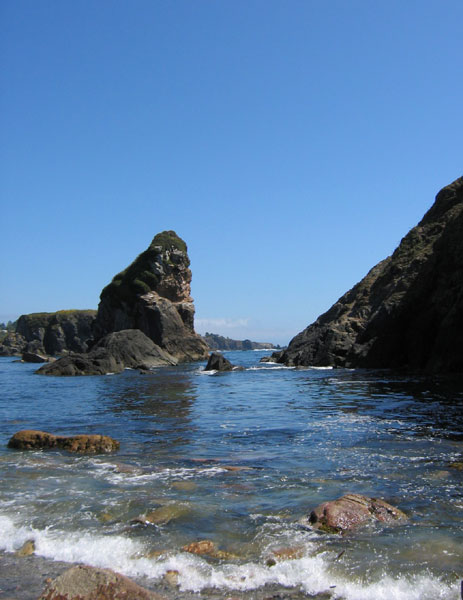
Once we got the tents set up, we headed down to the beach to do some rambling among the rocks and sitting on the sand as the waves crashed in. The view from the top of the hill is stunning. Large rocky headlands jut out from the shore with many craggy outcroppings littering the tidal zone.

Rosey was particularly pleased to be out of the car, and when she wasn't curled up in some little nest she'd dug for herself or rolling in the dirt like a real dog, she was dipping her belly in the surf and doing her best seal imitation.

When friends Dawn and David arrived with their dog Reuben, a big gentle giant, and had set up their tent, we were well on the way to serving my brother's much-vaunted spaghetti carbonara ala Marcella Hazan accompanied by a green salad with balsamic vinegar, shallot and mustard dressing. In keeping with the menu, David brought a 2001 Arnaldo-Caprai Montefalco Rosso to the party, which was followed by a 2001 Fattoria di Poggio Capponi Petriccio Chianti. I'm sure Marcella herself would have rolled up the sleeves of her fleece sweatshirt and dug right in with the rest of us. Dessert was that campfire classic, S'mores, supplied by the lovely Dawn and abetted by the campfire which had burned down to perfect glowing coals.

The next day was spent writing, reading, spelunking on the beach and playing more Train, a set of 91 colored double-twelve dominoes where the object of the game is to discard all your dominoes onto the "trains," your own or those of the other players. It's very easy and a longtime family favorite where you get to yell, accuse others of cheating and try to gang up on whomever is winning. Big fun.

So a quick dinner of grilled-on-the-fire-pit salmon, a delicious fresh corn risotto and some more S'mores and we were ready to call it a night. The next morning we packed quickly and headed home to Portland, feeling like this trip was the perfect way to (almost) end the summer.

Read the rest of the posts in the series: Thunder Road Redux, Stop1: Jack's Grill, Stop 2: The Sundial Bridge, and California Campin'