Showing posts with label David Padberg. Show all posts
Tuesday, February 11, 2014
What's Cookin' at Good Keuken
"I remind them that cooking traces itself to the dirt. We telescope into a place, learn what sort of agriculture the soil supports, what evolves through the season, and who historically inhabited the place. Suddenly there is a different clarity at the moment the fire is under the skillet."
- Robert Reynolds
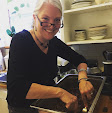
It's not easy to carry on the work of a legend, but that's just what Blake van Roekel (below left) is doing at Good Keuken (pron. COOK-in). Robert Reynolds, a chef and educator who'd cooked his way through some of the best kitchens on at least two continents, settled in Portland and opened The Chef Studio to work one-on-one with students, passing on his passion for local food. Van Roekel had been one of those students, eventually spending five years under Reynolds' tutelage, later becoming the heir to his mission when he died in 2012.
She opened Good Keuken in an intimate space behind Ben Meyers' Old Salt Marketplace, part of Meyers' vision to make the building a center for the surrounding community to gather, eat and learn. Opening with consumer-friendly cooking classes for the general public, van Roekel recently took the next step in achieving her vision with the addition of Chef David Padberg (below right) as Chef Instructor and Director of Curriculum.
With a resumé remarkably similar to Reynolds', Padberg began his career cooking his way through Europe, absorbing cuisines and techniques that helped refine his own approach. Moving to Portland, he was blown away by the region's vast bounty of fresh ingredients. An avid forager and gardener, he built relationships with a network of the area's best farmers and ranchers, rising to run kitchens at some of the city's best restaurants.
Also a dynamite writer and teacher, he's intent on sharing his passion for the seasonality of ingredients, teaching how to obtain and use the best of a region's ingredients in a hands-on culinary education. In rewriting Reynolds' curriculum, he said his goal is to make a more direct connection to the farm, focusing not so much on history as technique, teaching the art of cooking and the principles of taste by increasing the layers of students' experiences.
Other efforts taking shape at Good Keuken include yanking culinary education outside the confines of the kitchen with Get Dirty Farm Tours, a first-in-Oregon tour company where chefs and food lovers—the "farm-curious"—can connect with farmers who are using sustainable, ecologically sound practices. Plus there are the continuing classes in everything from modernist cuisine to butchery with some of the area's best chefs, and opportunities to meet-and-greet with cookbook authors and teachers.
Sounds like a solid next step in Portland's culinary evolution, one Robert Reynolds would have been proud to be part of.
Details: Good Keuken, 5031 NE 42nd Ave. 503-753-1655.
Photos: Collage at top and Blake van Roekel from Good Keuken; David Padberg by Jeremy Fenske.
Sunday, August 18, 2013
Follow the Bouncing Cherries
The message appeared on my Twitter feed one day from Dave Shenaut, aka Neon Dave, barmaster extraordinaire at Raven & Rose.
"Today's conundrum…what should I do with this 40 lbs. of sour pie cherries?"
Quickly cooking the cherries to retain their shape and texture is key.
Replies started streaming in: "Housemade Sourpuss?" "Rum soak some, shrubb, and cherry bounce." "They would make wonderful garnishes for sour beers or a nice fruity saison." There were suggestions for sour cherry liqueur, using them as garnish for sour beers and fruity saisons, as well as muddling them to make a cocktail called "So We're Havin' a BBQ, Huh?"
Filling the canning jars.
Now, normally when produce comes in the door of the restaurant it goes straight into the kitchen's walk-in and ends up on patrons' plates. It's not that common for the bar in a restaurant to be allotted a portion of the produce to make into cocktail ingredients that will end up in their glasses. But the team at Raven & Rose—owner Lisa Mygrant, chef David Padberg and Mr. Shenaut—are shaking up that convention by making their own cocktail ingredients, including shrubs, syrups, tonics and bitters, from the seasonal goodness from area farmers.
Mmmm…bouncy!His executive decision? Make a cherry bounce, an infusion of cherries, sugar and a spirit, which Todd Appel, writing for Imbibe magazine, said dates back to the days of Martha Washington when "the first First Lady even documented her own version on husband George’s stationery."
And not being one to waste any of the leftover fruit juice, Shenaut saved it to use as a spiced cherry syrup in a fantastic sour cherry limeade (recipe below).
Cherry Bounce
From Lisa Mygrant and Dave Shenaut of Raven & Rose
2 qts. cane sugar
1 qt. water
2 star anise
2 cinnamon sticks
2 qts. fresh sour (pie) cherries, stemmed and washed, NOT pitted
2 long strips lemon peel
20 oz. Slow N Low* (or other high-proof spirits such as whiskey, brandy, rum, or vodka)
Wash two 1-quart mason jars with brand new lids (note: new lids must be used for canning in order to achieve a proper seal) in hot, soapy water or run through the dishwasher. Fill a small oven-proof container with water, add the lids and place with clean jars (lids in water, jars not in water) in 250° oven to sterilize while you prepare the cherries.
Place the sugar, water, star anise and cinnamon in a large saucepan and bring to a boil to dissolve sugar. While this is coming to a boil, pour 10 oz. of your chosen spirit into each jar and place it back into the oven. This step is important because the entire contents of the jars must be boiling hot in order to achieve a proper seal and to remain sterile, therefore far extending the shelf life of the canned cherries.
Once the syrup has boiled and the sugar has dissolved, turn it down to a bare simmer and add the cherries. You want to barely simmer the cherries for approximately 2-3 minutes, but no more. They are very delicate and will split easily. You want them to barely lose their raw texture but retain their fresh flavor and shape. After a minute or two, taste one. As soon as it is warm in the middle, it is ready.
Carefully pull the hot jars from the oven, add a strip of lemon peel to each one, and—using a canning funnel and being careful to keep the rims of the jars completely clean—fill with cherries and syrup to within 1/2 inch of the top of the jar. Make sure a cinnamon stick and a star anise make it into each jar, and close with the sterile lids from the water bath. Twist lids firmly but not too tightly; making it too tight can actually cause the seal to fail. You will have lots of extra syrup that doesn't fit into the jars with the booze and cherries. Save this and mix with lime juice and soda water for delicious sour cherry limeade (recipe below)!
As the jars cool, the buttons on the lids should pop down, indicating a proper seal. Store the sealed jars in a dark, cool place. Flavor will improve after a week or two. Once opened, store in the refrigerator. Unopened, they should store indefinitely.
* From Mr. Shenaut: "Slow n Low is rock and rye—a whiskey sweetened with rock candy syrup made by the same folks that brought us St Germain. Ask for it at your local liquor store."
Sour Cherry Limeade
3/4 oz. cherry syrup (see above)
Juice of 1/2 lime
2 dashes acid phosphate
Crushed ice
Seltzer**
Sour cherry garnish
Place ice in tall glass. Add other ingredients and top with seltzer.
** If you don't have phosphate and seltzer, simply substitute soda water. The flavor will be slightly different, but still lovely.
Sunday, January 27, 2013
Shrubs Growing in Portland Bars
It hasn't hit an episode of Portlandia yet, but drinking vinegars and their close relatives known as shrubs are taking over some of the city's toniest bar tops. The shrub has been around since the 17th century or so when vinegar was used to preserve fruits and berries for use in the winter. The fruit would be left to infuse the vinegar, then the fruit would be strained off and the resulting liquid would be sweetened with honey or sugar to make a syrup. It could then be mixed with water or soda to make a soft drink, or with alcohol to make a cocktail.
The advent of refrigeration made this method of preservation unnecessary, but in the last few years the shrub has experienced a resurgence among bartenders who are making their own syrups and bitters. A recent visit with Raven & Rose bar manager Dave Shenaut gave a glimpse into the process of making this shout-out to his predecessors of yore, as well as a recipe for a mighty fine cocktail to be featured on the specials board at that establishment. (Shenaut warns, however, that there is a limited quantity of the syrup, so get it if you see it on the board.)
The recipe for the shrub calls for medlars, an unusual fruit that was popular in the Victorian era but, like the vinegary shrub, fell out of fashion, perhaps because of its extreme astringency. Chef David Padberg, also of Raven & Rose, got a delivery of these fruits from a uniquely named fellow, Tremaine Arkley, who grows the equally arcane quince on his farm in Independence, Oregon. His experiments with the strange fruit resulted in several new applications, including this shrub. (Read a more complete description of medlars and their Shakespearean bona fides in Padberg's post, What to do with a Medlar?)
As You Like It
For the medlar shrub:
4 c. medlars
2 c. demerara sugar
2 c. muscat vinegar
For the cocktail:
3/4 oz. madeira
1 1/2 oz. pisco
1/2 oz. medlar shrub
Splash of Bittermen's Orange Cream Citrate
The medlars, like other astringent fruits such as persimmons and loquat, should be so ripe that they're mushy, or bletted, when used. In a large glass jar or other glass container combine the bletted medlars with the sugar. Cover and let sit in a cool, dark place for 24 hours. Add the vinegar and stir until the sugar dissolves, cover and let sit for a week or so in a cool, dark place. After a week, pass the mixture through a food mill, then strain through cheesecloth or a fine mesh strainer to remove most of the organic matter. Taste and adjust the sweetness. Store in the refrigerator for another week until the vinegar flavor mellows.
For the cocktail, fill a mixing glass half full of ice. Add madeira, pisco, the shrub and the splash of orange cream. Stir for a minute or so to chill and serve up with a twist of lemon.
Photo of medlar, top, by David Padberg.
Labels:
cocktail,
dave shenaut,
David Padberg,
medlar,
Raven and Rose,
recipe,
shrub,
Tremaine Arkley
Sunday, December 30, 2012
Raven & Rose: First Impressions
I am a complete sucker for old architecture…homes, buildings, barns, cabins. (Regarding the last two, the more decrepit the better.) Maybe it had to do with growing up in older homes, ones with creaking floors, out-of-plumb walls and door jambs and hidden nooks and crannies. The first home Dave and I owned in Sellwood turned out to be the oldest in the neighborhood, with support beams made of logs (including bark) that had been cut from trees on the property.
House-cured gravlax, crumpets, winter chicories.
So it was no wonder I was taken with the story of the Ladd Carriage House, built by William S. Ladd to house his horses and the carriages they pulled through the streets of what was then jokingly known as Stumptown. He arrived three months after Portland was incorporated with a load of alcohol on consignment from a college pal in San Francisco. Ladd then proceeded to make a fortune selling liquor to the new city's thirsty inhabitants and, with that same college pal, set up the first bank north of San Francisco (take that, Seattle). He was elected mayor twice and built a grand home on Southwest Broadway with his horses lodged across the street.
Jasmine and Blood & Sand in the Rookery.
His house didn't survive but the carriage house, amazingly, did. In 2005 the First Christian Church, which had bought the property in 1971, got a permit to demolish it to build a parking lot. (Proving Joni Mitchell was right.) A group, Friends of the Ladd Carriage House, quickly formed to save the building and arranged to move it several blocks away while an underground parking garage was built. The Carriage House was then moved back to its original site.
Mr. David Shenaut.
Restored with the help of historic photographs, the building was subsequently bought by the Mygrant family of Hayward, California, when their daughter, Lisa, who was looking for a spot to open her first restaurant, saw the building was for sale. Long story short, she recruited David Padberg of Park Kitchen as her chef and David Shenaut of the Oregon Bartenders Guild to run the bar program. The restaurant is scheduled to open Jan. 4.
Braised shortrib, horseradish cream, Yorkshire pudding.
I was invited to attend a test dinner recently, and jumped at the chance to preview the space and see what was in the works. While certainly not intended as any kind of review, the dinner went off without a hitch, the bar was spot on and the food was terrific. According to Padberg, the menu will be similar to a European gastropub with "a nod to the British isles." It will feature as many local ingredients and suppliers as he can cram onto it, including eggs from Lisa Mygrant's own chickens. In the initial phase, Padberg said, they'll open with a limited menu of spot-on entrées featuring Northwest ingredients like sturgeon, salmon, mussels and short ribs accented with seasonal produce like root vegetables, chicories and greens.
Working the wood-fired oven.
On the beverage front, the two bars, one in the restaurant dining area and another called The Rookery Bar in the former hayloft, will have a list of house specialties along with classics, as well as an extensive wine and beer selection. I plan on going back in the near future, and I suggest you should, too.
Details: Raven & Rose, 1331 SW Broadway. 503-222-7673.
Look for an upcoming episode of Food Farmer Earth featuring my interview with Mygrant and a tour of the building.
Wednesday, April 25, 2012
A Walk in the Park (Kitchen)
I am so glad I chose to write about farms, farmers' markets, gardening, seasonal eating, Northwest travel and (thanks for your patience on this) my dogs. I can't imagine having one of those restaurant blogs where there's constant pressure to keep up on the latest who's-smashing-dishes, what's-the-hottest-table, what's-opening-where-and-when gossip.
Sprout salad, carrots, hazelnuts, quinoa.
So when a friend asked where we should meet for dinner recently, my head started swimming. Should we go check out a new place of the too many I hadn't been to yet? What kind of food? I froze up.
When I hadn't called back for several hours, she wisely took matters into her own hands, suggesting that we meet at Park Kitchen. My brow immediately unfurrowed, my death grip on the phone relaxed. I'd run into PK's owner Scott Dolich at a lunch at Raptor Ridge winery, where he kindly let me watch him make quenelles (cool!). And David Padberg, his Chef de Cuisine, was a pal of Clare and Brian of Big Table Farm, as well as filming a video on cooking with wasabi with my friend Rebecca at Cooking Up a Story. I knew we'd be in good hands.
We arrived to find our table ready, its copper top gleaming in the intimate (but not dim, thank you) lighting that makes the small dining room feel cozy rather than crowded. I had a great view of the unfussy open kitchen where Scott, David and the crew were cooking and plating the orders of the diners already seated, and watching the plates sail by only confirmed the decision to come here.
Flank steak and blue cheese salad.
Nettles, beets, wild mushrooms and spring greens, along with wild salmon and local meats populated the simple menu comprised of small hot and cold plates, large plates and desserts. After ordering a Boulevardier for me and a French 75 for my companion, we opted to share a couple of small plates and an entrée.
The baby octopus arrived topped with crusts of light bread, the better to sop the broth below, and the tiny barely blossoming rapini and small, tart chunks of pickled celery gave this plate a nice balance of tang and texture. The flank steak, blue cheese and sherried onions turned out to be a lovely salad of butter lettuce, with shreds of the medium-rare meat mixed with the other ingredients and tossed in a simple vinaigrette. The kitchen then sent out a complimentary salad of quinoa and carrot purée topped with crunchy housemade crackers.
Our large plate was a hefty slice of salmon on a bed of potato horseradish gratin, topped with watercress and trout roe and with a lightly creamy wine sauce underneath (top). The salmon had a perfect, clean flavor that only the freshest fish carries, and the soft, almost gravlax-like texture practically melted in my mouth. On the recommendation of our server we chose to pair it with a pinot noir from the always-satisfying Athena Pappas and Stewart Boedecker of Boedecker Cellars.
Love the dots!
Normally not a big dessert person, I was glad we'd shared our plates since we weren't too full to order the ricotta fritters with preserved blood oranges and little dots of bay leaf panna cotta. My friend said the fritters reminded her of beignets, those airy Southern specialties, and the bay leaf panna cotta went on the "gotta figure this out at home" list. Stay tuned!
And I have to remark on the service that, even though the restaurant was busy and the kitchen humming, made us feel very well cared for. For its focus on locally sourced, sustainably produced food, perfect execution and the aforementioned attentive service, Park Kitchen should be high on your list of the best restaurants in town.
Details: Park Kitchen, 422 NW 8th Ave. 503-223-7275.
Wednesday, April 15, 2009
Sunday on the Farm with Clare (and company)

Once in awhile an invitation comes over the transom (or, in this case, the ether) that feels like winning the lottery, or indicates that your karma is enjoying an attack of the happies. (Was it the three dogs I found on separate occasions wandering in the park across the street and returned to their owners? Or some random act I was completely unaware of?)
Brian's fried and marinated smelt.In any case, the kind offer was made by Brian and Clare, the hard-working stewards of Big Table Farm, to come out to their 70-acre spread in Williams canyon near Gaston. The occasion was Easter dinner and a tour of their property and critters, which to me is the equivalent of having Christmas, a trip to Paris and a litter of puppies magically fall in my lap on the same day.
Though Dave had come down with an unfortunately timed head cold, my brother and his bride were also invited, so we piled into their brand-new Mini and drove out into the wilds of Washington Country. We turned off the two-lane highway onto not one but two dirt roads till we spotted the telltale pink Victorian farmhouse on the canyon's steep sides, and pulled up to be greeted by the lovely Clementine, their Catahoula Leopard Dog.
Rabbit rillette.The tiny woodstove was cranking out the heat and the kitchen island was covered with incredible homemade appies prepared by Brian and another invitee, David Padberg of Park Kitchen. (Get what I mean about the karma-working-overtime thing?) Included were...get this..fried and marinated smelt covered in sautéed onions and toasted pine nuts, a rabbit rillette, head cheese made from last summer's pig, and sides of crispy crostini, homemade mustard and tart cornichons. Where to start?
Since Clare had suggested touring the farm during a break in a drenching downpour, I scarfed as much as I could grab, pulled on my wellies (I came prepared) and we set off to meet their chickens, cows, draft horses, pigs, goats and Edward, the guard llama. I was in heaven, of course, tromping up and down the steep hillsides and feeding the animals out of hand from the bucket of feed Clare had brought along.
Clare on tour.It was on the tour that the full extent of this talented young couple's skills came to light. Brian is (and I'm not laying it on hoping for an invitation back): a talented winemaker, farmer, expert gourmet-level cook, welder (he made most of the coops and animal shelters as well as the biggest steam-punk-style smoker I've ever seen, all of them on wheels), and millwright, felling trees and milling beams to shore up the barn that collapsed in last winter's snow. Clare is: a martial artist, plowhorse wrangler, farmer, painter and graphic designer, responsible for not only their wine labels but those of many other wineries. It made me tired just hearing about it!
The tour over, we got back to find the eponymous Big Table in the dining room set with a beautiful collage of old silver, mason jars for water and an egg at each place that, when we sat down and read each one in turn, was a praise poem for spring. Then the food started coming, beginning with Brian's incredible homemade homemade ravioli stuffed with ricotta, caramelized onions and pine nuts with sage butter.
Dinner, not only gorgeous but soooo good!As the dozen of us ate and laughed and drank some of the many bottles of wine that had been opened, Clare and Brian served up the main course of a luscious corned beef from Mossback Farm that had been brined for five days, a potato gratin from Amy Benson and Chris Roehm of Square Peg Farm (who were also there that evening) and farmers' market asparagus topped with Brian's rich garlic aioli.
Then came...are you still with me?...a warmed arugula, walnut and grilled onion salad with greens from Square Peg. And, as the evening grew dark and candles were lit, an assortment of cheeses for dessert, plus, obviously, more wine, much happy chatter and eventually a walk back our cars in the star-studded moonlight shepherded by the attentive Miss Clemmie.
Lighting the Pascal tea lights.As I've said so often before, am I lucky or what?
Labels:
Big Table Farm,
Brian Marcy,
Catahoula,
Clare Carver,
David Padberg
Subscribe to:
Posts (Atom)


