Showing posts with label grains. Show all posts
Tuesday, July 11, 2017
Guest Essay: A Grain of Wheat
There's the old saw that the best way to teach kids to swim is to toss them into the deep end of the pool. While I may not agree with that theory (Hello…Red Cross swimming lessons???), the idea of learning by doing is a good one. So when my friend, hunter, forager and author Hank Shaw, found wheat growing in his yard, he decided to see what it took to grow, harvest, thresh, winnow and grind his own flour.
“I say to you, unless a grain of wheat falls into the earth and dies, it remains alone; but if it dies, it bears much fruit.” - John 12:24
How little we consider the grains that sustain us.
Tiny seeds that contain within them the power to change humanity, and by so doing render themselves almost invisible in their ubiquity. By the time The Gospel of John was written, somewhere around 70 AD, wheat, rice, barley, rye, millet, and, here in the Western Hemisphere, corn, had already dictated our existence for eight millennia.
Grain, or more accurately dependence on grain, is what separated farmers from foragers, Jacob from Esau. Grains underpin civilization: portable, easily renewable, nutritionally dense foods that can be grown in surplus and stored—or kept from those the holder deems unworthy.
Every culture that tamed a grain, although it could easily be argued that the grains tamed us, has held that grain sacred. In Japan, there is a saying that each grain of rice contains 88 souls, and to waste one is a sin. Similar proverbs exist all over the world.
So how did grain fall from sacred to commonplace? To become something tossed about without thought, wasted, even scorned?
I have been guilty of all of this. And chances are, so have you. I can distinctly remember times when I’ve thoughtlessly poured several cups of flour into a bowl to dust a piece or fish or schnitzel, then tossed the vast majority of it into the trash when I finished. It’s just flour, right?
Well, yes. But then, one day, I decided to make flour.
I started with acorn flour. Why? Well, I am a forager living in California. Here, the native people relied not on grain for their daily starch, but on flour made from acorns. California acorns have the decided advantage of being large — sometimes three inches long in the case of the Valley oak. And, again in the case of the Valley oak, these acorns can be low in tannins, and plentiful. Very plentiful. One old mother tree can drop a literal ton of acorns in a good year.
Making flour from acorns requires that you leach out the tannins first. You do this by shelling the acorns, breaking them up into small bits and soaking them in multiple changes of water. It is a lengthy, but not difficult process. (If you are interested, here are my directions for making acorn flour) When your acorns are no longer bitter, you must then dry them and grind once more to get flour.
When I did this, I became acutely aware of how much work this all was. How precious this flour truly is. I do my best not to waste a teaspoonful.
But acorns are not grains. Grains, by definition, are the seeds from grasses. They offer a distinct advantage in that they are annual. If my village is dependent on a grove of oak trees, many of which may be a century old, and you come and burn down my oaks, my village starves. But I can hide a sack of grain seeds in a hole. And when marauders have burned everything and left, I can replant, and, in a year, rebuild. From one seed comes many grains of wheat.
As it happens, I got a chance to see this first hand. No, marauders did not come to my house and burn down my oak trees. Rather, my yard became an impromptu wheat field.
Holly [Heyser, Hank's partner in crime] bands doves for the state fish and wildlife department. To do so, she is given bags of mixed grain to bait them into a live trap, so she can capture the doves, band them and let them go. Apparently doves vastly prefer safflower to wheat, because when the rains came in October this past year, it was wheat that began to grow in our yard. Lots of it.
I became determined to harvest this wheat. I had no idea what the yield might be, nor did I care. I wanted to see what it actually takes to harvest a grain of wheat.
In late spring I began with green wheat, called freekeh or farik in North Africa. You harvest it when the grain heads are fully grown, but the plant still holds moisture; typically when it begins to yellow.
Now if you’ve seen a wheat grain head in all its glory, it is a beautiful sight. You can see why gatherers all those millennia ago would want them. Large seeds (for a grass) that are, relatively speaking, easy to collect and remove.
I gathered a mess of green wheat and set the sheaves on a steel plate. To make farik, you then set them on fire briefly to burn away the little spikes on the grain heads, and to parch the seeds a bit. You then let all this dry in the sun for a day or two, which makes it far easier to thresh and winnow your wheat—literally separating the wheat from the chaff.
Read how Hank threshed his wheat. Read how Hank winnowed his wheat. And read one of the very practical reasons our ancestors may have ground their grains into flour.
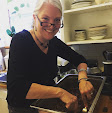
Top photo by Holly Heyser; the rest by Hank Shaw.
Labels:
frikeh,
grains,
guest essay,
hank shaw,
hunter angler gardener cook,
wheat
Monday, September 15, 2014
Salad Smackdown: Barley Is a Winner
I love a good grain salad, so when I heard Anthony Boutard of Ayers Creek Farm waxing poetic about the quality of their barley this year, I had to get some. Of course, I'd never cooked barley before, though I'd made a killer salad with his frikeh, but I decided what the heck, my family will pretty much eat anything with enough garlic and fresh vegetables in it. To up the ante a notch, we had old friends coming over for a grilled salmon dinner, and it seemed like a grain salad with some crunchy raw vegetables would be a good match.
I wasn't wrong.
Adding water to the soaked grains.
Between the terrific salmon, which Dave grilled to perfection, and the 2009 Seufert Zenith Vineyard Pinot Noir my brother supplied to go with it, not to mention the near-perfect late Oregon summer evening and the table lit by candlelight, we all were swooning. The pop of the grain and its sweet, carrot-like flavor just made it all that much better. I don't think you could ask much more of a salad.
Barley salad
1 lb. hulless barley
1/2 red bell pepper, chopped fine
1/2 red onion, chopped fine
1 fennel bulb, chopped fine
1 c. corn kernels (or kernels sliced from 1 corn cob)
5 or 6 leaves kale, sliced into chiffonade
1/4 c. olive oil
Juice of 2 lemons
2 cloves garlic, pressed through a garlic press
2 tsp. salt, then more to taste
Put barley in large pot. Cover with cold water by 2” and soak overnight. The next day, drain and rinse the barley in a fine mesh sieve. Put in pot and cover with cold water by 1”. Bring to a boil, reduce heat and simmer for 25-40 min. until done to your liking. (I like it a bit al dente, so only cooked mine 25 min.) Add more water if it gets dry.
When done, drain barley and rinse in cold water. Put in large salad bowl. Add bell pepper, onion, fennel, corn and kale and mix to combine. Add olive oil, lemon juice and salt. Mix to combine. Cover and place in refrigerator for a minimum of 30 min. before serving. Prior to serving, taste for salt and adjust as needed.
Labels:
Ayers Creek,
barley,
grain salad,
grains,
hulless barley,
salad,
salad smackdown
Saturday, July 27, 2013
Summer Salad Smackdown: Grains of Truth
zeitgeist: The defining spirit or mood of a particular period of history as shown by the ideas and beliefs of the time.
It's something I've experienced before, and it could be a complete coincidence. When I was in advertising, I'd come up with a headline that was so original, so clever, a concept that I'd never seen or heard before. My ad would appear, and then I'd see the exact same concept in an ad for some national product that must have been developed at about the same time I was coming up with mine.
So I can only assume that Mark Bittman and I were in the same cultural cloud when we were coming up with our summer recipes this week. His appeared on Wednesday, so he beat me by a couple of days, but I swear on a stack of holy books that mine was in process before I saw his.
The spirit that moved the two of us was inspired by the humblest of ingredients, what a writer like Michael Pollan would call the civilizing influence on the human race. Mine was provided by the frikeh I picked up from the Ayers Creek Farm stand at the Hillsdale Farmers' Market, a parched wheat with a faint, smoky essence.
Here is my point: these grains, whether farro, frikeh, bulgur, millet or some other whole grain, are perfect for summer salads. Cook the grain in the cool of the morning, preferably enough to last a couple of meals, then throw it in the fridge to make up later. And I agree with my colleague, Mr. Bittman, that these grains provide the base, the bass note to carry the playful tune played by whatever seasonal ingredients you can lay your hands on, whether carrots, radishes, spring onions, parsley, tomatoes, etc., etc., etc.
Mine was an eclectic collection of sweet red spring onions, the very last of the albacore I canned last summer, avocado, chopped parsley, cubed pecorino and purslane. I prefer to dress grain salads with the simplest of dressings, i.e. olive oil and lemon, but you can get fancy with herbed vinaigrettes or emulsions of balsamic and shallots if you prefer.
Grain salads are hearty and filling, yet cool and fresh, and definitely fit for company. They pair well with a full-bodied rosé, especially served around a table in the back yard with a gentle summer breeze.
Get the other recipes in the Summer Salad Smackdown series.
Labels:
frikeh,
grains,
parched green wheat,
salad smackdown
Thursday, September 09, 2010
Salad Smackdown: Grain and Bear it!
I've decided I'm going to name my next cat, when I find it, Tabbouli. If it's a tabby, that is. And it probably will be, since I'm bound and determined to find a marmalade cat like our dearly departed Chester, one of those red-rather-than-orange types like Thomasina in The Three Lives of Thomasina.
Chester, unretouched.
My favorite movie as a child, I would weep through the whole thing, especially when she (of course) is returned to the child, Mary, at the end. It was only slightly ruined when I watched it with my son when he was four or five and he pointed out that Thomasina was played by two different cats with very different markings. So I told him that the Easter bunny and Santa were fakes. (Not really…)
Frikeh simmering on the stove.
What does this have to do with salad, you might ask? Well, I not only like the name Tabbouli, I also adore the grain salad with the same moniker. So when I ran across Eamon Molloy's recipe for a frikeh tabbouli in the Hillsdale Farmers' Market newsletter, I knew it was one I had to try and it didn't disappoint. It can also be made with other grains like farro, bulgur or couscous (not technically a grain, I know), but those obviously won't have the slightly smoky flavor imparted by the scorching of the wheat. (Frikeh has a notoriously short season unless, unlike me this year, you buy as much as you can and then freeze it for future use…d'oh!)
Frikeh Tabbouli
1 c. cooked frikeh (cooled)
6 Tbsp. olive oil
2 c. finely chopped fresh flat-leaf parsley (about 3 bunches)
1/2 c. finely chopped fresh mint (about two bunches)
2 medium tomatoes, cut into 1/4-inch pieces
1 cucumber, peeled, cored and diced
1/2 c. finely diced sweet onion or scallions
6 Tbsp. fresh lemon juice
Salt and pepper to taste
To prepare the frikeh, rinse the grains and then combine one part frikeh and two parts water in a pot of water. Bring to a boil and then simmer for about a half hour. Frikeh can be used in recipes calling for rice or bulgher. Tabbouleh is simple summer salad where you can use frikeh. If using other grain, follow directions for its preparation.
Wash and dry parsley. Finely chop leaves and small tender stems. Wash and dry mint, remove leaves from stems and finely chop. Combine mint, parsley, onion, tomato and cucumber in a bowl. Add frikeh, olive oil and lemon juice.
Eamon adds a note at the end: "Tabbouleh recipes are, as Captain Barbosa in Pirates of the Caribbean would say, 'more like guidelines.' If you like more grain in your tabbouli, just add more frikeh."
More salads in the Smackdown: Kale Salad with Anchovies, Olives and Lemon and Panzanella.
Labels:
frikeh,
grains,
parched green wheat,
salad smackdown,
tabbouleh
Tuesday, June 02, 2009
Great Grain

With the weather creeping toward summerlike, I'm thinking more about cool salads and picnics in a park, not to mention easy but impressive side dishes I can take to potluck dinners. This recipe for farro salad fits all those categories, and is perfect for any vegetarians in the crowd. And yes, I've posted this recipe before, but it's just so good I have to share it again.
Farro & Pecorino Salad
From Luan Schooler
1 c. whole grain Farro
Salted water
4 oz. good aged pecorino, cut into little cubes
1 c. halved cherry tomatoes
1/4 c. oil-cured olives, pitted & chopped roughly
A handful of basil leaves
6 tablespoons (more or less) of good, full flavored olive oil
Salt and fresh cracked pepper to taste
Cook the farro in the salted water at a bare simmer until just tender. Drain well and spread on a baking sheet to cool (or, if you're in a hurry, run under cold water and drain thoroughly). Gently combine the farro, cheese, tomatoes and olives. Drizzle with olive oil—start with about 4 tablespoons, let it sit a few minutes, taste and add some more if it seems dry. Tear basil leaves and fold into salad, then season with salt and pepper to taste.
Friday, June 22, 2007
Far-Out Farro!
I love to read about new food ideas (I can hear you saying, "Oh, really? I'd never have guessed!") and I'm always cutting recipes out of newspapers and magazines. But on a daily basis I tend to rummage through the same old bag of tricks to come up with solutions for meals. It's when guests are coming over that I'll look for something new and exciting, a side dish or dessert that will light up a meal and make the evening shine.This was exactly the case when I read my friend Luan's blog about a salad that used a grain I'd heard of but had never tried, a variety of wheat called farro in Italy and known as emmer wheat here. It sounded like it might be just the thing to have with the grilled salmon filets we were planning to have that evening, and a nice summery alternative to the usual risotto or potatoes that we'd (yawn) usually have.
Extremely simple to prepare, it only takes about 10 minutes to cook the farro in boiling water till it's slightly al dente. While that's cooking, it's easy to chop the olives, cube the cheese and halve the tomatoes. Then toss those with the cooled farro (I ran it under cold water), a little olive oil, salt and pepper and torn basil leaves, and it's ready for the table. Perfetto!
I can tell this is going to be the new go-to side for our summer entertaining, and the leftovers are wonderful for that I-don't-have-time-to-cook quick lunch or dinner. Download the recipe from the Foster & Dobbs website here.
Subscribe to:
Posts (Atom)


