Showing posts with label Providore. Show all posts

Saturday, January 04, 2020

Providore Adds Revel Meat, Two X Sea


I just got permission to unburden myself of a secret I've been keeping for almost two months, one that is going to make my life—and hopefully the lives of many other fans of local meat—so much more delicious. Fans and those whose lives were bereft when Ben Meyer closed down Old Salt, his palace of sustainable meat, can now rejoice: He and his partner in Revel Meat, James Serlin, have just signed a lease and stocked cases of their local meat inside Providore Fine Foods.

Kaie Wellman, co-owner of Providore and longtime Portland specialty grocer, Pastaworks, with her husband, Kevin de Garmo, and Bruce Silverman, termed the partnership a "perfect marriage."

Bringing Revel Meat to Providore continues the group's commitment to partner with providers who have deep relationships with local farmers and can give customers the kind of high quality, thoughtfully sourced products they're looking for, Wellman said. "Partners who excite us are the people who are as passionate about food as we are."

Serlin echoed that excitement, saying it was Providore's roster of partners like Rubinette Produce, Little T Baker and Hilary Horvath Flowers that made it an ideal choice for Revel's first retail outlet. "It's a big deal for Revel to be associated with Providore," Serlin said. "The idea behind it, as a place where people can come to get the best produce, meat, fish, cheese and bread, is a perfect fit."

Beef and pork from local farms like Pat-n-Tam's Beef in Stanfield, Campfire Farms in Mulino, Rieben Family Farms in Banks, and 6 Ranch in Wallowa County will stock the big meat cases on the west end of the store with both frozen and fresh cuts. Don't see what you're looking for in the case? Revel will also be happy to accommodate orders for custom cuts—I've already put in my order for some beef neck—with pickup available at Providore. (Read more about Revel Meat and its mission to rejuvenate local meat processing.)

And who will be occupying the coveted space recently vacated by Flying Fish Company? None other than Two X Sea (Two By Sea) the Bay Area fishmonger born in 2009 out of owner Kenny Belov's frustration with the lack of honesty and accountability in the seafood marketplac and fair pay for the fishing industry.

"The only way to change wholesale was to become wholesale," said Belov, who has been selling seafood to top Portland-area restaurants for more than four years. All of Two X Sea's suppliers must answer specific questions before their fish are accepted into its program: Who caught the fish? Who was the captain? What's the name of the boat? How was the fish caught? Was the fish caught on purpose (as opposed to it being bycatch, which means fish caught while targeting other species)? Belov believes that those answers give an opportunity to share with consumers all of the information about every piece of fish in the case.

"Their sustainability standards are unmatched anywhere," Wellman said. "These guys walk their talk."

Belov said that architectural drawings for the new space are being completed, and he's hoping for Two X Sea to open in late spring. Plans include an oyster bar and a menu that showcases the offerings in the fresh case. He said it's an opportunity to expose guests to preparations of seafood that they might also make at home, and he's excited to see what chef Jacob Harth—chef at the much-lauded Erizo and who will compose Two By Sea's offerings—orchestrates in conjunction with Providore's other partners.

Wellman said that Pastaworks, with its nearly 40 years in Portland, and now Providore, are set to move to the next level in its evolution as a vortex for people who love to cook and who care about where their food comes from. "It's a community of like-minded businesses and business owners," Wellman said. "It's the antithesis of a grocery store experience. It's a place where customers come in and are surrounded by real food and high quality products from small producers they can't find elsewhere."

Then comes the throwdown: "Nowhere else in the U.S. has this level of a food experience and offers customers this kind of engagement with their food."

Providore Fine Foods is a sponsor of Good Stuff NW.

Thursday, June 20, 2019

In Season: Summer Avalanche Warning


It wasn't an auspicious beginning to a meeting. As I sat down to talk with Josh Alsberg, aka "Fruit Monkey" and proprietor of Rubinette Produce in the wondrous land of food that is Providore Fine Foods, he said he had sad news.

"Strawberries are done," he deadpanned.

Hood strawberries.

My shocked expression caused him to quickly add, "I mean Hoods. The heat cut them off." Then Alsberg assured me that we will be seeing other varieties like Seascapes and Albions through the summer and into September, though the harvest this year is looking slimmer than usual—the word he used was "trickle"—so he's advising you strawberry addicts out there to get to the farmers' markets on the early side to get your fix.

In happier news, he said the bounty of other berries is about to bury us, and he's started to see raspberries, blackberries, tayberries and loganberries on farmers' fresh sheets. He expects marionberries and local blueberries to appear en masse by the 4th of July, and the "bloobs," as we refer to them here at home, should stick around well into August.

Blueberries ahoy!

A caveat: Alsberg emphasizes that the summer's heat will affect all the berries—it can make strawberries more woody. He said the best time to buy berries at the markets is on the early side while they're still cool, then process them soon after you get home so they're not sitting around in the heat. As for freezing, his advice is to spread the berries out on sheet trays—the industry refers to it as "IQF" or "Individually Quick Freeze"—before freezing and bagging. (I hasten to add that Monsieur Boutard of Ayers Creek Farm would disagree…)

Cherries aplenty

Alsberg also crows that "cherries are on!" and we should be seeing local—he includes Washington's Yakima-area fruit in that definition—red-fleshed varieties like Attikas, Royal Brooks and Chelans at farmers' market stalls. Pro tip: Alsberg shares that local cherries tend to be more expensive at the beginning of the season when the harvest is just getting going, so if you can hold off until after July 4th, you should see prices begin to drop somewhat. (Wink wink, nudge nudge.)

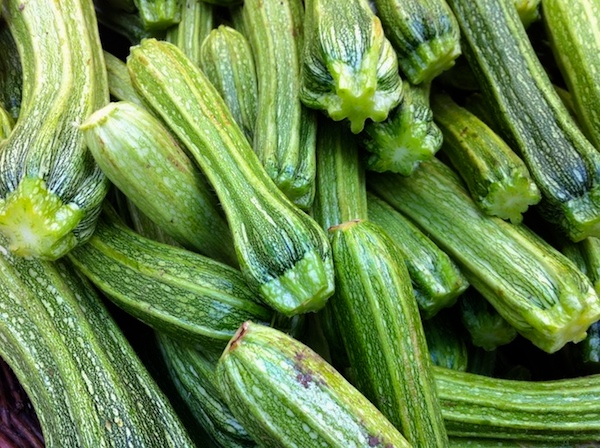
Costata romesco squash.

It's not all fruit out there, either, and despite his Fruit Monkey moniker, Alsberg is equally excited about the coming avalanche of vegetables about to bury us in local green (and yellow and red and…). We're in the throes of squash season, he says, with zucchini, crookneck, eight-ball (a type of ball-shaped zucchini), pattypan and costata romanesco (a ribbed green summer variety) flooding in. You'll also find alliums in abundance, with scapes of all sorts—leek, shallot, garlic, etc.—sticking around for a bit, soon to be overshadowed by fresh, as opposed to cured, Walla Wallas, red onions, scallions and fresh shallots.

Sprouting cauliflower.

There is the slightest whisper about local tomatoes starting to appear, but Alsberg said that it'll be mid-July before they'll be available in any quantity. Peas, asparagus and favas, those fleeting bright green delights of spring, are on their way out, as are the spring roots like radishes and turnips, but cucumbers are coming and local lettuces are in their glory right now. Romano beans and their compatriots are just starting to appear, as are all the herbs, including my favorites, basil and tarragon, along with local celery and carrots, as well as newer faces like sprouting cauliflower and purple sprouting broccoli (referred to as PSB in certain circles).

A rainbow of potato varieties.

Alsberg didn't realize he'd made "ze leetle joke" when he said that "new potatoes are starting to turn up" (ha!), but shoppers should find yellow, red and fingerlings aplenty. With warming temperatures, rhubarb will be getting scarce, but don't despair, local eggplant is coming, as are melons (by the end of July) and apricots.

Other bits and bobs to look for include orach, a red-leaved plant in the same family as spinach and chard, and arugula. Local corn will be coming around the end of July, as will the plethora of peppers from sweet to hot. You'll start seeing plums in mid-July with the full panoply appearing in August along with table grapes.

My advice? Boot up your spreadsheets and make a plan to use some of this local goodness now with schemes to preserve some for winter!

Saturday, April 06, 2019

In Season: Bound, Hop, Jump, Leap, Vault!


No matter how you say it, spring in the Northwest is a much-anticipated season. Gardeners are getting out their seed packets and determining how many yards of compost their backs can withstand—see this post about holding off on the tomatoes for now—and cooks are dreaming of the bright green herbs and greens that will soon festoon their tables.

Seeing nettles and fiddleheads already popping up in my social media feeds, I figured it was time to talk with produce guy and fruit monkey Josh Alsberg of Rubinette Produce about what he's seeing on his local farmers' fresh sheets. So grab a pencil, kids, it's time to make our spring farmers' market shopping lists!

Raab-o-Rama

Josh knows my weaknesses, so of course the first thing he pulls out is the list of the various raabs, rapinis and rabes on offer. We could both hear Anthony Boutard of Ayers Creek Farm snorting that the only true raab comes from turnips, the rest are the inflorescence of plants, defined as "a group or cluster of flowers arranged on a stem that is composed of a main branch. Morphologically, it is the modified part of the shoot of seed plants where flowers are formed."

Raab with mushroom sauce.

So, with that, in alphabetical order, look for these inflorescences at the markets: bok choy, brussels sprouts, cabbage, kale, kale sprouts, mizuna, red choy, spigarello, tatsoi and turnips, among others. Josh notes that each tastes slightly different depending on the parent plant's particular flavor profile, but all have that amazing, vibrant flavor and crunch when pan-fried—I like to brown a little homemade bacon and chopped garlic first, then add the greens, chopped or not—or, in the case of the bigger sprouts, roasted quickly in a hot oven.

Whew!

More Greens

As for other greens, look for watercress, various mustards, mizunas both green and red, arugula, and a new one to me, wasabi arugula—Josh said it has the tangy bite of that Japanese root. (Note to self: must try.) Lettuces are just barely coming on but will be available shortly, and spinach, which is a bit more cold-tolerant, is here now.

Fiddleheads.

With spring running about a month later than last year, wild things are going crazy trying to catch up. Look for the aforementioned fiddleheads, as well as "triangle leeks" or wild onions, which have a curious folded vertical green, as well as nettles. These will be available at the markets, but if you're headed out on a hike, here's a guide to foraging wild onions and garlic.

Calçots, that spectacular Spanish scallion relative pioneered in Oregon by Manuel and Leslie Recio at their late, lamented Viridian Farms, are appearing, too, so make some salbitxada sauce and throw a spring calçotada! Spring onions like Walla Walla and red onions should be appearing soon, but green garlic is here now—use them like scallions or make a pesto to toss with pasta or serve it alongside grilled meats and fish.

Purple sprouting broccoli.

Dribs and drabs of local asparagus and purple sprouting broccoli—refer to it as PSB if you want to sound cooler-than-thou—are just now coming into season, but Josh advises that you need to get to the markets early to get the little asparagus available, at least for the next couple of weeks before the full harvest comes in.

Bundles of fresh spring herbs like parsley, oregano, chervil, thyme and chives are beginning to show up, so chimichurries and other herb sauces are definitely called for. Microgreens and shoots of favas and peas should also make your list and will only get more abundant as the season rolls out.

Roots and More

Radishes, spring beets and the small, white hakurei turnips as well as their greens are terrific roasted and served with the herb sauces mentioned above. Small local bulbs of fennel will be here toward the end of the month.

Rhubarb.

One of my favorite vegetables-that-cooks-like-a-fruit, rhubarb, is flashing its red stalks, and Josh said a green variety that, unlikely as it seems, is a bit more sour than the red variety, is also being grown locally.

Look for local mushrooms like maitake and lion's mane are coming in from forests and fields, and I've heard whispers that this year's morel harvest may be a big one. Though Josh warns that false morels, or verpa bohemica, a species of fungus known informally as a "false morel" is sometimes sold as a true morel, so be sure to ask your vendor.

Strawberries?

Still two to three weeks off, according to Mr. Alsberg. Look for them at the end of April or the beginning of May. He said that Unger Farms in Cornelius is the driver for strawberry season in the Willamette Valley, and the first to appear will be Albions, followed by Seascapes. The first Hoods will most likely be available around Memorial Day, though—and this is a mantra we should all take to heart—"everything is subject to Mother Nature."

Tuesday, May 22, 2018

Guest Essay: What Does Real Change in Our Food System Look Like?


Lyf Gildersleeve, owner of Flying Fish Company, a sustainable seafood retailer in Providore Fine Foods, is a second-generation fishmonger and a vocal advocate for national fisheries policy. This is a guest post he wrote for the Marine Fish Conservation Network, a coalition of fishermen, conservationists, scientists and citizens around a mission to conserve and revitalize wild ocean fisheries.

Obesity, chronic heart disease, depression, cancer, diabetes, and malnourishment are all components of our failing food system. Worldwide, we produce enough calories of food to feed the entire planet, but due to economic inequality and unequal distribution of power there are billions of people who are starving.

Here in the United States we have a different problem: the food we are eating could be killing us.

Comparison of wild Atlantic salmon (left) and farmed (right). Note misshapen jaws of the farmed fish.

In land-based agriculture we often overuse artificial chemical fertilizers, growth-enhancing hormones, and antibiotics. In most open ocean fish farming we use artificial color in the feed to make the fish look like wild salmon, we overstock the pens so disease is commonplace, and the finished product is less nutritious than its wild counterpart. Additionally, we abuse the use of preservatives in order to cater to our industrialized distribution of the food. These examples and many more show the alarming discrepancies between how our food used to be produced and how it is produced today.

The communities in which we live depend on the infrastructure of the old food systems. Rather than keeping jobs in the USA, however, corporations are shipping products overseas to be processed by cheaper labor. This doesn’t come without additional price tags, including child labor, green house gas emissions, inferior food safety standards, loss of domestic jobs, increased trade deficits, and lower food quality. We need to wake up and realize this isn’t okay; big changes need to happen.

So-called "free range" chickens in a factory farm.

There is a reason why large multi-national corporations don’t want consumers to see behind the doors of their production and processing facilities. The industrial food production system is structured to maximize output, minimize input, and maximize profit. What is missing is the humane, logical, reasonable conditions in which we would want animals to be raised, the commitment to using our natural resources sustainably, using minimal additives in order to provide our bodies with maximum nutrition and healthy antioxidants to fight off illnesses.

Now how do we change that?

The answer is: one bite at a time. In the famous writing of the Tao Te Ching, Laozi stated, “The journey of 1000 miles starts with a single step.” This saying teaches that even the longest and most difficult ventures have a starting point; something which only begins with taking the first step. The same goes for the food system. We have to learn to be conscious consumers, choosing to support local fishermen and community supported fisheries like Tre-Fin Foods from Ilwaco, Washington, which catch, process and distribute their own albacore tuna directly to consumers and restaurants. This is how we become active citizens who stand up against our current unsustainable food system.

Money spent at farmers' markets goes directly to farmers, ranchers and fishermen.

Portland, Oregon, and the surrounding area is an amazing mecca of food culture, world-renowned chefs and restaurants, biodynamic farms, non-profit organizations fighting the good fight, and a consumer base that genuinely wants to do good for the environment and for their bodies. Portland has a burning desire to learn, grow, and do things differently than the status quo. We are hungry to learn and change; we just need the information. It’s in communities like this that real change happens. We have the opportunity to be leaders in our nation by leading by example.

Changing a massive food system takes a whole gamut of folks. It’s people like Jeremy Coon, who is investing in infrastructure in the fishing port of Garibaldi, Oregon, to make it easier for fishermen to offload their catch and sell direct to small buyers, instead of being forced to sell to the massive seafood processing and distribution companies, which have been alleged to price-set and manipulate the market for their own financial gains.

It’s non-profit organizations like Ecotrust, which is investing millions of dollars in a food hub that provides a platform for local farms and fishermen to store and distribute their products in the Portland metropolitan marketplace. Finally, it’s the consumers who choose to shop at the small local artisan store or marketplace or, better yet, their local farmers' market, where they get to talk with the producers and put more money in local farmers, ranchers and fishermen's pockets by going outside the mainstream food system channels.

That’s how we change a food system, one step (and dollar) at a time.

Disclaimer: Providore Fine Foods is an advertiser on Good Stuff NW.

Monday, December 18, 2017

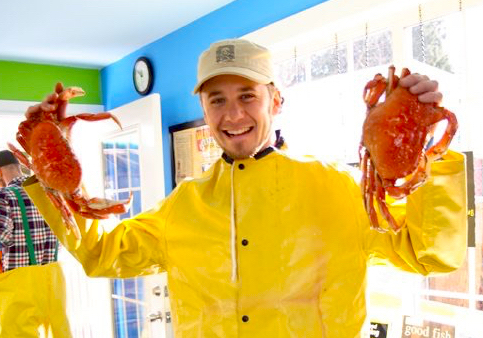
Crabby Politics Put Dungeness Crab Fishery at Risk


Lyf Gildersleeve (above), owner of Flying Fish, a sustainable seafood retailer in Providore Fine Foods, is a second-generation fishmonger and a vocal advocate for national fisheries policy. Two bills before Congress right now, H.R. 200 and H.R. 3588, weaken America’s key fishing law, the Magnuson-Stevens Fishery Conservation and Management Act (MSA). At the end of Lyf's report is a link to contact your congressional representatives, which I urge you to do.

Fisheries policy has a responsibility to be sustainable, that is, to ensure that future generations will have access to the same resources we’ve had the luxury of taking for granted. Fisheries policy also has a responsibility to the people who make a living from the fisheries, whether directly at sea or indirectly at market. Policy needs to provide safety nets for fishermen, working waterfronts and the communities within the fishing industry. Policy must evolve and adapt to a changing industry, climate change and market needs.

Since its inception over 40 years ago, bipartisan support has been the hallmark of the Magnuson-Stevens Fishery Conservation and Management Act (MSA). The MSA is the federal fisheries law which creates safeguards to protect our fisheries and the communities supported by them. Unfortunately, the current political climate in Washington DC does not give equal consideration to both sides of the equation with regard to the MSA and its much-needed reauthorization.

The west coast’s Dungeness crab season similarly requires a two-sided approach: one side that considers consumer options, the other which considers fishery and ecosystem issues. Fortunately for the health of the fishery, and unfortunately for the fishermen and the consumer in Oregon, bipartisan considerations delayed the 2017-18 season.

In fisheries policy on a broad scale and in Dungeness crab practice locally, the equation is thrown out of balance when only one side of the equation is considered. A one-sided approach has potentially dangerous effects to both the environment and the livelihood of the communities dependent on the ocean.

As with most fish, objectives for the Dungeness crab consumer boil down to two things: safety and value. This year, the Oregon Dungeness crab season was delayed because the crabs had not reached market size. This was unfortunate for the crab fishing fleet, but it was a safeguard to protect the ecosystem and the consumer. Hard decisions always require trade-offs, but if the decisions account for all sides of the equation, then we can stand strongly and confidently. If all sides are not considered, somebody will get an unfair treatment, whether that's the fishery or the people whose livelihoods depend on it.

Total allowable catch quotas have long existed to sustain fisheries, including the Dungeness crab, for future generations. Sadly, the current bill to reauthorize the MSA, H.R. 200, introduced by Republican Congressman Don Young from Alaska, emphasizes “increasing flexibility”—i.e. it guts accountability in favor of the bottom line.

Pushing this version of the Magnuson-Stevens Act insults the spirit and legacy of the act, which has set the standard for fisheries policy worldwide. It weakens America’s key fishing law—it’s bad for fish, it’s bad for oceans, and it’s bad for coastal communities. It creates very real potential for overfishing and the not-very-long term instability of fishing communities.

Last week, the House Committee on Natural Resources voted in favor of legislation sponsored by Congressman Young (H.R. 200), and his Republican colleague from Louisiana, Garret Graves, who is promoting H.R. 3588, the Red Snapper Act, that wholly undermine the MSA. These two bills disable the science-based data on total allowable catch quotas, and the euphemistic “flexibility” disempowers the law that has allowed several fishery stocks to rebuild from the verge of collapse.

We have a chance—and an obligation—to learn from the tragic overfishing that depleted stocks on the East coast and around the world. These failed policies have decimated the wild Atlantic salmon to levels of extinction, and the populations of several ground fish across the east are so low they can’t rebuilt. The already troubled red snapper, an icon of the Gulf Coast, stands to suffer the same fate in light of Congressman Graves’ bill.

The panel’s top Democrat, Raul Grijalva of Arizona, had this to say: “Ocean management is about sustainable use and enjoyment, not just making environmentalists unhappy. Like most of the bills advanced by the leadership of this committee, this bill is extreme and has no future in the Senate. Until my counterparts decide to take the issues in our jurisdiction more seriously, we’re going to keep wasting time on unpopular bills that have no chance of becoming law.”

While this is certainly encouraging—and from a Congressman from the desert, no less—we still need to apply pressure and call, write, email, tweet our elected officials. These disastrous bills have reached the Senate, which has a chance to stand up to such indecency.

We can do better. We have the power. Do it for the environment. Do it for the fishermen and communities whose livelihood depends on a healthy ocean. Do it for your grandchildren. Defend the ocean and the important part it plays in all of our lives. Contact your Senators and tell them to vote NO to H.R. 200 and H.R. 3588.

In Oregon:
Top photo courtesy Flying Fish.

Friday, March 25, 2016

Showing Off My Take on Portland's Food Scene


Where would you take a well-known food writer who asked you to show her your favorite Portland haunts? That happened to me last week when Leslie Kelly, Seattle food and wine writer and staff writer for the Dish section of Allrecipes.com, asked if I'd be interested in meeting up and showing her a few of my go-to spots.

She made it easy when she asked to start a few blocks from our house at Muscadine, the tiny outpost of genuine Southern American cooking owned by chef Laura Rhoman. During our sumptuous order of fried chicken, sea island red peas, collard greens, biscuits, oxtail ragu, cheesy grits and eggs arrived—did I mention we're both passionate eaters?—she did a short video of the meal while we plotted a few stops in the 'hood.

Since, like me, Leslie's a committed carnivore, I wanted her to meet my favorite vegan-turned-whole animal-butcher Ben Meyer (left). Handily for us he was right next door at Grain & Gristle for the day, so we marched in and promptly ordered G&G's signature and justly lauded burger along with a tap cocktail, a house-made hibiscus gin fizz that was an ideal counterpoint to the richness of the juicy pasture-raised beef in the burger.

Leslie managed to moan over the burger while at the same time talking cuts of beef with Ben. With second lunch literally under our belts, we drove up the street to tour the newly burgeoning businesses on 42nd Avenue. We stopped in so I could buy a chuck roast from Old Salt Marketplace's butcher case (right), and as it was being wrapped I gave Leslie a tour of the meat aging gracefully in the walk-in, then showed off the dry goods and value-added pickles and preserves that Ben has begun producing out of the space.

Across the street was Tommy Habetz's new Pizza Jerk, so we popped in for a slice of cheese pizza (left). (If you're keeping count we're now at third lunch…) Part of my not-so-hidden agenda was to drag my guest away from restaurants and shift the conversation to ingredients. Knowing that the Cully neighborhood is home to two urban farms, we drove a few blocks down NE 42nd to Simpson Street Farm, Rex Rolle's nearly 1-acre plot that supplies vegetables to farmers' markets and local restaurants.

A little further up the street is The Side Yard Farm (top photo), one of the small-acreage urban plots that is also a farm-to-plate catering service and supper club, the brainchild of chef and farmer Stacey Givens. As we stood surveying the orderly planted beds, Stacey herself emerged from one of the outbuildings and gave us the background on the project, along with farm schwag of mugs and a shopping bag. Do I need to mention that Leslie was totally impressed with the scale and ambitiousness of our urban agriculture scene as embodied by these two places?

My guest was needing to get back for her next appointment, but I prevailed upon her to make one more stop at Providore Fine Foods (right) the new location for the patres familias of the city's provisioners, Peter de Garmo and Don Oman, who opened their legendary Pastaworks shop on Hawthorne 25 years ago. This new incarnation is now owned by de Garmo's son Kevin and his wife, Kaie Wellman, who converted (in an oh-so-Portland move) a former car dealership on what is a still-developing stretch of lower Sandy Boulevard.

After chatting about kalettes and sea beans with Ken Fisher, wet rack wunderkind and body man to Rubinette Produce owner Josh Alsberg, exchanging fish stories with Flying Fish's Lyf Gildersleeve, then oohing and aahing over the fresh-baked focaccia, cheese-and-charcuterie counter and pasta display, I almost had Leslie packed in the car when she saw the Pie Spot (left). Part of the Ocean micro-restaurant hub that backs up to Providore, she had to run in and grab a few samples of the mini-pies on display and try to recruit them to open a branch in Seattle.

I'm guessing that means she was happy with our three-hour tour.

Read more about Providore Fine Foods and its purveyors.

All photos by Leslie Kelly.

Wednesday, February 10, 2016

Providore Fine Foods Collects City's Best Purveyors


Hawthorne Boulevard was a run-down stretch of pavement lined with dilapidated buildings when Pastaworks first opened in 1983. But the rent was cheap and the neighborhood was ripe for reinvention, so business partners Peter de Garmo and Don Oman, inspired by a pasta shop in Boston that de Garmo had wandered into, decided to open a European-style food emporium. Within a year other businesses began flocking to the street, and what started as a whim began looking like a genius move as Portland's food scene started taking off.

Josh Alsberg (l) and Ken Fisher of Rubinette Produce.

So more than 30 years later, when Pastaworks' owners, Peter's son Kevin de Garmo (top photo) and his wife, Kaie Wellman—Oman sold his share of the store and founded Casa Bruno, one of the city's top-rated wine distributors—announced that they were closing the shop and moving it to Northeast Sandy Boulevard, neighbors were aghast. But in what may come to be seen as another whip-smart move, the new shop has taken residence in a former car dealership on an up-and-coming, close-in stretch of Sandy that in years past was known for its drug dealers, dive bars and ladies of the night.

Lyf Gildersleeve of Flying Fish and Meat Monger.

Like the original Pastaworks, this new incarnation, renamed Providore Fine Foods, is a collection of some of the city's best food purveyors, including, of course, Pastaworks itself:
  • Rubinette Produce: Known as a true produce geek, Josh Alsberg was lured away from Food Front Co-op by the opportunity to open what he conceives of as a daily farmers' market. Josh is well-regarded for his relationships with the area's top farms, so you'll find produce sourced from local farms like Deep Roots Farm, Gathering Together Farm, Stone Boat Farm and others.
  • Flying Fish Company and the Meat Monger: Lyf Gildersleeve started his Flying Fish Company on Hawthorne five years ago, marketing sustainable, local seafood out of a rolling trailer. Like the original, this outlet will also be featuring whole fish and adding a daily oyster bar for your delectation. The Meat Monger is a new endeavor featuring local, sustainably raised pork, beef and lamb.
  • Little T Baker: Tim Healea's loaves are among the best to found in this gluten-friendly town, and his were at the top of the list when Providore came knocking. Also find his breakfast pastries to enjoy alongside an Illy espresso.
  • Emerald Petals: Hilary Holmes' eco-friendly, botanical flower shop is committed to the "slow flower" movement with organic, locally sourced flowers and arrangements.
  • Arrosto: Rotisserie chicken is all the rage, and the Pastaworks team has designed this Mediterranean-style rotisserie chicken to satisfy the take-out crowd or dine-in noshers. Head to the walk-up window for chicken and sides like they have in Italy.
Details: Providore Fine Foods, 2340 NE Sandy Blvd.