Showing posts with label Lovely's Fifty Fifty. Show all posts

Thursday, February 22, 2018

Fermented Grain, or The Borş Identity, Part 2


One chef at the Ayers Creek Farm tour held for its retail and restaurant customers summed it up nicely. "I wouldn't miss this for the world," he said, noting that not only is it one of the region's premier organic farms with a completely original, single-minded vision behind everything grown there, but "there's nowhere else can I talk with 150 other local chefs and restaurant people with the same approach to food."

(l to r) Fermented wheat; Peace, No War purple corn; and barley.

It was a chance for Carol and Anthony Boutard to thank their customers, yes, but there was a not-so-hidden agenda behind the festivities. The farmers behind this unique place—Anthony is the author of the Farm Bulletins, a staple of Good Stuff NW for more than ten years—have been working to promote the idea of using fermented grain, a happy accident they discovered while researching Anthony's book, Beautiful Corn. (Read his essay on fermented grain, or borş.)

Romanian in origin, it takes just a couple of cups of ground grain—corn or barley are ideal—and a bit of salt to get it started. Mixed with warm water and left out at room temperature for four or five days, it results in a perfect stock for savory dishes. It adds the same body as a meat-based stocked with the added benefit of being much cheaper to make, plus it has the probiotic qualities common to fermented foods.

Posole with fermented corn stock.

While a few folks had picked up the idea, Anthony felt another reminder might be required to put it on their front burners, so to speak, so he and the farm's chef, Linda Colwell, collaborated to come up with a menu based around this elixir. They chose an astonishing posole of pork shoulder rubbed with aci sivri chile oil and paste that was roasted and shredded; then added fermented grain stock from Peace, No War corn; hominy made from nixtamalized Amish Butter flint corn; and steamed borage and poppy leaves.

A second soup was made from cardoons, slow-braised in butter along with potatoes and run through a food mill, then the pulp and fibers were combined with fermented barley stock. Its soft green color was tantalizing, and its flavor reminded me of the dill pickle soups that were popular a few ago. A third dish and, as a devotée of risotto, one I'm dying to try, is a risotto using fermented wheat stock. Linda brilliantly paired it with caramelized onions and the farm's Arch Cape chicory, which were stirred in just before serving.

Sarah Minnick with Arch Cape chicory pizza.

All this was put over the top by special guest chef Sarah Minnick of Lovely's Fifty-Fifty, who skillfully handled the farm's massive wood oven, pulling out pizza after pizza of her addictive sourdough crust topped with spears of Arch Cape chicory, green garlic and raw, organic cheeses from Cascadia Creamery in Trout Lake, Washington. Icing on the proverbial cake was a jostaberry kuchen made by farmer Myrtha Zierock—of which I managed to score a couple of pieces before it was demolished by the crowd.

Thus fortified, Anthony and Carol trooped everyone out to the fields to survey the Arch Cape chicories marked for seed, plus mustard, wheat, favas and new breeding projects, some of which have already been years in development. Is it any wonder that their farm is one of my favorite places (and they are two of my favorite people) on the planet?

Fermented Grain, aka Borş

200 grams coarsely ground grain (corn, barley, wheat, etc.)
28 grams sea salt or kosher salt
Water

Put the grain and salt in a two-quart mason jar. Add very warm water to fill past the shoulders of the jar. Secure with a lid (the plastic lids work great for this). Shake vigorously to combine. Loosen the lid to allow any developing gases to escape and leave on your kitchen counter for four or five days. Tighten the lid and shake two or three times a day, loosening the lid again after each shaking.

Use like stock in soups, risottos, or any dish that requires a savory stock (see post, above).

Friday, February 16, 2018

Lovely's Fifty-Fifty Chef Nabs Beard Nomination


The James Beard awards are considered the Oscars of the food world. Yesterday one of Portland's most dedicated chefs—and one of my favorite people—Sarah Minnick of Lovely's Fifty-Fifty, was named a semi-finalist in the Best Chef NW category.

Sarah was featured in an article I wrote in 2015 about women chefs who "are turning the tables on business-as-usual by nixing the giant cans of sauces, bags of salad greens and feedlot meats that supply most restaurants, even in the foodie heaven known as Portland. You won’t find big trucks from industrial food distributors pulling up to their doors and burly guys with pallet jacks and hand trucks wheeling crates of supplies shipped in from out of state. Instead, following in the footsteps of chefs like Cathy Whims of Nostrana, these women are working to buy their supplies direct from local farmers, who deliver produce and meats in the backs of beat-up pickups and vans, unloading crates overflowing with fresh produce mere hours after they’ve been harvested from the fields."

From the article:

One look at owner Sarah Minnick’s pizzas will tell you instantly that this chef is serious about farm-fresh produce. Her pizzas are pictures of crave-worthy perfection—circular works of art brimming with local greens, cheeses and a sauce from tomatoes harvested at the peak of their flavor, preserved so her customers can taste summer even deep in a Northwest winter.

You’ll see unusual ingredients like summer squash, quinoa greens, potatoes and local cured meats adorning her pies, in addition to the occasional drizzle of honey from Bee Local, a Portland company whose hives are scattered around the state, taking their flavors from flowers wild and domesticated. Not unlike Sarah herself, who buzzes around local farms and farmers’ markets collecting ingredients like a honeybee collects pollen.

Dig a little deeper and you’ll find her handmade pizza dough is made from the whole grains and artisan flours of Camas Country Mill in the central Willamette Valley and organic flour from employee-owned Central Milling in Utah. And she sources the organic custard base for her extraordinary ice cream from Strauss Family Creamery, adding berries and fruit from area farms, along with more exotic flavorings from the leaves of peach, fig and bay.

Looking at her accounts from last year, Minnick said she was able to purchase nearly 90 percent of her ingredients from local sources [now more than 98 percent - KB]. While that may sound like a foolish way to run a small business, if you ask about the economics of buying direct from farmers versus large distributors, she said that the cost works out to be pretty much the same, since farmers are much more careful about the quality of their produce, meaning it’s less work to prep and less of it ends up in the compost.

She’s thrilled to be working directly with farmers, "actually knowing who is growing it and why and how," and finds the enthusiasm of some of Oregon’s younger farmers infectious. "They don’t have a lot of the weird old baggage," she said of their eagerness to try growing new crops.

And after three years of running the kitchen at Lovely’s? "I’m addicted to it," she said. "I love coming into work."

Photos from an event at Ayers Creek Farm.

Monday, December 28, 2015

When Everyone Else Goes Right…


No, this isn't about Hill vs. Don or Bernie. It's about perspective, and, from what I've seen so far, mine is pretty different from the pack. As background, Mattie John Bamman, the new editor for the Portland outpost of the restaurant-industry website Eater, sent the following request: "Would you be interested in sharing your dining opinions as part of Eater Portland's end-of-year coverage?"

Now, I met Mattie—yes, it is his real name and isn't short for Matthew (the reason he gives is that he had "hippie parents")—at a media lunch given by the wonderful Bette Sinclair. For whatever reason he decided to include me in this year's survey. Here are the questions and my answers. I'll include links so you can read what others felt was noteworthy.

What were your top restaurant standbys of 2015?
My husband and I don’t go out much because, frankly, dining out is way too expensive for us to do on any kind of regular basis, so I’m hopelessly out of date on the “hot list.” As a matter of fact, several of them will close before we ever get a chance to go to them. (Cases in point: June, Levant, Noisette.)


Nostrana's Cathy Whims (r) and one of her—and my—favorite farmers.

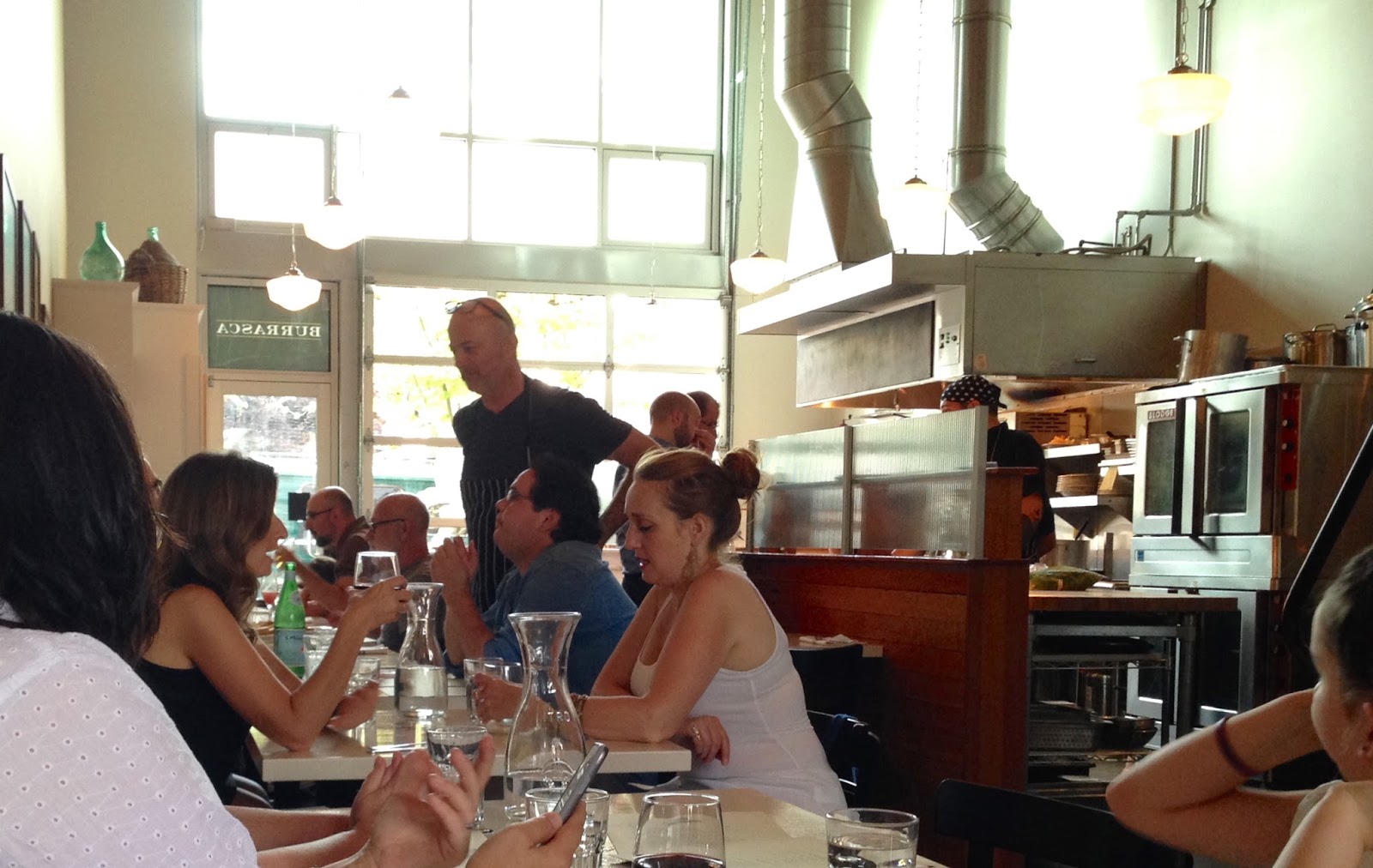
So our standbys are places that make the kind of food we love and source ingredients from local farms and farmers: Bar Avignon, Lovely’s Fifty-Fifty, Old Salt Marketplace, Nostrana, Lucca and Davenport. Tastebud has to be included even though it’s just opened (we’ve been twice) because Mark Doxtader and Sarah (of Lovely’s) are the god and goddess of woodfired pizza made with local ingredients. Burrasca has become a favorite on our hit parade, as well.  Read more.

What were the top restaurant newcomers of 2015?
Tastebud because of the reasons listed above (Mark Doxtader, right). Burrasca (top photo). Love their take on Florentine classics like ribollita, peasant food that uses the simplest ingredients like old bread, leftover beans and greens to make a bowl of comfort; pappa al pomodoro; the deeply intriguing combination of squid and kale that is inzimino.

I’m hoping they’ll find a source for the fourth stomach of a cow, the abomasum, so I can have the famous street food favorite of Florence called lampredotto. Read more.

Describe the 2015 Portland restaurant scene in one word.
Free-for-all. Read more.

What was the best dining neighborhood in 2015?
No place like NE: We live within walking distance of Alberta, Killingsworth, Cully, Williams and Mississippi. (Sarah Minnick of Lovely's Fifty-Fifty, left)

Cully has to be the up-and-comer. Read more.

What was the biggest dining surprise of 2015?
No idea.

What was your single best meal in 2015?
Overall, very few meals can match what we have at home on a regular basis, from roast chicken to braised beef neck to pig trotters in a pot of Ayers Creek Farm beans to steaks on the fire when we’re camping.

Ben Meyer (l) and Bill Hoyt.

Meals out, wonderful as they can be from any of the places listed above, become more special because I don’t have to cook them. Current crave is the beef tartare at Old Salt using beef from Bill Hoyt of Hawley Ranch in Cottage Grove. Read more.

What was the biggest restaurant grievance of 2015?
The focus on chefs and technique versus good food made simply using the best ingredients (preferably local). Read more.

What are your headline predictions for 2016?
No idea.

Saturday, September 05, 2015

Farm Bulletin: Field Peas on the 45th Parallel


For well over a decade, we were stymied by the genus Vigna, our efforts figuring as one of the farm's major nonprofit endeavors. The best we could achieve was parity, a ratio of one pound sown to one pound harvested, and we were almost celebratory about that pathetic achievement, seeing it as a hopeful sign. Most efforts failed even this slight measure of hope.

The adzuki in the field.

Indigenous to tropical Africa and Asia, this genus of legumes has a complex of vernacular names, including field peas, cow peas, chickpeas, southern peas, mung, dal, gram and adzuki. They have a distinct gamy flavor relative to the garden beans. They were also one of the original "beans," along with the fava, of southern Europe—a character in Annibale Carracci's classic 'Mangiafagioli' (~1585) was tucking into a bowl of black-eyed peas, not the American garden beans we associate with Italians today.

Fresh adzuki.

Many plants have highly sensitive biochemical chronometers which trigger various functions such as growth, dormancy and flowering according to the dark period of the day. Plants with this requirement are called photoperiodic, and field peas possess that characteristic. In some crops agricultural cultivars have been selected for a very tight photoperiod. For example, onions and cabbage are not useful if they go to flower, or bolt, willy nilly. In Oregon, crops adapted to southern latitudes do not set flower until the nights lengthen in August or September, and there is not enough time to set and ripen their fruits. This is why okra, limas and field peas are not successful at this latitude, and as yet have no commercial cultivars suitable for Oregon. We have wasted a great deal of time and treasure on all three; hope springs eternal.

Experimenting with other crops gave us an appreciation of the challenges farming at the 45th parallel. One of the fascinating entries in the Tokyo Foundation is about Longfellow flint corn originating in New England that is grown on the island of Hokkaido. The northern part of the island lies on the 45th, which is why that variety grew well. We realized we needed to understand the crops of the island better, and that led to our Hokkaido Project. Both soy and adzukis are grown on Hokkaido, so we started trying varieties from the prefecture. Adzukis are the one Vigna, or field pea, that has commercial potential here in Oregon. We are also working on two traditional soy varieties, more on that later.

Fresh adzuki ready for market.

Initially, adzukis didn't sell well. We had licked the biology only to confront a marketing challenge. Despite the hesitant reaction, four customers gave us the spine to plant more. Mio Asaka (Mio's Delectables) and Naoko Tamura (Chef Naoko) used them in a traditional Japanese way as red bean paste. Last winter, David Sapp of Park Kitchen asked us if we could suggest one of our beans as a substitute for black-eyed peas in Hoppin' John. A light bulb lit up and we suggested using the adzukis. We warned him they are different, but of a kind, whereas the other beans we grow are definitely not of that kind. He was happy with the result, and encouraged us to plant more. Sarah Minnick was the other person who brought them into her kitchen with a variation on their traditional use in sweets; at Lovely's 50/50 they ended up ice cream.

A couple of weeks ago we got the idea that perhaps adzukis would be tasty as fresh shelled beans. We asked people who might know and poked about a bit online, but no one seems to share our idea. Then again, no one had ever suggested grinding popcorn and cooking it for polenta, or steeping it in slack lime for hominy, so there is no harm in trying an unshared notion. Bear in mind there are a host of ideas that have been discretely buried and forgotten in the Ayers Creek compost pile as well. As it turns out, fresh shelled adzukis make a tasty dish, just like one of the southern peas. Not quite the perfection of a Lady pea, but up there with next tier field peas. We will have some at market this week, a one-time event, and then you all will have to wait for the dried adzukis.

Monday, February 09, 2015

Farm Bulletin: To Every Farm, a Muse


No visit to Ayers Creek Farm is complete without a demonstration of the culinary uses of the food that contributor Anthony Boutard and his wife, Carol, grow on their 140-acre farm. To their credit, their decade-long Herculean effort has been rewarded with the appointment of their very own muse. 

Before the Olympian deities took over and bureaucratized the Office of Muses, there were just three muses residing on Mount Helicon: Aoide (expression), Mneme (memory) and Melete (occasion). Linda Colwell is our Melete. Whether it is a ramble or some other occasion, Linda steps in and everything flows smoothly.

Linda Colwell, Ayers Creek's Melete.

When Lane Selman of the Culinary Breeding Network asked us on a hopeful afternoon in April if we could host a lunch and tour at Ayers Creek for the Organicology conference in early February, it seemed like an reasonable idea. With our lovely Melete watching over us, what could go wrong? Nothing, as it turns out, even in a week marked by torrents of rain, the sun shone and we all had a good time.

The gorgeous groaning board.

Working with Mark Doxtader and Jason Barwikowski of Tastebud, and Sarah Minnick of Lovely's 50/50, Linda showcased the fruits, vegetables and grains of the farm. While we led a tour in the fields, Linda gave a talk about the various ingredients in the lunch. One participant confided to us that he loved Linda's talk so much that he was tempted to sit through it a second time. Here is the quartet's menu:
  • Amish Butter popcorn with Aci Sivri cayenne
  • Black Radish soup
  • Green Posole made with Amish Butter hominy, pumpkin seeds, and sorrel
  • Late treviso panzanella style salad with roasted Sibley squash and kakai seeds
  • Roy's Calais Flint polenta with braised Borlotti beans with leeks and chicory
  • Oven-roasted sweet potatoes
  • Focaccia with late summer dried green grapes
  • Sprouted barley toast with roasted winter squash drizzled with honey and Ayers Creek jam
  • Winter field greens as available: rocket, chervil, kale
  • Adzuki bean ice cream between Kakai pumpkin seed cookies
  • Chester blackberry ice cream between Amish Butter and Almond cookies
Salad of winter field greens.

The Tastebud oven has welcomed guests to the Ayers Creek since the first ramble. This Christmas, we received greetings from a former Hillsdale Farmers' Market regular, now residing in Portugal, recalling that day. Sami's teenage daughter was convinced rather reluctantly to fritter away a Sunday afternoon at that ramble. The walk went well for her but the high point of the day was walking into the shade of the oaks and seeing her favorite feature of the Hillsdale market, the Tastebud oven. It always heralds a good event when Mark's truck maneuvers into position.

Friday, November 14, 2014

Amazing Pizza in PDX? Lovely's Lovely!


Much to my chagrin, I hadn't met Sarah Minnick until just a few weeks ago. She was ably manning the woodfired oven at Ayers Creek Farm (below left), having made its acquaintance a few scant hours ahead of having to crank out dozens of pies for people attending the farm's annual Ramble.

Sarah working her oven magic.

She'd built the fire and was trying to suss out its individual peculiarities—hot spots, cold spots, timing—by making a few test pizzas. Nicely blistered and oozing with the incredible flavor of the farm's tomatoes and greens accentuated by Fraga Farm's goat cheeses, these were some of the best pizzas I'd had anywhere. By the end of the day, with the oven and chef having settled into a mutually copacetic groove, I'd made a vow to get myself and Dave over to her pizza joint on Mississippi, which she owns with her sister, and have her pizza in situ.

Cornmeal cookies with Chester blackberry ice cream for the farm tour.

Just like Sarah herself, the interior of Lovely's Fifty Fifty is warm and inviting, the wood oven roaring in the back and the lighting at just the right level, enough to see what's on your plate and yet feel cozy, even at the long shared table. There's a seating area as you walk in if you're picking up a to-go order or getting some of her stunningly delicious ice cream to take with you. (I had a sample of her Chester blackberry ice cream sandwiched between cornmeal cookies made by Linda Colwell and thought I'd landed in a crunchy-creamy purple dream. In other words, even if you've stuffed yourself on pizza and the creative woodfired sides on the menu, order some ice cream anyway. Seriously.)

Black radish, peppers and soft cheese pizza on the farm tour.

We ordered their classic housemade fennel sausage pizza with braising greens and rosemary (top photo) and it came out just as I'd remembered it from the farm…the dough blistered with a pillowy rim, the base not crackery-thin but not too thick, the amount of filling in the just-right category, with plenty of there there and ever-so-fresh. Our side of wood-roasted cauliflower with golden sultana raisins and frenched almonds was toothsome (i.e. not cooked to mush) and slightly smoky, with a sweet-tart tang from the raisins and a crunch from the almonds. I'm going to be working on a version of this at home, for sure.

When it comes to using locally sourced, seasonal ingredients, there are only a couple of other places in town that can compare with the 'za coming out of Sarah's oven. We're lucky that her place is just a few blocks from our front door—it's taken me long enough to get there, but you can be sure we'll be stopping in regularly from now on.

Details: Lovely's Fifty Fifty, 4039 NE Mississippi Ave. 503-281-4060.

Thursday, October 09, 2014

Farm Bulletin: It's Time to Ramble!


Don't blame me if you miss your once-a-year chance to visit Anthony and Carol at Ayers Creek Farm, especially now that the weather wizards have looked into their murky cauldrons, pulled out a bat's wing and changed the forecast from rain to partly sunny. Still, I'd bring wellies to change into just in case. And feel free to bring your (well-behaved) kids…they'll love it!

The Ramble will take place on Sunday, Oct. 12th from 3:00 to 6:00, rain or shine. 

Showers are currently in the forecast [see above re: changed forecast - KB]. Bring a slicker and, as mud is a fact of life when it rains, a change of shoes or maybe some Wellies. We don't want muddy shoes in the harvest shed, please. It is a visit to a working farm, not an agritourism affair.

The harvest shed (before painting was completed).

There has been a merlin in residence, as well as a pod of meadowlarks, so binoculars may come in handy for the birders. Yellow jackets have been pretty tractable this year, but they are present and a bee sting kit is recommended if you are allergic.

There will be light fare provided by our own Linda Colwell, who has helped harvest so much of what you all enjoy at Hillsdale, and Sarah Minnick of Lovely's Fifty Fifty. No need to RSVP. 

One young rambler.

Our street address is 15219 Spring Hill Road, Gaston, if you need to inform Siri. Otherwise, our directions have been working pretty well, and long before unflappable and inscrutable Siri was even a twinkle in Timothy Cook's eyes.

From Portland:

Take 26 West out of Portland toward Beaverton.  Exit onto 217 (69A) toward Beaverton/Tigard.  Follow 217 to the  second exit (Beaverton, Routes 8 and 10, exit 2A).   Take this exit and go straight across Route 8 to the second traffic light.  Turn right onto Route 10, which is also called the Beaverton-Hillsdale Highway.

After crossing the railroad tracks, Beaverton-Hillsdale Highway turns into Farmington Road. After rambling on about 12 miles, Farmington Road T's onto 219.

Turn left onto 219, cross the bridge and take the first possible right turn, Bald Peak Road, in about 200 feet.

Bald Peak Road very soon splits into a “Y”. Bear to the right, staying on Bald Peak Road. You will follow Bald Peak for 3+ miles up a long hill. (Note: about half way up the hill, Laurel Road merges on the left, stay on Bald Peak Road by snaking to the right.)

The road peaks at the very top of the hill and curves sharply to the left, at the stop sign which doesn't make you stop, turn right onto Laurelwood Road, marked with a sign indicating "Scenic loop".

Go down this curvy road and through the hamlet of Laurelwood (about 3 miles) until the road T's onto Spring Hill Road. Turn left onto Spring Hill. In 1/2 mile, you will pass Gibson Road which comes in from the left. Turn right onto the next driveway. There are 2 mailboxes as we share this driveway with the Huserick Brothers nursery next-door. We have a sign.

[A quicker alternative, if less scenic, route for those coming from downtown or Northeast Portland: take Hwy. 26 west to the Glencoe Rd. exit (past Hillsboro). Take a left onto Glencoe Road, and in about a mile at the signal take a right onto NW Zion Church Road. It will turn into NW Cornelius-Schefflin Road. At the first roundabout, turn onto NW Verboort Road. At the second roundabout, turn onto NW Martin Road. It will end at Hwy. 47 (Nehalem Hwy.). Take a left into Forest Grove (mind the speed limit) and at the signal (at McMenamin's Grand Lodge) continue straight through onto Hwy. 47 to Gaston. Right after entering Gaston, take the first left onto SW Gaston Rd., then take a right at the stop sign onto SW Springhill Road. Follow a couple of curves and up and down a couple of slight hills till you pass Gibson Road which comes in from the left. Turn right onto the next driveway at the Ayers Creek Farm sign—there are two mailboxes as they share this driveway with the Huserick Brothers nursery next door.

If you're coming from Southeast, the best bet is to take Powell Blvd. across the Ross Island Bridge. Follow the signs to Hwy. 10, Barbur Blvd. Take Barbur to the Beaverton-Hillsdale Hwy. exit (still Hwy. 10) and follow it out through Beaverton. Cross the railroad tracks, then follow Anthony's directions for proceeding on Farmington Road. - KB]

From Salem and points further south:

From I-5 North, exit at Brooks (Exit 263), about 10 miles north of Salem.  The stop sign turn left on to Brooklake Road. Follow the Brooklake Road for about a mile and, at the 4-way stop after crossing the railroad tracks, turn right onto River Road.

A couple of miles past the Wheatland Ferry turnoff, you must turn left towards St. Paul, this is still River Road.  Stay on River Road all the way through St. Paul and then to Newburg.

River Road ends at 99W on the east side of Newburg.  Turn left onto 99W and staying in the right hand lane.  About a mile, you will see a sign for 240.  If you are in the right lane, you will have to exit onto 240.

Take Route 240 west out of Newberg.  Follow for approximately 5.5 miles.  Turn right on to Ribbon Ridge Road.  The sign points to Gaston. Follow the main, paved road as it swings to the left about a mile later, becoming North Valley Road.  The road will meander along the side of the valley for 5.7 miles and then comes to an intersection where the main road swings to a sharp left.  Go straight onto Spring Hill Road.  You will see our berry fields at the top of the rise.  Follow Spring Hill for approximately a mile and look for gravel driveway on the left.  This is our farm's driveway.