
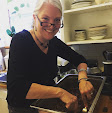

I can't tell you how much I've missed contributor Anthony Boutard's missives from Ayers Creek Farm the last couple of months. It's a privilege to welcome him back, and we will continue to enjoy them as he and Carol finish up their tenure at the Hillsdale Farmers' Market (they are scheduled for the markets of Nov. 15th and 22nd and Dec. 6th and 20th). And I can testify from a day spent "helping"—they kindly let me come out occasionally and ineptly struggle through chores—that the escarole and chicories are, indeed, as magnificent as described below.
We buttoned up the harvest just a few days ago. In between, the wheat for next year's frikeh, the barley and favas were planted; all are emerging well. We finished our processing at Sweet Creek and now have the full range of preserves. The rhythm of the season is important, and this year it allowed us an easy gait through the fields and chores. Still some odds and ends left to finish, but we are happy albeit a little tired.

As the notation indicates, we approach tomorrow's market with a healthy measure of cheer even if the weather offers little comfort. It will be good to see you all again. The van will hold a full complement of beans and a lot of cornmeal, both Roy's Calais Flint and Amish Butter. We will also carry pickling lime and whole kernels for those wanting to make hominy. The popcorn needs several more weeks before it will pop, though. We will have pumpkin seeds and squash, sliced and whole.
This is the season for, and the year of, escarole (top photo). The best we have grown. This chicory is good for both salads and as a pot herb. The Portuguese make a traditional soup of white beans and escarole. Jacob Harth, chef at Nonna, treated us to a lovely version earlier this week. Also good in chicken soup. And any soup benefits from a bit of grated horseradish.

Creamed escarole with polenta.
Shortly after agreeing that marriage might work out, we took a trip with Cecil Boutard to introduce Carol to the various far flung members of the clan. It was early April and, on a whim, Cecil decided he wanted to swim in the Mediterranean because, apparently, all members of the family had done so before him. We drove from his brother's summer house in southern Switzerland, it was the ancient farmhouse where Lenin lived during his exile, down to Nice via Italy.
On the return we decided to travel through the southern French countryside and cross the Alps around Grenoble. The road to the resort area was well developed, and then it turned into a glorified goat path and very slow going in the dark drizzly spring weather. Late in the evening we stopped at a bar in small mountain village for a bite to eat. The owner brought out a plank of wood for each of us with two walnuts, a slab of bread, a chunk of cured sausage, a knife and an apple. The flavor and texture of that apple stayed with us. It had been in a cellar for nearly six months and its flavor was full and complex. In the The Anatomy of Dessert, Bunyard describes the contemplative joy of eating a really great apple, and that dingy little russet was of such pleasure that it lingers 39 years later.
For us, the plums were nowhere to be seen, but we have a good supply of russets. Growing apples for us is an indulgence rather than a commercial venture. We don't worry about the grubs or scab, and we prefer small fruit as the flavor is in the skin. This year, the apples received no irrigation. It was not due to some droughty virtue on our part, we just didn't have time to get the water to the orchard. We keep the apples in an unheated room and enjoy them through March. If you want more flavor from an apple, these russets might please, so long as you are willing to share with the occasional grub. After all, if a grub is not enticed by an apple, how good can it really be? Certainly not the fodder for a 39-year-old memory.
Check out these delicious escarole recipes including Blueberry, Cherry Tomato and Escarole Salad; Creamed Escarole with Polenta; and Bean, Escarole and Polenta Soup.
Read the second installment in this series, 2. Vivace—Lively.


 Posts
Posts

